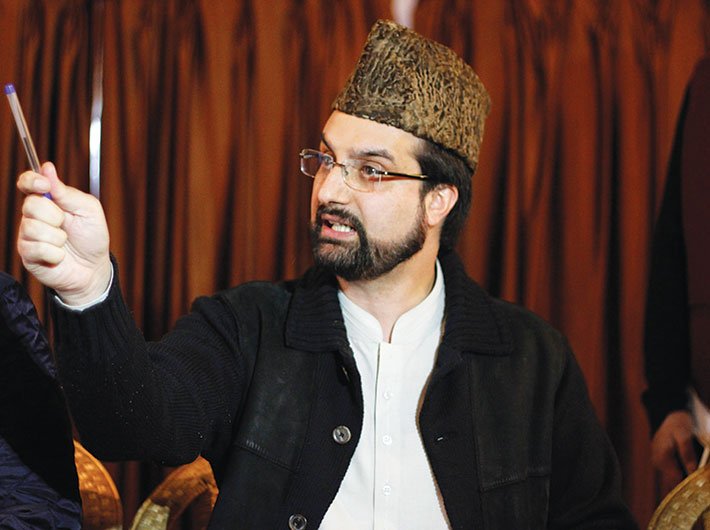
What do you make of the huge voter turnout?
People have voted in huge numbers for two reasons. One is the recent floods in Kashmir. Somewhere people have realised that they need a government and systems that work or else such mismanagement will continue to recur. The flood was a grave reminder to all of us that we need a government to run the daily affairs of public.
Second, people, it seems, have learnt to keep their grievances separate from their aspirations [for azadi or independence]. We, in the Hurriyat, also know that we cannot give ‘sadak, pani and bijli’ to the people, so we also went easy on poll boycott. This vote should not be
seen as support for India but for people’s desire for development and good governance.
Did more voters come out thinking that a boycott will increase the chances of BJP in Kashmir?
True, this is another reason for people to vote in large numbers because they realised there was a real threat of divisive forces playing their game. There is a threat to the Muslim-majority character of the state as the BJP clamours for ‘Indianisation’ of Kashmir. So, there was a clear message to the voters that they must vote in large numbers to keep the BJP out. Hurriyat also did not press for boycott for this precise reason.
The clamour for governance and development among voters combined with death of indigenous militancy in Kashmir does not augur well for secessionists.
Violence has been coming down for the last six to eight years. There is a great realisation about the impact of violence on the society in the wake of the 2008 incidents (the Amarnath agitation that had polarised the state between Hindus and Muslims and also along the regional lines). However, the pro-freedom people are being denied the political space in Kashmir which is making some of the boys very frustrated and return to militancy. I am worried about this. In fact, this year out of 10 encounters in the state, locals [militants] were killed in at least nine. This is a bad omen. After 2008 we have consciously decided to pursue the political movement and not support violence.
What are your expectations from PM Narendra Modi on Kashmir?
Mr. Modi has visited Kashmir five times, but not even once has he touched the main issue of Kashmir imbroglio. He is a good leader, a competent prime minister and a good administrator too. But keeping mum on the major problem that touches the lives of everyone here is no solution. Things may be looking fine but in Kashmir one incident is enough to turn [it] into a fireball situation. Modi has all the advantages. He enjoys an overwhelming majority in parliament. He has a roadmap and a platform set up by Atal Bihari Vajpayee on Kashmir. He just needs to move ahead on it. Modi needs to sincerely revisit the path laid out by Vajpayee for Kashmir’s resolution.
What is your sense of Modi’s Kashmir plan?
My worry is that he is not even ready to show sensitivity to people by acknowledging that the Kashmir problem exists. He cannot insult people by talking only about economic packages, development and economic benefits. He has to acknowledge the human tragedy of Kashmir and revisit the confidence-building measures between India and Pakistan and between New Delhi and Srinagar. It is ironic that today we, the Hurriyat, are being seen as separatists and enemies of peace.
Also, we wish the BJP comes to power in J&K and not its proxies like the National Conference because ultimately the Kashmir issue will have to be resolved by the centre.
What about Pakistan – is there any change in its attitude about Kashmir?
Yes, during my last visit to Islamabad, I realised Pakistani leaders like Nawaz Sharif, Imran Khan and other, younger leaders are ready to change their stance on Kashmir. They too feel the Kashmiri people should gain from this movement. In a way Pakistan was ready for a major policy shift on Kashmir, which was to snatch Kashmir from India. But incidents like what happened in Uri recently (the attack on the army camp by Pakistan-backed fidayeen) are a huge setback.
Has the recent verdict of an army court punishing soldiers for fake encounters in Macchil soothed the frayed nerves in Kashmir?
Yes, to some extent it has. It is good that the government has given a signal that there is zero tolerance for human rights abuses. With the falling levels of violence, we hope, one day, AFSPA will also go away, paving the way for demilitarisation of the region. Modi should use the situation to pursue the peace path with Pakistan. Right now, there is no movement on that front and, unfortunately, we, the Hurriyat, are seen as spoilers of the talks between two countries. Why do people presume that when Hurriyat leaders meet Pakistanis we always speak or plot against India? The fact is that in the past we have played a role in keeping the Indo-Pak dialogue going. This has to be accepted; otherwise divisive forces will rise again.
Modi has an opportunity in the relative peace in Kashmir and he needs to take quick decisions. Yes, this is also a fact that Kashmiris are afraid of ulterior motives of RSS in the valley. In Vajpayee’s time when India and Pakistan prepared a roadmap for peace and people-to-people contacts and the PM spoke of taking an approach of ‘insaniyat’ on Kashmir, RSS was not so vocal and strong. We fear RSS wants to change the Muslim-majority character of J&K.
The interview appears in December 16-31, 2014, issue