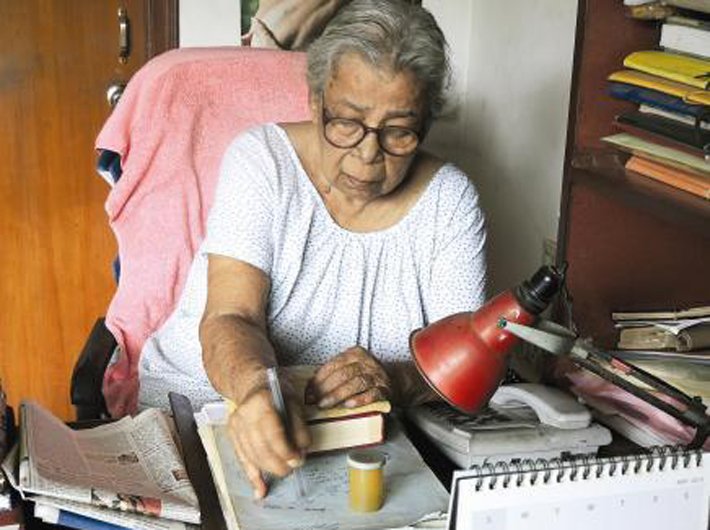
Renowned activist-writer and Jnanpith award winner, Mahasweta Devi passed away at 90. A look back at her interview with us as she spoke about Bengal politics and tribal communities
The pre-monsoon shower pitter-pattered against the car window as I waited at the traffic signal, eager for the light to turn green and the bottleneck to ease up. I had called up Mahasweta Devi, the legendary activist, writer and Magsaysay award winner, the previous day and she had given a green signal for an interview.
Like the traffic stuck in the rain at the time, most Indians shy away from taking the initiative to discern the life and struggles of the tribal communities and the poorest of the poor. Fewer still decide to stand up and lend a voice to the faceless men, women and children toiling day in and day out to eke out a living.
Mahasweta Devi is among the handful of such people in India at present.
At 87, she is still a prolific writer, and still making efforts to comprehend the problems faced by people from tribal communities and backward classes – figuring out their needs, hopes and dreams. Besides activism on ground, her literary works have also focussed on the struggles of people ignored by the state.
In fact, the Ramon Magsaysay award given to her in 1997 mentioned both roles – while she won it for journalism, literature and creative communication, Devi was cited for her “compassionate crusade through art and activism to claim for tribal peoples a just and honorable place in India’s national life”.
But unassuming she still remains despite the fame and acclaim as I finally made it to the rendezvous – the green and white nameplate was the only giveaway of the famous occupant of an unassuming three-storey white house in south Kolkata. Entering it, I was directed to a room on the first floor. A huge portrait of the author-activist greeted me. Sitting on a chair facing a large window, the octogenarian looked frail but age has failed to drown her feisty spirit.Even Mamata Banerjee, the equally feisty chief minister, was forced to admit as much recently – she “thanked” Mahasweta Devi for her “efforts and inspiration” on June 23 while slamming others of the intelligentsia for allegedly “deserting” her as the chorus against the state government’s indifference to atrocities on women grew. This, despite the fact that Mahasweta Devi has criticised the Trinamool government on more occasions than most of these writers and artistes.
Excepts from the interview with Puja Bhattacharjee:
The prime minister has called Maoist terror the biggest internal security threat at present. Being close to the causes they espouse, what’s your take on that?
If he has said that, he has his own arguments. (But) I do not see Naxalism as the biggest internal security threat.
But is violence the only way to achieve those means?
I do not think violence is the only way. It is better to solve issues through discussion, exchange of views and trying to reach a point where both (parties – Maoists and the state) can benefit. Dissent should be solved through mutual discussion, keeping in mind the welfare of the country and its people. Discussions should continue in national interest, not along sectarian lines or party-based interest. But I feel there is lack of coordinated thinking at present. People who sit for discussions should remember that they do not matter so much – the people of India matter (the most), and they have to pay the price.
In a growing economy like India, there is a conflict of interest between industry and the tribal community. What do you think is the best way to strike a balance?
For years, tribal people have not been seen as intelligent or reliable. There has been little coherence in efforts towards understanding them. (But) we should remember that they have been our friends in saving the eco-balance. I do not know of indiscriminate forest felling or disturbing the course of hilly rivers or streams by the tribal people. In their world, they worship and maintain the balance of nature – they are a very understanding lot. When they understand (an issue), they cooperate.
There is a question of survival for tribal people in the new economy. Since their resources in their habitats are under threat from the state, many migrate to urban centres and end up as labourers. What is their future?
It is not possible to say that in absolute terms. I think tribal people should be absorbed (in projects) if development work is carried out in tribal areas. It should be explained to them first. They understand the word ‘community’ very well; for them, community is greater than individuals. Take, for instance, the Purulia Ayodhya hills area. Hostels and schools have been built there and the local tribal people have cooperated (in construction work). It was an uphill task for them to seek education (but) they are keen to go to school.
Is the state doing enough for denotified tribes? Any specific complaints?
The term ‘notified tribes’ was coined by the British, who did not understand the tribal people. But members of these tribes were treated as criminals even after the British left India. Resistance began from among the tribals when they started going to school. There was a girl named Chuni Kotal in Medinipur (district) who was courageous and determined – she graduated (BA) and enlisted in university to study MA. But a Lodha girl who dared to join university with a dream of becoming a teacher was too much for the so-called civil society. Chuni was hated so much that she committed suicide, which triggered a furore (in the community).
In fact, it created so much commotion that the Lodhas dared to defy the strictures and many more opted for (formal) education. Today there is no barrier for a Lodha boy or girl going to school or university. There is no discrimination in West Bengal nowadays but the situation is not the same in every state.
My organisation is working among the Kheria Shabars of Purulia for many years. Initially I had to fight a lot for their right to education. Since schools would not accept them, we had to make people aware and the government cooperated with us. The progress has not been as much as I had expected but it is (a struggle) going on. Now a child born in the Lodha community knows that he/she will go to school.
What needs to be done for the upliftment of denotified tribes?
Not even the three higher castes – Brahmin, Baidya and Kayastha – are in a good state now. People from denotified tribal communities are doing what everybody else is doing. The policy of rural employment is not fully implemented; the state still has much left to do. Had the West Bengal government vowed to ensure 100 percent literacy in the state then the available resources would have been enough.
[A phone call interrupts the conversation at this point. Mahasweta Devi keenly listens to the person at the other end of the line and ends saying, “Live with your head held high. I am there. You have nothing to fear.” You realise immediately the might of the activist-writer only from the strength in the voice that uttered those three short, staccato sentences. She turns back and says an acquaintance with a triple MA degree managed to secure a job as a peon. She refuses to discuss the issue any further.]
What prompted you to take up the role of a public intellectual/activist? Any specific experience or event that you would call a game changer?
My father was posted in Medinipur and Purulia. When I was about 10 or 12 years old, I used to travel a lot with my father. The more I observed, the more I learnt. I used to roam around in villages, and experienced a lot. You observe and learn the most when you travel on foot. I grew up pretty independently.
How do you see your role as an activist?
Once, when I was working among people of Munda tribe, the local village school would not admit children from the community. I had to fight on their behalf. It was easier for me to convince them as they saw me as one of their own. When people saw what I was doing was good, they did not oppose much.
What are your views on contemporary literature? Any favourite author?
I cannot read much nowadays. I like Bibhutibhushan Bandopadhyay and prose of Rabindranath Tagore. I studied in Santiniketan when Tagore was alive. When I was studying BA, we used to go to nearby villages to educate the people – It was a no-holds-barred environment (at the time).