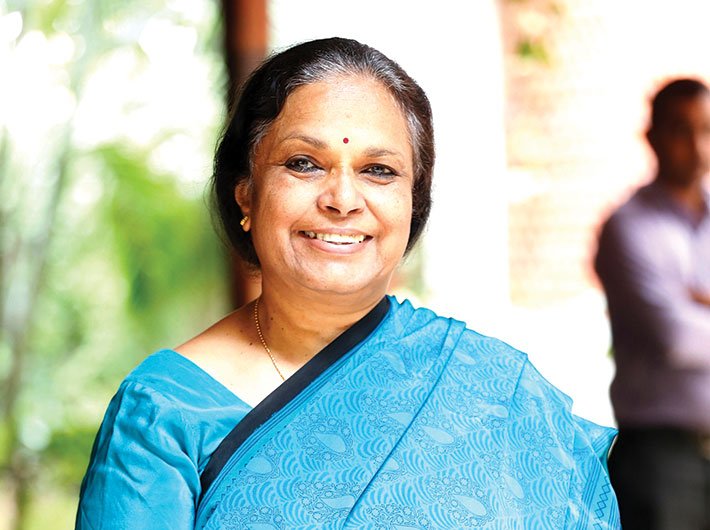
K Sujatha Rao, author of ‘Do We Care? India’s Health System’ speaks about India’s healthcare system, the national health policy and more
What is the biggest crisis India’s health care sector is going through?
It is a loaded question. As you have seen in my book [‘Do We Care: India’s Health System’ Oxford University Press, 2017], whichever party that has been in power at the federal or at the states level has not given due attention to health. The doable thing within the constraints of funding is to take a strategic view.
See book review: Health sector, heal thyself
Not to concentrate on big things but basic items. Strengthening primary care and improving water supply and sanitation can address 90 percent of the ailments. It can save 50-60 percent of out-of-pocket expenditure. Every country in the world, barring African countries, has addressed this as their first priority. A very fancy health insurance programme that covers catastrophic events is of no help. If we focus on expensive treatments, we are not going to achieve health outcomes. It is spending money in a wrong way. If you want to provide universal healthcare for all then spend 10 percent of the GDP. But money and choices are limited so the focus should be on the better being of the population.
Given the fact that there is little improvement in primary care over the last 70 years, is there any scope of transformation now?
I think the National Rural Health Mission (NRHM) was the first big initiative taken after independence in the health sector. NRHM’s main goal was to improve health facilities in rural areas. Any programme takes time to reach its maturation. NRHM over the years made mistakes, [but] also learnt its lessons and continued persistently. But the programme got a jolt in the 12th five-year plan. Enough money was not given and there were questions on its continuity.
We think primary care is all about infant, child and maternal mortality and a few vertical disease control programmes like [those for] malaria, tuberculosis and leprosy or HIV/AIDS. Primary care is a much larger concept. Primary care involves 35-45 interventions the government needs to do. You can get an x-ray done at the primary care setting in the UK. Immediate emergency care comes under primary care. It requires a team of 20-30 people at the primary healthcare facility where you don’t need to go to a hospital. You are stabilised and taken care of and you don’t go to hospital until you are referred. It is called gate-keeping. Many countries like Japan or Germany don’t have a gatekeeping mechanism but in a large country like us with large distances and disparities, it’s important to have such a system. Ninety percent of your need for curing the ailment is settled at the primary level. It’s cost effective for a poor country like us. Studies done in Denmark and Brazil in the last ten years have shown hospitalisation has come down significantly, by 30-40 percent. That’s a big gain because emergency care is the most expensive part of healthcare. We are not able to provide leadership for this issue and unless we do that I am afraid the manner in which we are going ahead will be of any use.
Does the National Health Policy 2017 address these critical issues?
Unfortunately, it is the third health policy and we should have learnt our lessons by now. NHP 2017 is a big disappointment because it is again talking about the vision and aspiration which cannot be realised by one percent of GDP you are putting [in the health sector]. If you really mean to achieve NHP goals under the given timeline, then two percent of the GDP should be used [for the sector] now, and not by 2022. You put the money today, and it will take five years to get the outcome.
There is a huge gap in the capital infrastructure. For example, in the USA, in the 1960s, the government gave money to entrepreneurs to set up hospitals to expand the capacity. China did the same. But here we are not putting any capital investment at all. According to the government’s own statistics, capital investment required building sub-centres and primary health centres as per the Indian Public Health Standards will run into lakhs of crores. Now, is that money going to be available? Five years before Thailand declared a Universal Health Coverage in 2002, they spent entire budget on building up the rural infrastructure. I wonder whether our government is ready for such huge expenditure. Seventy-five percent of the child and maternal mortality and disease burden is on 275 districts. The private sector is not chasing any of these districts. Their purchasing power is negligible here because these districts are very poor. The government has two alternatives –strengthen public facilities or incentivise private entrepreneurs. Neither is happening. These are things for which mapping has to be done because we talk on broad aggregates in our country. NHP 17 talks about such aggregate data rather than looking at district-wise data. The differentials in the planning and the resource allocation have been overlooked.
The centre says there cannot be a uniform policy for all states as health is a state subject. Your comment?
That’s not entirely true. Health should be a responsibility of both federal and state governments. But it is not. Look through the seventh schedule: there are certain subjects that fall under the state authorities, mainly service delivery. Meanwhile, the centre is responsible for disease control, family planning, medical education, drugs and cosmetics.
I don’t see any sense when the ministry of health is held entirely responsible for maternal or child mortality. We give the ministry of women and child development funds to provide a cash incentive of Rs 6,000 to pregnant mothers but we blame the ministry of health for mortality. A severely malnourished kid comes under the health department but a mildly malnourished child is under anganwadi, run by the ministry of women and child development. Why this departmentalism? The more complexities you create, the more difficult it is to coordinate at the grassroots level. There is no division of responsibilities and strict accountability.
Right now, it’s not money alone, what is required is sorting out the arrangements and bringing several reforms in financial and administrative systems - a strategic vision uncluttered with many objectives. There has to be a political consensus. But there is no serious thinking about all this in a coordinated manner.
Do we see any solution to the growing commercialisation in the health sector?
The government has lost the option to be the only service provider. In whatever circumstances we have allowed the private sector [into healthcare].
Commercialisation of health is not right. There should be policies to prevent doctors from exploiting the vulnerabilities of the patient. There are no policies in our country that protect doctors from the temptation to make money from the vulnerability of the patient. There is no firewall being put in place. Germany has standard protocols preventing commercialisation. People who deviate from the norms are hauled up. In the UK, doctors get bonus two times the salary if they work well. In any public-private partnership the risks have to spread equally. It has to be carefully worked out.
In every programme there are a large number of vested interests. It is not India alone; other countries also face the problem of corruption. But then they have addressed health issues and have sorted them out. When Turkey started its health reform, the first thing they did – the health minister tells me – was to remove the dual practice that allowed government doctor to practise in private clinics. Can we stop this dual practice? Can we look for ways to raise the [doctor’s] income? Incentives structures are all wrong. You need policies to be on the right track, consistent with each other. A lot can be done because not everything requires money.
Commercialisation of health is a painful thing that is happening. Commercialisation is different from privatisation. The government cannot be the sole provider of everything. But profiteering from patients is not justified.
A lot of stress is being laid on technology. Can it be seen as a solution to problems?
It can really help India. Computerisation can reduce the management cost by half. Overall costing can be brought down by two to three percent. It is surely the tipping point. But when it comes to monitoring, technology cannot be the substitute for human interventions.
(The interview appears in the July 1-15, 2017 issue of Governance Now)