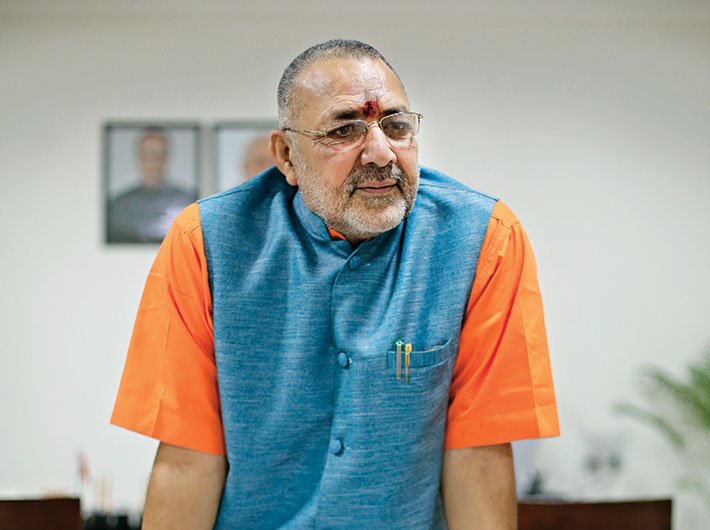
A veteran of Bihar politics and a central minister, Giriraj Singh, talks to Sweta Ranjan about the role and initiatives of the micro, small and medium enterprises (MSME) ministry. Excerpts from the interview:
What is your ministry’s role in boosting the country’s economy?
After agriculture, which provides employment to maximum people even today, MSME contributes 40-46 percent to the gross domestic product (GDP). There is an investment of '10-11 lakh crore in big industries, but in the MSME sector there is a '5.77 crore unit that employs 14 crore people. On the one hand we are contributing to the GDP of the nation and on the other we are helping export and providing employment.
ALSO READ: Interview with Kalraj Mishra
India needs to create 1-1.5 crore jobs per year for the next decade to provide gainful employment to its young population. The Indian population is growing unbridled. It is sad that we do not have a population control policy, like in China. However, we should channelise village industries and MSMEs to provide employment to our youth, increase our share in the growth of the GDP, support the export sector and help build ‘Make in India’.
What is the ministry doing to encourage innovation and R&D in MSMEs?
Innovation is a continuous process. It is not that in a few months of my work the decisions I take will do wonders. We have worked on some schemes, like ASPIRE (A Scheme for Promoting Innovation, Rural Industry and Entrepreneurship) and SFURTI (Scheme of Fund for Regeneration of Traditional Industries). We plan to come up with 500 incubation centres across the nation. I have the responsibility of skilling 1.5 crore people, and also contributing to their financial inclusion.
What are the promising areas for MSMEs and how is the government encouraging entrepreneurship?
The biggest challenge before MSMEs is financial inclusion. I would like to thank the prime minister for establishing MUDRA Bank for refinancing. A corpus fund of '20,000 crore has been provided, out of which '3,000 crore has been kept for the credit guarantee scheme. At present banks are including old schemes in the guarantee scheme. We have to sort out this issue and monitor it as well as ensure transparency. The promising areas of MSMEs are technology induction centre, cluster development, skill development, incubation and innovation, etc. The ASPIRE will open vistas of incubation landscape to the micro segment of the vast rural economy.
The MSME sector is seeking a panel to monitor adequate credit flow as suggested by the RBI many times. What is your opinion on that?
There should be a monitoring panel. But only the financial institution being monitored, and not the problems of entrepreneurs, will not be justified.
Do you have any specific plans for your constituency or state?
Three projects of my ministry which would have been beneficial for lakhs of farmers in Bihar have been stalled by the current state government which neither has the will, nor the infrastructure. I requested for only 25 acres of land for a fragrance extraction plant, on the lines of one in Barabanki, Uttar Pradesh, where farmers are earning '50,000-60,000 per acre. It has been six months. I went to meet the chief secretary much against the protocol, but in vain. That project would have benefited 5-10 lakh farmers.
How does the ministry intend to tackle problems like poor access to finance, non availability of collaterals, etc., which have been plaguing the MSME sector?
Access to credit is one of the major hurdles a first-time entrepreneur faces in setting up an enterprise. In spite of the network of banks and programmes for self-employment, the supply of credit is far less than the demand and, therefore, there is a need for innovative means of finance and leveraging the available funds to cater to a large number of entrepreneurs. In the ministry the issue of credit is addressed through better bank linkages, collateral free loans up to '10 lakh to entrepreneurs, credit guarantee through CGTMSE, SIDBI ‘Funds of Funds’ and linkages from MUDRA Bank. Many other linkages for easy credit availability are also under review and in various stages of implementation. We have made a corpus fund which is free of collateral for youth investing less than '1 crore. We are requesting state governments to contribute to this fund.
Is the new public procurement policy beneficial to the MSME sector or is it anti-competition?
We have not only made policies like PSUs should buy from MSMEs but are also implementing the same. Those who call this anti-competition don’t understand the trauma on the other end. A company like Godrej makes almirahs and furniture and at the same time smaller entrepreneurs do the same. Who will understand their pain?
After the government’s decision to allow 100 percent foreign direct investment (FDI) in single-brand retail, Swedish furniture major IKEA is asking for relaxation in norms like changing the definition of MSME. Your comments.
After China, India is becoming a preferred choice [for MNCs] and when people start making this choice then the MSME sector would turn into a big sector, because in China the labour cost is rising like anything. In India, labour is relatively cheaper. I am confident that those who are blindly running after China would gradually look towards India. As far as IKEA is concerned, it has to be decided on what grounds should the definition of MSME change – on the basis of slabs or according to the limit of the slab. We presented the issue in the Lok Sabha to raise the slab limit and the matter is with the standing committee. I don’t think there is a requirement to change the definition of MSMEs.
As per the MSME development institute, 79 small business units are turning financially unviable every day. How do you plan to revive them?
There are RBI guidelines, we have plans and are working towards reviving them. For the first time our department has done industrial mapping to understand the number of industries in all states and districts. Only when we have the data, we can work towards reviving sick units.
[email protected]
(The interview appears in the September 1-15, 2015 issue)