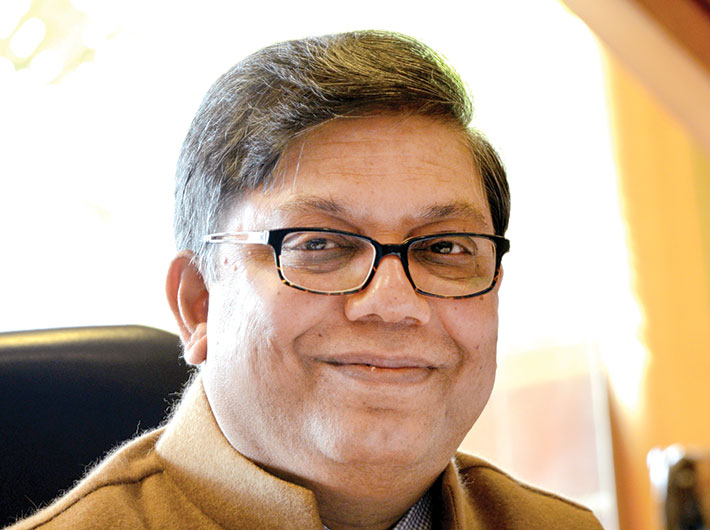
NTPC chairman and managing director, Arup Roy Choudhury, talks about the company’s deeply ingrained belief of doing business by building corporate social relationship through CSR
Besides being the country’s largest power generation company, the government-owned NTPC is also known for its contribution to the social sector. It has been conferred various awards for its CSR initiatives. In an email interview, NTPC chairman and managing director, Arup Roy Choudhury, talks about doing business by adding value to the community through CSR. He also says that an accountability tool for measuring the implementation is important to ensure effectiveness.
CSR has been on public sector enterprises’ menu since the beginning. But the new Companies Act is bringing this activity from the backroom to the boardroom, making it mandatory and an accountable exercise. How will this change your company’s perception towards CSR?
NTPC’s CSR activities are inspired by a holistic worldview and business outlook that has been wired into our DNA since inception. We believe that business should add value to the community and society on a sustainable basis through dedicated policies, institutional setup and engagement process to promote inclusive growth.
CSR activities have been guided and supervised by a board-level committee with an independent director right from 2004. There is regular monitoring of all activities and internal audits are carried out to ensure effective implementation. Transparent assessment and evaluation are taken up through credible external agencies for gauging impact of these initiatives.
As a member of the UN Global Compact since 2001, we are committed to work towards a sustainable and inclusive economy, which delivers lasting benefits to people and communities.
NTPC advances transparency and accountability through annual communication on progress (COP), a public disclosure to stakeholders, on progress made in implementing Global Compact’s ten principles.
We have also been engaging ourselves to integrate CSR activities in our business operations. It is good that the government has now stepped in and set clear expectations of companies. As such there will be no major change in the company’s perception towards CSR. We will fine-tune our programmes regularly in keeping with new requirements and new possibilities.
Will there be any change in CSR programmes already being conducted by NTPC?
We intend to focus more on long-term projects for improving social indicators in education, health, income generation, drinking water, etc. in line with the millennium development goals (MDG). Some of the long-term signature programmes we envisage are ‘Health on Wheels’ – mobile health clinics to improve health and hygiene indicators, solar-powered electricity and drinking water in all neighbourhood schools, adoption of meritorious students up to graduation, safe drinking water, sanitation through community and individual toilets, solar home lighting/streetlights, etc. for community in neighbourhood villages and setting up old-age homes.
How do you plan to operationalise CSR activities under the new rules?
NTPC has a three-tier structure for implementing these activities comprising of corporate centre, regional headquarters and operating stations. The corporate centre is responsible for policy matters, approval of CSR action plans, facilitating the allocation of funds to stations, capacity building, compilation of information and external reporting. Regional headquarters are responsible for coordinating and monitoring CSR projects at operating stations in their region. The operating stations are responsible for need assessment surveys, preparation of the CSR action plan, implementation, monitoring and reporting.
Our CSR activities are carried out in project mode with defined deliverables and timelines, and through specialised agencies, with effectiveness of programmes being assessed through a two-tier monitoring mechanism comprising of internal as well as external evaluation.
With a view to encourage active involvement of employees at all levels, NTPC encourages employee participation in community development activities through an initiative called EVOICE – employee voluntary organisations for initiatives in community empowerment, which are NGOs formed by NTPC employees at various stations to complement our CSR initiatives.
We also organise workshops for our employees, where CSR officers come together to share their experiences and best practices. Even the top management participates actively in these workshops. Training programmes are organised at reputed institutes like IRMA and XISS to keep our employees updated about the latest in CSR.
What are the your objectives with CSR?
Our long-term CSR objectives integrate social goals, closely linked with the practice of sustainable development in conformity with corporate and business plan of NTPC, development plans of state and central governments and the MDGs with the aim of achieving inclusive and sustainable growth.
We value partnerships we build with communities around our units. For us, corporate social responsibility is corporate social relationship.
NTPC’s objective is to strive to improve the standard of living of project-affected persons and the community in neighbourhood villages through CSR activities, and to maintain cordial relations with the local authorities and communities through transparency and continued development activities.
Will you focus on areas in the vicinity of your operations, or will it have a pan-India approach?
We have a pan-India presence, with most of our projects and stations located in backward regions, mainly in remote rural areas. In order to ensure inclusive growth, NTPC takes up CSR activities primarily in the neighbourhood villages of its stations, with special emphasis on the marginalised and downtrodden sections.
In addition, we have also taken up projects of national importance that benefit the society and include adoption or setting up new of ITIs to improve the quality of skilled workforce, training youth in J&K, information and communication technology centres at universities for persons with special abilities, disability rehabilitation centres in collaboration with the National Institute of Orthopedically Handicap providing rehabilitation/restorative surgery to physically challenged persons, old-age homes, preservation and conservation of heritage sites through ASI and relief and rehabilitation work during natural calamities.
Where do you see the development sector heading in the next five years? Which areas would you focus on for implementing CSR?
Despite the slowdown in the growth of the economy, India is still one of the fastest growing economies. This growth has been accompanied by certain aberrations like social and economic inequity, lagging human development indicators, and environmental degradation.
Our endeavour will be to ensure sustainable socio-economic development and reduce disparity to promote inclusive growth. We aim to make the marginalised and downtrodden sections of the society as part of the Indian growth story through CSR activities in areas of education, health, women’s empowerment, skills development for livelihood improvement and water and sanitation, among others.
NTPC will also augment government efforts and schemes for inclusive growth.
Do you think there is a need for an accountability tool to measure implementation of CSR by corporate houses?
We have always believed that accountability tool for measuring CSR implementation ensures that performance actually takes place at the ground level, giving interested parties an opportunity to see how well the company is meeting its commitments, and its effect on ground.
(At NTPC) there is regular monitoring of all CSR activities with periodic reporting. We have recently developed a module in ERP for CSR, which will facilitate analysis and dissemination of information on CSR activities.
A full-fledged internal audit is carried out to ensure effective implementation. Comprehensive information on CSR is made available to public through annual reports, communication on progress to UN Global Compact, corporate website, media releases (and) brochures, bringing transparency to our CSR operations.
With the new law in place, will CSR become a more corporate-driven activity or will it engage stakeholders and the community at large?
NTPC has always adopted a bottom-up approach for planning. All CSR activities are based on specific local requirements and guided by extensive socio-economic surveys/need assessment surveys, bearing stakeholders’ perspectives in mind. Village development advisory committee, rehabilitation and periphery development advisory committee, local administration, people’s representative are consulted extensively.
Can you give an estimate of the total fund allocation for CSR in the last two years and how much has actually been spent?
We have always exceeded the targeted amount (of spend) for CSR in the last three financial years, thereby demonstrating our commitment to CSR.