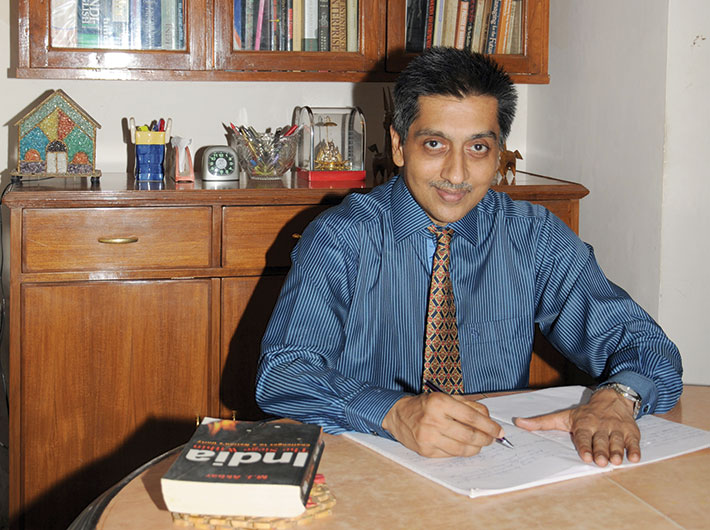
Professor of finance and accounting at IIM Ahmedabad, TT Ram Mohan, talks to Governance Now about financial inclusion
While bankers may flaunt their FI targets accomplished year after year, TT Ram Mohan, who teaches finance and accounting at IIM-Ahmedabad, admits that inclusion cannot be a one-off achievement. In an email interview with Governance Now, he speaks about the perils of setting unrealistic FI targets and how creating new institutions could mean additional trouble for the central bank. Excerpts:
Have we been able to take off from just opening of accounts and moved on to generating transactions?
Well, even on account opening the record has been dismal, leave alone generating transactions. As the Nachiket Mor committee has documented, nearly 60 percent households lack access to an account and a large proportion of SMEs (nearly 75 percent) still lack access to formal finance. From a very small base we have progressed, but we still have our work cut out for us.
Most banks still see FI as a sort of CSR and have not been able to make it a viable business opportunity. Why?
FI has seen a number of initiatives right from the establishment of cooperatives in the 1950s to bank nationalisation in 1970s and then the setting up of regional rural banks (RRBs). The ongoing initiatives are business correspondents and tie-ups with MFIs. The difficulties that banks have is in producing a low-cost model given their HR costs, the inability to motivate managerial staff to get out into the rural areas and the lack of incentives to practice FI when so many other business opportunities are available.
In my view, we must do more to leverage the existing infrastructure. If private ownership and regulatory forbearance are the key elements, as the Mor committee thinks, why not convert some RRBs and cooperatives into companies and bring in private ownership, while diluting statutory liquidity ratio (SLR) norms? We also need to see how BCs and bank-MFI tie-ups pan out. Rushing into new institutions may lead to new regulatory headaches.
Banks talk of leveraging technology for achieving FI. Why hasn’t mobile banking taken off then?
Technology is a delivery vehicle, particularly for transactions. It cannot produce inclusion by itself. A mobile operator that gets into banking has to generate acceptable returns on deposits and to find a way to process and hand out credit. This requires business models such as the ones discussed above. All of them involve technology but do not rest on technology alone.
How achievable is the 2016 target set by the Mor panel?
It would be unwise to set such a tight deadline for inclusion. The banking system is under stress today and we do not need bankers chasing unrealistic targets. It would be better to set reasonable year-on-year growth targets.
What do you think of the panel’s idea of setting up additional institutions like payment banks?
One has to wonder whether payments banks will be viable. They are allowed to collect deposits up to Rs 50,000 on which they will pay interest and park the proceeds in three-month SLRs. Will this provide enough of a margin? If not, they will start levying large fees for payments which would come in the way of inclusions. As for wholesale banks, it is not clear what role they will perform that is already not carried out by NBFCs. There are serious conceptual issues with the whole idea of 'differentiated licensing'.
There is a perception that private sector banks are not doing as much as public sector banks for financial inclusion.
Private sector banks tend to fall behind on lending to agriculture, especially direct lending. They end up parking shortfalls in the Rural Infrastructure Development Fund which provides a return of around 4 percent. If private banks cannot meet even priority sector targets, one has to wonder how they will meet more stringent targets for inclusion without the use of the regulatory stick.
Corporate houses are in the queue for new banking licences. Will they contribute to FI?
Corporate houses will not have any incentives to pursue inclusion any better than the existing set of banks. I had proposed that they be let into banking only in rural areas for an initial period; and if they met targets, they could be rewarded with licences in urban areas.
Any out-of-the-box ideas to ensure that banking is no longer a luxury?
Well, we don’t think of instant solutions to some of these problems. Banking needs to reach out to more people but this will require sustained efforts over a long time. It cannot be accomplished with a dramatic flourish or two. Private ownership in RRBs and cooperatives is one out of the box idea we might pursue.