
What Arundhati Roy felt about the idea of justice

We replug our conversation with Roy as some of her remarks seem to have been foresighted for the current scenario

GN Bureau | February 19, 2016

#jnu protest   #jnu row   #kanhaiya kumar   #arundhati roy  


Long before the JNU row, renowned author Arundhati Roy who was once booked under the sedition law (which failed to stand up to judicial scrutiny) felt that justice is a thing which is out of the imagination. Amidst the debate over the sedition charge put against Kanhaiya Kumar, the police inaction at Patiala House and the ongoing protest by JNU students and faculty members, we re-plug our conversation with Roy. Some of her remarks sound apt in the current scenario.

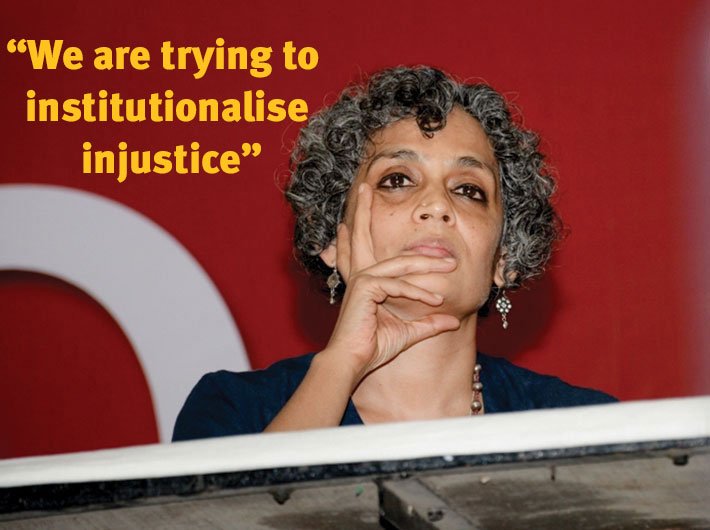
"The idea of ‘justice’ has been replaced by the idea of human rights. This is a big and clever change in language. Talking only of human rights violations allows the media and NGOs and everyone else to make a great equivalence between, say, for example, Maoists and the government. Of course, they are both violaters of human rights, but this allows the political context, the idea of justice to be left out of the conversation.We are trying to institutionalise injustice. Justice is a thing which is just out of the imagination."


"Modi has already lost a great deal of credibility because he simply cannot deliver on the absurd election promises he made.
Also, I think people feel a little embarrassed by the level of idiocy that has entered public discourse. When a prime minister announces that Ganesha’s elephant head was an example of plastic surgery in ancient India it really is embarrassing. How long will even people who long for fascism tolerate such foolishness?"


"In the late 1980s/early 1990s, two locks were opened, the lock of the Babri Masjid and the lock that regulated India’s markets and its economy. With this, two types of fanaticism were unleashed: Hindutva fundamentalism and economic fundamentalism. These two manufactured their own “terrorists” – the “Islamic terrorists” and the “Maoist terrorists”. This then gave the state the excuse to militarise rapidly. The Congress and BJP both did the same."


"Every institution in this democracy seems to see its role as being to control people, not to work for them. We do not seem to be a society that is striving towards justice, but quite the opposite."


"Once again, we have all been taught that Gandhi was against the caste system. This is not true. He was against the practice of untouchability, but he believed that varnashram dharm was Hinduism’s greatest gift to civilisation."


"In this new economy most dalits continue to be landless and continue to work in their hereditary occupations. There are great exceptions, of course, but on the whole caste and capitalism have merged into a toxic alloy.
"

READ full interview here


Comments


Other News

AI@Work: Driving productivity, jobs, and innovation

Key Takeaways     India ranks 3rd in Stanford University`s 2025 Global AI Vibrancy Ranking.     Data infrastructure, entrepreneurship and demography are key enablers for AI adoption.     In India the relative penetration of AI skills was 2.5 ti

Urban Blind Spot: Animals, governance, and the cost of ignoring coexistence

India’s cities are expanding at an unprecedented pace, absorbing people, infrastructure, and economic activity at scale. What urban governance frameworks have been slower to absorb is a reality already playing out on the ground: animals are an inseparable part of urban life. From community dogs and p

How India uses AI in the field of culture and languages

* India is institutionalising AI for culture and languages through national platforms such as BHASHINI, Anuvadini, Gyan Bharatam and Adi Vaani etc. * AI is being used to make cultural and knowledge assets usable by digitisation of manuscripts, translation of academic content, and in

India improves position on Network Readiness Index

India has improved its position by four slots and is now placed at 45th rank in the Network Readiness Index 2025 (NRI 2025) report prepared by Portulans Institute, Washington DC.   The report, released on February 4, maps the network-based readiness landscape of 127 economies based on th

Framework for India-US Interim Agreement announced

India and the United States on Saturday announced they had agreed on an interim framework for an interim trade agreement, indicating a broad roadmap of the opening of the markets and reduction in trade tariffs on both sides. In a message on X, prime minister Narendra Modi said, “Great

India’s quiet rise as the world’s `Third Pole`

A silent re-calibration is going on in the international system, which is becoming more polarized, volatile, and entered of spheres of influence. The world does not evolve in the new era of bipolar competition of the United States and China, nor does it evolve on the setback of Russia in the role of a spoi


Archives

Current Issue

Opinion

Facebook Twitter Google Plus Linkedin Subscribe Newsletter

Twitter






