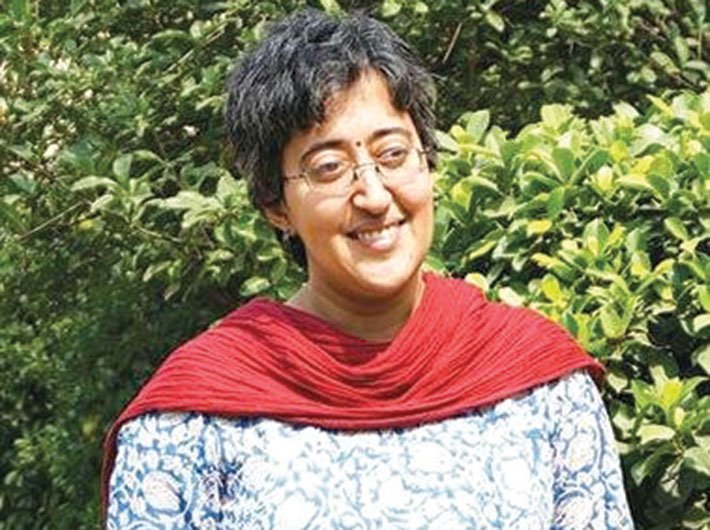
Marlena, advisor to deputy chief minister and education minister Manish Sisodia, talks about the challenges that Delhi government schools are facing
Giving highest priority to education, the AAP government in Delhi is working towards bringing government schools at par with private schools. Atishi Marlena, advisor to deputy chief minister and education minister Manish Sisodia, talks to Jasleen Kaur about the challenges that government schools are facing.
What ails the education in government schools?
It’s a complex question because there is not one, just one thing; there are multiple reasons for this education crisis. First, education has always been a neglected sector. There are some basic problems like shortage of teachers, infrastructure, etc. Even if you have teachers there is lack of accountability. In addition to that, with the no detention policy (as part of the RTE Act) whatever little accountability that existed in the government schools system has gone.
In theory I am a supporter of no detention policy because we want a stress-free education system. But in the large-scale government system, you need some system of accountability.
Whether the child goes to school regularly or goes for just a few days, he/she will be promoted to the next level. So while we have achieved higher enrolment, there is still a problem of long absenteeism. Also, in the past two decades, enrolment has increased from 60 to 96 percent. But these children are the first-generation learners. When they enter the school at the age of six, they have little or no exposure to written language, as compared to others who have been in the pre-school system and have got good exposure. So, the curriculum and the pedagogy are not suited for them. And this deficit starts at six years of age and is never rectified. So when no detention policy is added to this, it becomes a toxic mix.
So you are saying pre-schooling is essential?
Systematic work on early childhood is essential. There is a need to fundamentally re-look at the early childhood education either as part of schools or through anganwadis.
Also, for children who are already in schools the focus should be on what they are actually learning rather than the completion of the curriculum. We cannot run away from the fact that sixth graders in Delhi government schools cannot read their textbooks. Amendment [proposed in the RTE Act] to include learning outcomes is a step in the right direction. But much more needs to be done.
What are your government’s priorities in the education sector?
Initially, we were focusing on ensuring adequate infrastructure, including sanitation and drinking water facility. Then we worked hard on getting communities involved in the schools system to ensure teachers are accountable. From the second year onwards our focus has been on the learning outcomes. We have realised that there is a very serious learning deficit. Bridging this learning deficit has been our major focus area. We have introduced ongoing learning assessments which are not based on content or rote but actual learning and skills. We have also started level-wise grouping of children. This grouping is not permanent. It will keep changing based on the improvement of the learnings. We hope that by March 2018 we will be able to bridge the learning gap.
Realising that teachers lack adequate training we have initiated a programme called mentor teacher programme for continuous support. Some 200 teachers who are good, motivated and creative have been roped in. Each mentor teacher has been allocated five schools, for visiting once a week.
What makes it difficult to hire teachers?
Yes, there is a shortage of teachers, but it is not huge. We have a lot of contractual teachers, who are qualified. We have been trying to bring policies to regularise these contractual teachers but they have been repeatedly turned down by the LG. We had suggested three ways to regularise them.
We cannot open out the posts because then 17,000 contractual teachers will be out of job. We do not have a funding problem because we have increased the contract teachers and doubled their salaries. The challenge is to ensure their regularisation. In addition to the existing contract teachers, last year we had created 9,500 new teachers’ positions. For these posts, recruitment is still to happen. Once we fill these posts we will be nowhere to regularise the contractual teachers. Because of the policy paralysis, we will eventually end up hiring more contractual teachers.
Are you on track to achieve these targets?
We are in a peculiar situation because our schools start from class six. And children coming from MCD schools virtually know very little. So, on an ongoing basis our schools must have some bridging mechanism in class six only, because the older they get, the greater the gap is. With the initiative we have taken, we can see the improvements in the learning outcomes. Hopefully, in next few years, we will be able to improve the situation. To ensure that the curriculum and teaching methodology is as such that the gap does not grow early childhood education has to be introduced.
(The interview appears in the June 1-15, 2017 issue of Governance Now)