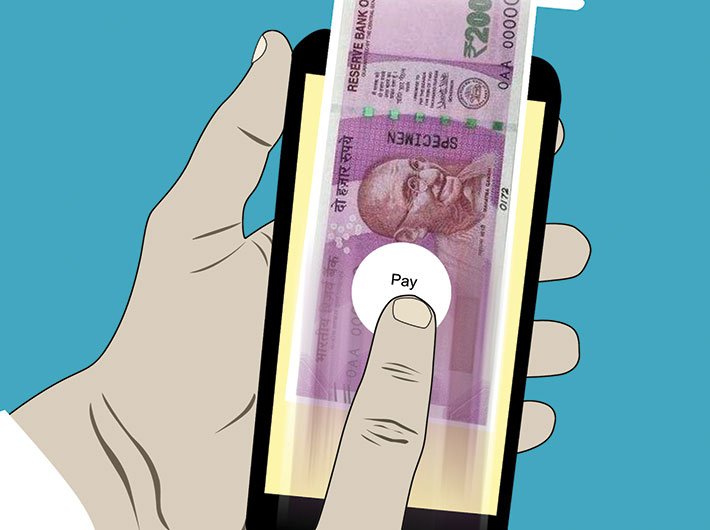
Payments banks pay interest on deposits but do not lend to earn interest. Yet they hope to make money. Is the model flawed? Will they fade away like pagers?
It’s common knowledge that banks thrive on interest spread, the difference between the rate they charge borrowers and the rate they pay depositors. Bank profits hinge on those vital two to five percentage points, besides small service charges for cheque books, ATM transactions and so on. Enter a paradox: banks which accept deposits but do not lend. So, are they viable?
That question is vexing business minds since the Reserve Bank of India (RBI), in 2015, gave in-principle licence to 11 entities to launch what have come to be called payments banks. These are banks-on-your-cellphone that allow customers to do little else than make payments from their deposits. Among those who received these licences were telcos like Airtel and Vodafone, electronic payment giant Paytm, and the public sector India Post, all united by widespread customer bases. These harbingers hope to profit from small transaction charges each time a customer uses their platform to pay, say, a utility bill, a milkman, a plumber or grocer. Like normal banks, they will also charge for a range of services such as doorstep banking.
Given the small amounts such payments and services involve, they count on the numbers adding up – a ‘low value, high volume’ model tapping the ‘unbanked’ and ‘underbanked’ at the bottom of the pyramid. One of the restrictions RBI has placed on these ‘differentiated’ banks is that an account cannot have more than Rs 1 lakh, encouraging the supposition that they are aimed primarily at small businesses, the unorganised sector, low-income households and migrant labourers.
Payments banks hope to have an edge by keeping overheads low – being branchless is a major saving. But already, each player faces ten too many. Besides, there are numerous payment portals; and regular banks, too, allow customers to pay utility bills, etc.
“For any business to survive or make an impact, there has to be a sustainable business model. Given the current economy, these licences are getting sandwiched between established banks and fintech companies. Today, the merchants in the market are not really paying anything to anybody, and if this continues, how will these banks make money?” asks Sanjay Kapoor, former chairman of Bharti Airtel.
The interest these payment banks offer on customers’ deposits is bound to be their biggest burden, given the rates they are offering, at least in the initial phase. When Airtel’s payments bank was launched in January, it offered 7.25 percent, which is an aggressive 3.25 percent above the four percent regular banks offer. The India Post Payment Bank offers 5.5 percent. Others will therefore be compelled to offer comparable rates, at least in the initial phase, to encourage people to register.
AP Singh, CEO of India Post Payments Bank, admits, “The interest rates being offered are very short-term affairs, and I don’t think people should be opening accounts with payment banks on the basis of the interest rate they will get. Because that’s something a regular bank will provide. Regular banks specialise in interest rates, not payments banks.” (As a government enterprise, the India Post Payments Bank is required to invest deposits in treasury bonds, in which returns are not high. That’s one more stumbling block for his organisation, one that private players don’t have.)
The idea, therefore, seems to be: let the interest rate serve as an incentive to register, then taper off (or abruptly cut), by which time users are committed enough not to migrate to another payments bank. E-commerce and aggregator apps follow this model, offering mouth-watering discounts or unbelievable rates in the initial phase and over time, hoping to keep the customers so won with good service. And earn, perhaps, by providing ancillary services.
An Ernst & Young report put it quite blandly: “Considering the restriction on payments bank to lend, it is imperative they focus on adjacent revenue opportunities in the build-out phase itself. Payments bank build on traditional banking and remittances-led models alone many not be able to create the long-term value envisaged by the regulator.”
Some payments banks have found a via media by tying up with regular banks. Airtel has partnered with Kotak Mahindra Bank and India Post Payments Bank with Punjab National Bank. The State Bank of India has tied up with Reliance Industries for the yet-to-be-launched Jio Payments Bank. Shailesh Pandey, executive vice president and head of strategy and marketing at Fino Paytech, a payments bank, says it’s not worth competing by offering higher rates. Instead, Fino Paytech has gone for partnership with ICICI Bank and Bharat Petroleum Corporation Ltd (BPCL). “Without partnerships, the model might struggle to make good money,” he says. “Our partnership with BPCL has helped us a lot. Today, the cost of acquisition of customers is very high. With this partnership, the cost will go down dramatically. We also have a partnership with ICICI Bank, so we don’t have to worry too much.” Fino has raised Rs 400 crore, of which Rs 251 crore is from BPCL for its payments bank.
Such symbiosis could be useful to an extent: payments banks, for instance, could help their ordinary partners sell credit products, or, using algorithms that analyse consumer spending patterns, help their partners target groups or regions for selling services, investment products and so on. In turn, the regular bank could seed the corpus and provide the sense of solidity their brick-and-mortar structure inspires.
Payments banks also hope to effect further cost-cutting by verification using Aadhaar. “With Aadhaar, a bank account can be opened in a few minutes. If we do e-KYC, cost comes down to one-seventh, compared to KYC done physically. Even the cost of transaction comes down with Aadhaar,” says Pandey.
But the sticking point is: there’s nothing that payments bank do that regular banks cannot. After all, regular banks are already using or moving towards mobile banking, internet banking, and the United Payment Interface (UPI) to expand their reach. With the government already pushing Jan Dhan accounts, the BHIM app and the new Aadhaar Pay option, and there are enough and more other payment options offered by banks and private players. It’s indeed a crowded business space.
But Singh maintains that the payment industry in India is big and largely untapped. “There is competition,” he says, “but we all have different customer segments. Is Paytm being used in Tier-3 towns and below? Maybe, or maybe not. There’s an entire market waiting to be grabbed. India has over a billion people. The number of bills paid in this country is a billion in a month. But logically, it should be more, because everyone has telephone and electricity and most people pay education fees. The number of bills generated in the country should be around 4 billion at least. It’s just the surface that has been scratched.”
Perhaps payments banks should be allowed to face the competition in the spirit of “creative destruction” that economist Joseph Schumpeter spoke of, essentially the ‘survival of the fittest’ as applied to entrepreneurial ideas. It’s the norm in the hyperaccelerated web start-up ecosystem, where to every success story there are thousands of failures. As ethereal entities – being branchless – payments banks at least won’t sink as much money as regular banks would.
[email protected]
(The article appears in the May 1-15, 2017 issue)