
Expected revenue loss for companies: $5 trillion!

Covid-19: Fitch Ratings expect recovery to be slow and halting

GN Bureau | June 10, 2020

#Covid-19   #Coronavirus   #economy   #corporate sector   #energy   #oil and gas  
(Illustration: Ashish Asthana)

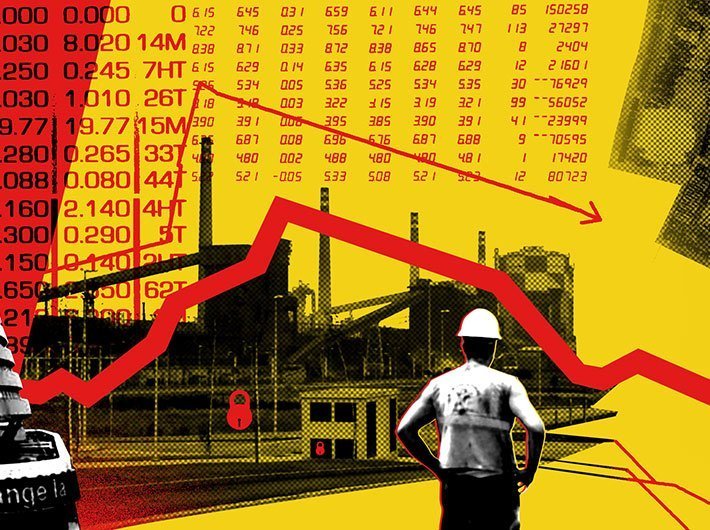
 The corporate sector around the world is expected to suffer losses in revenue worth USD 5 trillion, according to a report prepared by Fitch Ratings. 

 
“The most stringent period of lockdown is over for many jurisdictions, signalling the start of a challenging period of reopening,” Fitch Ratings said in a release issued in London Tuesday. It has published a sector-by-sector analysis of its assumptions for the road to recovery, for more than 80 corporate sectors and sub-sectors globally.
 
“Our projected revenue-recovery curves for corporate sectors, using our baseline scenario, confirm a slow and halting recovery process for many sectors. Our recovery narratives suggest revenue destruction of more than USD5 trillion in 2020, compared to the USD26 trillion of revenue reported by our corporate portfolio in 2019, extending to more than USD8.5 trillion of revenue destruction by end-2021,” the release said. “This estimate only covers our corporate rated portfolio, which in turn represents USD14 trillion of the estimated USD74 trillion corporate debt globally.”
 
The oil and gas sector accounts for the most revenue destruction in dollar terms, representing 40% of the aggregate revenue fall, it said. While the oil price has recovered from historic lows, pricing is still well inside Fitch’s price-deck estimates and it expects economic sentiment to remain subdued after the initial post-lockdown euphoria dissipates.
 
It projects a decline in car sales of about 20% globally in 2020 (followed by a recovery of around 15% in 2021), making the automotive segment – a critical element of the global manufacturing base – the second-largest revenue victim after oil and gas, albeit by a large distance. Further downside revision is possible if demand for big-ticket items weakens further, the release added.
 
The most severe relative declines for any sector occur in the leisure and transport sectors, Fitch said, projecting for it revenue losses of 40%-60% in 2020. Although the underlying segments account for a relatively minor share (just 3%) of the aggregated global corporate revenue in the Fitch portfolio, they have a disproportionate contribution to employment in the wider economy. 
 
The report also identifies a range of sectors and sub-sectors that Fitch expects to prove resilient post-lockdown, including telecoms and individual segments within technology, healthcare and even retail.
 
“The range of region-specific variations we analyse in our report do not meaningfully change the shape of the global recovery curve, with all regions generally adhering to a global pattern of a slow recovery from a traumatic 1H20,” it said.
 
More detail on the regional distinctions and the full narrative for all 87 sector curves are included in the report ‘The Road Back: Post-Lockdown Assumptions for Global Corporates’, available at fitchratings.com.
 

Comments


Other News

Not just politics, let`s discuss policies too

Why public policy matters Most days, India`s loudest debates stop at the ballot box. We can name every major leader and recall every campaign slogan. Still, far fewer of us can explain why a widow`s pension is delayed or how a government school`s budget is actually approved. That

When algorithms decide and children die

The images have not left me, of dead and wounded children being carried in the arms of the medics and relatives to the ambulances and hospitals. On February 28, at the start of Operation Epic Fury, cruise missiles struck the Shajareh Tayyebeh school – officially named a girls’ school, in Minab,

The economics of representation: Why women in power matter

India’s democracy has grown in scale, but not quite in balance. Women today are active participants in elections, influencing outcomes in ways that were not as visible earlier. Yet their presence in legislative institutions continues to lag behind. The Nari Shakti Vandan Adhiniyam was meant to addres

India will be powerful, not aggressive: Bhaiyyaji

India is poised to emerge as a global power but will remain rooted in its civilisational ethos of non-aggression and harmony, former RSS General Secretary Suresh `Bhaiyyaji` Joshi has said.   He was speaking at the launch of “Rashtrabhav,” a book by Ravindra Sathe

AI: Code, Control, Conquer

India today stands at a critical juncture in the area of artificial intelligence. While the country is among the fastest adopters of AI in the world, it remains heavily reliant on technologies developed elsewhere. This paradox, experts warn, cannot persist if India seeks technological sovereignty.

RBI pauses to assess inflation risks, policy transmission

The Reserve Bank of India (RBI) has begun the new fiscal year with a calibrated pause, keeping the repo rate unchanged at 5.25 per cent in its April Monetary Policy Committee (MPC) meeting. The decision, taken unanimously, reflects a shift from aggressive policy action to cautious observation after a signi


Archives

Current Issue

Opinion

Facebook Twitter Google Plus Linkedin Subscribe Newsletter

Twitter


