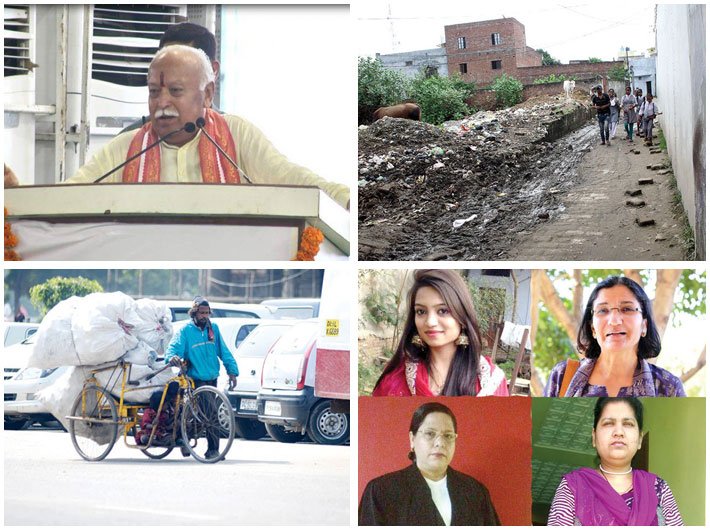
From women who fought triple talaq to Mohan Bhagwat's views on Hinduism, we bring to you columns and stories to keep you busy over the weekend
Instant triple talaq – which the supreme court banned recently, while asking the government to legislate against the decadent practice – is something Muslim women had no doubt wanted to speak up against but couldn’t muster strength to bring about progressive change. It took five Muslim women, who received little if any support from the community and were opposed by religious leaders, to finally go to court and have the practice halted.
Despite the court’s decision, many religious leaders, particularly those of hardline views, continue to say this is no victory for women; that women in the community were always well looked after; that none of their rights was being denied to them; that talk of Muslim women being exploited was nothing but rumour. But the stories of the women who took the case to court, and the threats they faced, in themselves speak of how women in the community are victims of sexism.
READ: Women who fought it out
In a candid conversation with diplomats from 50-odd countries recently, RSS chief Mohan Bhagwat is learnt to have drawn a distinction between Hinduism and Hindu-ness. Bhagwat's considered view, according to reports, was that while Hinduism can be guided by certain rigidities, codes and dogmas, Hindu-ness is a liberated concept, free from such limitations.
Here's what he is reported to have said in that closed-door meeting, according to a report in The Indian Express, quoting tweets of unnamed attendees: "With time, we change. When someone says I am a Hindu it is not about religion or how one lives. It is about accepting others as they are. It is not about wearing this, eating this. That imposition is an 'ism'. Hindu-ness is free from this 'ism'. Hindu-ness is the ever changing quality of Hinduism."
READ: Mohan Bhagwat’s views on Hinduism not new: that’s old RSS position
We are already in an age where some people have a job, some have work and a lucky few have both. ‘Job’ and ‘work’ are used interchangeably. Within a fast changing urban context, however, there is a fundamental distinction between the two. A job is a product of a classical urbanism whose end state is a city. It’s a city that’s always powered by a large scale urban economy, both formal and informal. It’s a scale that can only be achieved, maintained and ordered exclusively through a complex set of top-down and centralised policy processes that create employment. It’s a set of processes that are increasingly intersected and driven by market forces transforming once organic notions of space and place into material manifestations that range from central business districts and large factory complexes to shopping arcades, malls and entertainment centres. In essence, a job is a concrete representation of an asymmetrical power equation created and maintained by a system.
READ: Transforming jobs into work & why it’s good for us and the earth
It’s 10 in the morning and there is hardly any activity in the office of the Nagar Palika Parishad of Gonda. No garbage vehicles, dumpers and loaders are seen in the office premises. People sit in a chatty mood in their offices. Despite a dismal score in the Swachh Survekshan 2017, there is no sign to make amends. Ironically, the municipal council is observing ‘Swachhta Pakhwada’ – a 15-day cleanliness drive.
As I wait to talk with Swarn Singh, executive officer of the municipal council, his phone rings. While talking on phone about some meeting with senior administrative officers, he is continuously interrupted. First by a former sanitary worker, who complains about the delay in receiving her PF money. Then another sanitary worker enters the room and informs him that he got injured while cleaning one of the streets and hence will be taking leave. Singh is the fourth executive officer to be appointed this year. In 2014 alone, the charge was taken by six officers for various periods. The position remained vacant for a considerable time after August 2015.
READ: No one to clean this up