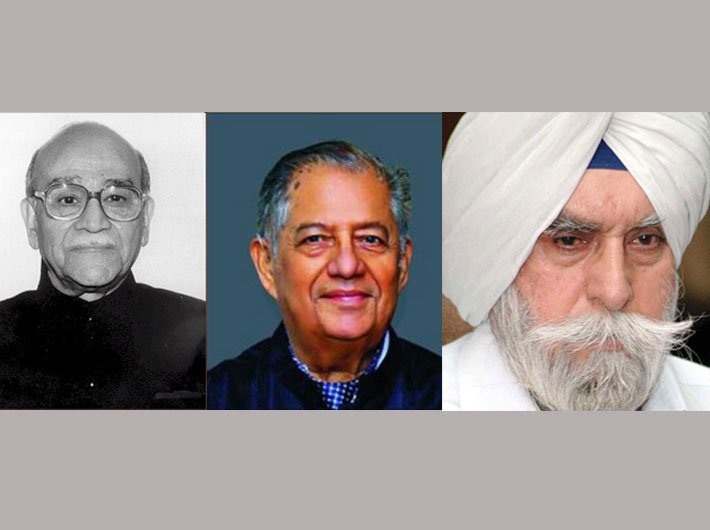
All the three fought terrorism with their characteristic cool demeanour; two of them without guns and hyperbole
Three men who have played a key role in India’s fight against terrorism have passed away, one after the other, in the last one-and-a-half months. They are Girish Chandra Saxena, an IPS officer who rose to become head of the Research and Intelligence agency (RAW) and a governor, I Ramamohan Rao, former principal information officer and media advisor to the government on terror-hit situations like J&K and Punjab, and KPS Gill, the super cop who is credited with ending terrorism in Punjab.
Saxena passed away on April 13, at the age of 90 and Rao a month later. Gill left the world a fortnight after Rao, both at the age of 83.
I had a chance to see Saxena and Rao at work and interact with them as a journalist based out of Srinagar for many years. Their professionalism and calm demeanour were impressive and a lesson for those who met them.
Saxena came to Kashmir as governor in May 1990, soon after his predecessor Jagmohan’s mishandling the situation had backfired and the Valley was seething with anger. Initially, most people feared him as he was the former head of the RAW – a name that conjures up an image of a dreaded organisation. However, Gary, as he was popularly known, surprised everyone with his calm demeanour and soft words. His tenure in Srinagar’s Raj Bhavan was one of the most happening periods in the recent history of Kashmir and yet he wore a stoic or at the most a grim expression that perfectly captured the reality of Kashmir.
Most of the Srinagar-based media persons were boycotting the government and would not visit Raj Bhavan or Cantonment those days. Four of us representing the Indian newspapers and radio would seek a monthly audience with Gary Saxena, the only authority ready to speak. He never gave us eyeball-grabbing interviews but would always sum up the emerging trends and new challenges in Kashmir for us. He never sounded like a pessimist nor did he behave like a macho authority that challenged terrorists and their supporters all the time. He seldom used adjectives even for militants.
Gary was a picture of poise and confidence; never betrayed emotions and handled the situation with efficiency. During his tenure, a police force overawed by the onslaught of militants was revived and all the agencies involved in fighting terrorists put their act together. His reputation travelled and common people felt confident of meeting him in Raj Bhavan. Many felt free to share with him crucial information about the presence of militants. It was therefore not out of thin air that the army and security forces were eliminating top terrorists one by one.
Gary was always at work but never showed it.
Once during Eid, all the roads to Kashmir were blocked due to landslides and people were upset at the prospect of celebrating the festival without eating mutton or chicken. Gary Saxena arranged to bring chicken in an aeroplane to Kashmir!
However, after three years, his tenure came to an abrupt end as he disliked the boisterous and political interference by the then junior home minister, the late Rajesh Pilot. He never betrayed his annoyance publicly and one day submitted his resignation without drama. But Gary’s performance was so impressive that when the popular government of Farooq Abdullah returned in Srinagar, he too asked for him to be the governor of J&K.
More importantly, even when Gary could have officially left for Jammu for six months of harsh winter, he chose to be in Srinagar, for he knew the grim situation required him to be there. Gary Saxena had told us once that he would never write a book. The man knew too much to write a few selected facts and let national secrets out.
Again, it was during Gary Saxena’s tenure that I Rammohan Rao was involved in the Kashmir policy of PV Narasimha Rao government. Based out of Delhi, Rao advised the government on tackling Kashmir at the psychological and perceptional level during the most difficult years. I knew about his behind-the-scenes role when groups of foreign envoys started visiting Kashmir; I even attended a briefing for them at the Badami Bagh cantonment. One of the envoys from a Gulf country got interested in a particular army officer, who was in civvies and started asking him questions about Islamic practices. I knew the officer, he was a non-Muslim. Without batting an eyelid he replied all his questions. The envoy seemed satisfied that he was briefed by a Muslim.
Another envoy in the same group had asked Governor Gary Saxena why his government was permitting newspapers to carry seditious matter. He had gone through some of the local Urdu and English newspapers to make this discovery. When Saxena told him that a democratic government couldn’t suppress the press, the envoy got upset. He is believed to have retorted, “I don’t believe this; your government is incapable of taking action against them and you are blaming it on democracy!”
Back then the Indian state didn’t seem to be getting tough with anti-nationals and as a young reporter, I would ask Rao was there a premium on being pro-Pakistani in Kashmir. He would command all his patience and say, “Look, there are two things: One, India is a soft state…” It was years later that I could appreciate the soft power of a state and realise how good it is for a nation to have it for long lasting resolution of issues.
He was behind the shift in foreign media’s coverage of Kashmir from a mere human rights issue to the one imposed by Pakistan on India. Saxena and Rao had fought India’s battle against terrorism without guns and got us good results.
Rao maintained his relations with journalists till his end. I met him a year before he passed away and later even reviewed his book, “Conflict Communication Chronicles of a communicator”.
I can’t claim to know Gill personally except that I had once met him at a journalism school in Delhi where we were to deliver lectures on conflict reporting. However, one has heard stories about his handling of terrorism in Assam from his colleagues. His courage made him stand apart from others as he took on terrorists by all means. The nation will remain indebted to him for ending the darkest chapter in Punjab’s history.