The queue at the ATM was a fine example of what Abraham Lincoln had in mind when he championed equality
The man standing in front of me shifted his weight from his left leg to the right leg. A minute later he gazed forlornly at the serpentine queue outside the ATM, adjusted his spectacles and shifted back his weight on to his left leg.
We had been standing in the ATM queue for just under an hour at an upscale neighbourhood of Noida thanks to the decision to demonetise. The seemingly endless number of people ahead of me and the ever lengthening queue behind me was disheartening. Some hopefuls, who arrived thinking they would take out cash, shrugged their shoulders and walked away. The queue was just too long for them.
The bravehearts did not give up. They stood patiently.
“So, where do you work,” I asked my queue member. “HCL” was his mono-syllabic answer. We needed to kill time as we snaked forward.
“And what about you,” I turned around and asked the guy behind me. He was in his dark blue pajamas, a crumpled well-worn T-shirt, and a pair of bathroom slippers. “I am an engineer. I have come from Chennai and staying with a friend,” he said. “I have an interview scheduled for tomorrow, and look I am here, standing in this (expletive) queue,” he added rolling his eyes.
We were not the only ones trying to while away time. A well-heeled man, who was little ahead of us, was having an argument over the phone. We could hear snatches of conversation. He was clearly grumpy having stood in the queue for long.
“Black money, black money,” he grumbled loudly. “I have lots of work to do and I am wasting my time here,” he said. We half expected him to walk away, providing some relief by shortening the queue. But that did not happen.
Half-an-hour later, an argument broke out in the front. Somebody had risked his life by trying to jump the queue. He is lucky that he got away with collective tongue lashing. One could not have ruled out lynching as tempers gradually began to take wing as the sun rose.
A tea vendor was making a killing. People were cooperative. They would ask their queue mates and go for a quick cup of tea. I too decided to have some tea.
A middle-aged man threatened to pay the tea vendor with a scrapped Rs 500 currency note. The tea vendor, with a-week-old stubble, looked at the man, then at the note and then back at the man, smiled and said: “Are you joking? You keep it. I don’t have change to give you back.”
“Ok,” said the man and fished out a ten rupee note from his breast pocket. The tea vendor gave him back small change.
The conversation around the tea-seller was only about currency notes. Lots of people had lots of ideas. Some practical, some simply outlandish. A man even suggested that our bankers be sent to Switzerland so that they learn a thing or two about banking. Another cut in: “The bankers will have a Swiss holiday and nothing else.”
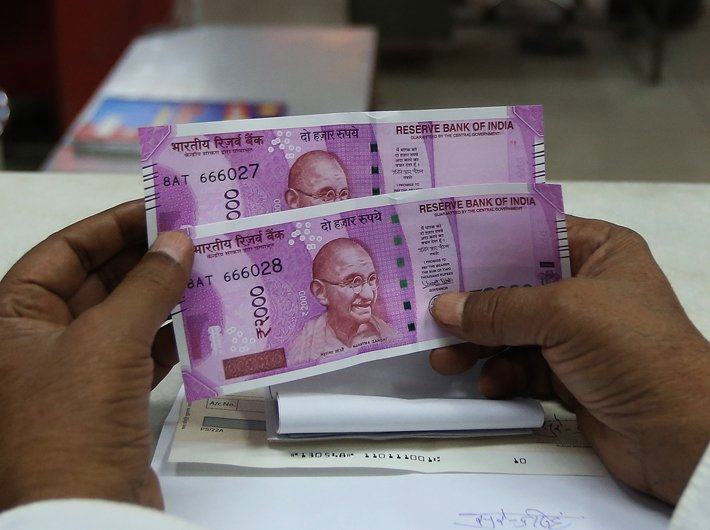
The new Rs 2,000 currency note with a garish purple colour was discussed threadbare. The purple colour looked as if it had been selected from a slick Moulin Rouge show. People felt that it would now be easier stash away black money in the form of these purple coloured currency notes.
As we spoke, we kept an eye on the queue. I took the last sip of my tea and stepped back into the line. A voice from the end shouted that this was not fair. “He was here only,” said another guy and the matter was resolved.
We were now close to approaching the two hour mark, when the inevitable happened. The ATM, which had been gleefully spitting out currency note, ran out cash.
It felt like my lungs had been sucked out of air or the last drop of water from earth had evaporated. Standing patiently for so long, and then nothing. This was too much.
“There is no more cash.” The message went down the queue.
For those who were closer to the booth, there was disbelief. And for those who had just joined the queue, they took it in their stride and walked away.
One of us simply did not believe. He still walked into the booth and inserted the card. Nothing happened.
We gave one last baleful look at the ATM machine, hoping for a miracle that was not to be.
We walked away, not before promising that we will back. And I did return the next day to take out Rs 2,000 from the ATM. I clutched the money triumphantly and walked away elated.