
Bimal Jalan’s new work sheds light priorities that the govt can implement to realise the potential of the nation’s economy
GN Bureau | June 24, 2022

From Dependence to Self-Reliance: Mapping India’s Rise as a Global Superpower
By Bimal Jalan
Rupa Publications, 184 pages, Rs 695
Bimal Jalan, a former governor of the Reserve Bank of India (RBI), has been one of our finest commentators on economy, known for lucid and reader-friendly analysis. In recent years, he has authored three books that give a broad-brush outline of India’s contemporary economic history: ‘India After Liberalisation: An Overview’ (2021), ‘India Reckoning: Rewards and Discontents of Democracy’ (2021), and ‘India Then and Now: An Insider’s Account’ (2020). His latest work, ‘From Dependence to Self-Reliance: Mapping India’s Rise as a Global Superpower’, “continues the strand of thought of” those three works, as he writes in the preface.
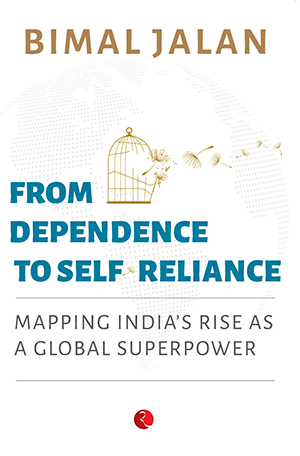 In particular, the new book aims to add to “the ongoing debate about India’s approach to future economic growth, as well as governance and political issues in the twenty-first century”.
With the BJP government in the second term with an unprecedented popularity across the country and majority in Parliament, the political profile of the government has undergone a major change. The government, with an unambiguous mandate, is now in a position to launch political reforms on its own without relying on the discretionary powers of members belonging to other parties. ‘From Dependence to Self-Reliance’ sheds light on some of the priorities that the government can implement at present, as well as in the future, in light of past experience.
Based on extensive research and data, this book provides a way forward to developing India as an economic stronghold. Its ten chapters are divided into three sections: Economy, Governance and Politics, covering a gamut of changes that have taken place since India gained independence and how these changes have had a ground-breaking impact on the development of the nation. It is a must-read to gain an in-depth understanding of India’s rise to power in the realm of economy, politics and technology.
Digital payments have become a reflex for urban India, but the confidence earned in paying has not yet carried over to borrowing. That is the central finding of `How Urban India Pays Report 2026`, released by Pahlé India Foundation in collaboration with Amazon Pay. Based on a survey of 5,149 consu
Commerce and industry minister Piyush Goyal has called upon businesses in India and the United Kingdom to translate the opportunities created by the India-UK Comprehensive Economic and Trade Agreement (CETA) into expanded trade, investment, partnerships and job creation. Addressing the Bu
The Gandhian movement in India, after Gandhi’s death, failed, says Ramachandra Guha, and blames Vinoba Bhave for it. But the movement found new, fertile grounds around the world and succeeded in bringing about a change in South Africa, the US and elsewhere. It is high time it returned home. Of cour
Tavleen Singh, noted journalist and political commentator, has turned to fiction, with her debut novel ‘The Actor’ (HaperCollins India). Set in the near future, it has a superstar, Amit Singh, turning to politics, when the political landscape is dominated by prime minister Guru Gaynendraj
The union cabinet, chaired by prime minister Narendra Modi, on Tuesday approved the setting up of a Special Purpose Vehicle (SPV), called Integrated Transport & Logistics Authority (ITLA), to strengthen research, planning, appraisal, monitoring and impact assessment within the broad domains of Transp
Foundational Literacy and Numeracy (FLN) are often described as the building blocks of education. Yet, their significance goes well beyond a child’s ability to read a sentence, write a response or solve a basic mathematical problem. These foundational skills shape how children understand the world,










