
Violence over beef, cow slaughter not new

Ahmedabad witnessed riots following cow slaughter way back in 1713 AD

rahul

Rahul Dass | June 24, 2017 | New Delhi

#cow slaughter   #viloence   #riots   #beef  
GN Photo
GN Photo

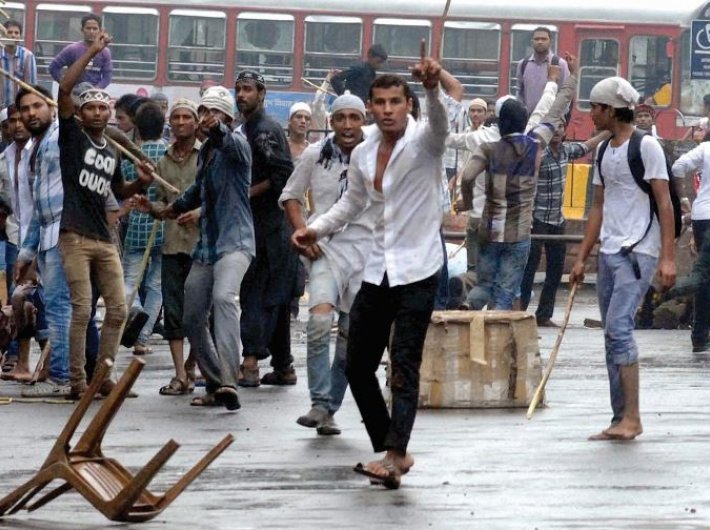
The Narendra Modi government has been repeatedly attacked over a string of violent incidents triggered over beef and cow slaughter, but the intolerance does not seem to be a new phenomenon that has spawned following the 2015 killing of Akhlaq in Dadri. Over 300 years back, communal violence broke out in Ahmedabad following cow slaughter.
 
Though communal violence between members of two religions is not equivalent to one-sided lynching in which a larger group pounces upon the victims, yet it is important to note that there has been considerable tension in the past over 100 years over cow slaughter. Lynching over beef, however, has been frequently happening ever since Akhlaq was killed.
 
Even beef rumours were enough to trigger violence. Just two years after India gained independence, violence broke out in Secunderabad and Hyderabad on a suspicion that beef was being carted on a tonga.
 
A 2007 ministry of home affairs report notes that invariably, a communal disturbance is sparked off by some trivial incidents, which often go unnoticed and generally ignored by the authorities. “Alleged killing of a cow or an animal held sacred by Hindus, by a member of other community, or vice versa.”
 
The report of working group of National Integration Council to study reports of commissions of inquiry on communal riots, quotes the group’s convenor Asghar Ali Engineer as saying that “parties believe in secularism but they do not speak out perhaps because the matters are delicate”.
 
“In Gujarat the number of villages have indicated on blackboards that the village is part of Hindu Rashtra and such indications have been found since Congress was in power in the state…West Bengal was a tinder box until Left came to power. In 1993, at Sitamarhi, Lalu Prasad Yadav ensured that communal clashes did not take place. Thus it requires only political will,” said Engineer.
 
The report, which carried an extract from the book Politics of Communalism by Zenab Banu, gave a list of incidents which triggered communal violence.
 
It mentioned about communal riots in 1713 AD in Ahmedabad following “opposition to solemnize the Holi festival on the one side and the cow slaughter on the other side between the neighbours of the two opposite communities”.
 
In 1890 in Aligarh, “Obstruction of places of worship - A pot of flesh was thrown at night in a mosque then beef was hung into two Hindu wells”.
 
Communal riots broke out in 1893 in Ballia due to a “reaction to the cow protection movement”.
 
In 1912, there was violence in Ayodhya, Faizabad “over the sacrifice of cows by the Muslims on the occasion of Bakri Id”
 
And in 1949, communal riots took place in Secunderabad, Hyderabad and Saharanpur after “started round tonga which was suspected to be carrying beef through a Hindu locality”.
That same year, Akola witnessed violence after slaughter of a cow in a Muslim household.
 
In 1953 Gauhati, an “angry crowd tried to prevent a Muslim family from sacrificing cow”.
 
A year later, there were communal riots in Ghaziabad following “slaughter of a stolen cow”.
 
There was violence in Sitamarhi in 1959 over “spreading of a rumour that a cow was slaughtered”.
 

Comments


Other News

Citizens of the Bay: Why BIMSTEC matters now

The international order is drifting into a dangerous grey zone as the very powers that built today`s multilateral system begin to chip away at it. The United States has increasingly walked away from global rules and forums when they no longer suit its interests, while China has rushed to fill the vacuum on

PM salutes armed forces on one year of Operation Sindoor

Prime minister Narendra Modi on Thursday saluted the courage, precision and resolve of the armed forces on the completion of one year of Operation Sindoor.   The PM said that the armed forces had given a fitting response to those who dared to attack innocent Indians at Pahalgam.&

Supreme Court judge strength to go up by four to 37

The strength of the Supreme Court is set to go up from 33 judges to 37 judges, paving the way for a more efficient and speedier justice. The Union Cabinet on Tuesday approved the proposal for introducing The Supreme Court (Number of Judges) Amendment Bill, 2026 in Parliament to amend The Sup

BJP set to capture West Bengal

The political map of the country is set to be redrawn with the BJP set to win the West Bengal assembly elections, apart from Assam and the union territory of Puducherry. In Kerala, meanwhile, the Congress-led UDF is set to regain power. The filmstar Vijay-led TVK has emerged as the front-runner in Tamil Na

Beyond LPG: Is PNG ready for India’s next cooking fuel transition?

India, the second-largest importer and consumer of LPG after China, faces growing pressure due to supply constraints. Most of India`s LPG imports transit through the Strait of Hormuz, a focal point of global turmoil. Given that LPG forms the backbone of household kitchens and the restaurant industry, any s

Maharashtra adopts hybrid model for Census 2026 data collection

The government has initiated preparations for Census 2026 in Maharashtra, introducing a hybrid approach that combines optional self-enumeration with comprehensive door-to-door data collection to ensure complete coverage across the state.   According to senior officials, the Self-


Archives

Current Issue

Opinion

Facebook Twitter Google Plus Linkedin Subscribe Newsletter

Twitter






