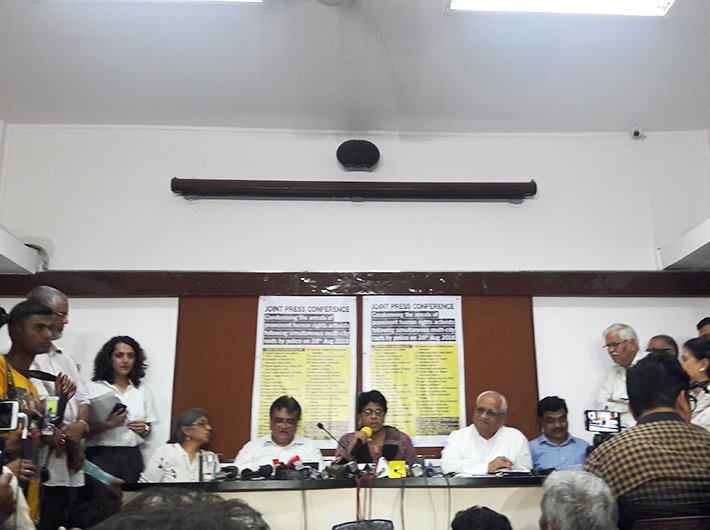
As many as 37 civil society organisations came together in a public meeting to condemn the raids and arrests of human rights and civil rights activists during a country wide simultaneous raids by Maharashtra police.
They called the arrests politically motivated and demanded to revoke the Unlawful Activities (Prevention) Act,(UAPA) which allows for the detention of the accused for up to six months without any charges, and up to 30 days in police custody.
On August 28, Sudha Bharadwaj, a civil rights activist and labour lawyer, Gautam Navlakha, former president of the People’s Union for Democratic Reforms, Varavara Rao, a poet-activist, Vernon Gonsalves, rights activist, and Arun Ferreira, activist and Mumbai based lawyer, were arrested in connection with the Bhima Koregaon violence that broke out in January this year during a march by dalit activists. The march was preceded by a conclave called the Elgaar Parishad.
According to the police, the activists had routed funds from Maoists groups for organising the Elgar Parishad conclave in Pune held a day before the Bhima-Koregaon violence. The charges on the accused include Rajiv Gandhi style assassination of prime minister Narendra Modi. However, these charges are subject to substantiation in the courts of law.
Former Jugde B G Kolse Patil organiser of the meeting stated that the people who had been arrested on August 28 as well as the five arrested earlier in June had absolutely no links to the Elgar Parishad and Maoist movement. “There is absolutely no connection between those arrested and the Elgar Parishad and maoists. Our event was not funded by them as is being claimed. The hall we booked had been booked for another event after which we were allowed to use it. Elgar Parishad had been suddenly linked to the riots when an earlier report of the police had said that that the riots were linked to incitement by Hindu activists Milind Ekbote and Sambhaji Bhide. The Bhima Koregaon riots were pre-planned and had nothing to so with Elgar Parishad” he said.
Justice Kolse Patil pointed out that the wrongful arrest of activists was an attempt by the state and central government to divert the attention from recent arrests of Sanatan Sanstha activists. The govt wants to divert attention from this and also from its failures in the run up to the 2019 Lok Sabha elections, he said .
Convenor of the People’s Union of Civil Liberties (PUCL) in Maharashtra, advocate Mihir Desai, said that none of the persons arrested on August 28 or earlier were present at Bhima Koregaon and sent Skype messages or had video conference as far as Elgar Parishad is concerned. Yet as per the FIR that deals with provocative speeches all have been arrested when they were not linked. The arrested people are lawyers who have been defending rights of marginalised, workers, tribals, dalits and women. He also said that the Rajiv Gandhi style assassination plot is fabircated. “These letters have not been given to courts. If the idea of govt is to muzzle dissent and stop civil society organisations from speaking out we are not going to agree with that”.
Lawyer and activist Susan Abraham, wife of Vernon Gonsalves, said that realising documents of the case to the media by police was blatantly illegal and barred by the Bombay High Court. “The police acts quickly when there are orders from above. They are just doing this to influence the public opinion. Some legal action has to be taken against the continuous release of fabricated documents to the media,” she said.
On August 29, hearing a separate petition moved by Romila Thapar, Devaki Jain, Prabhat Pattnaik and others, the supreme court observed that, "dissent is the safety valve of democracy… if it is not allowed, the pressure cooker will burst." The court issued notice to the Maharashtra government and directed that five rights activists and lawyers arrested by the police be placed under house arrest until the matter is heard next on September 6.