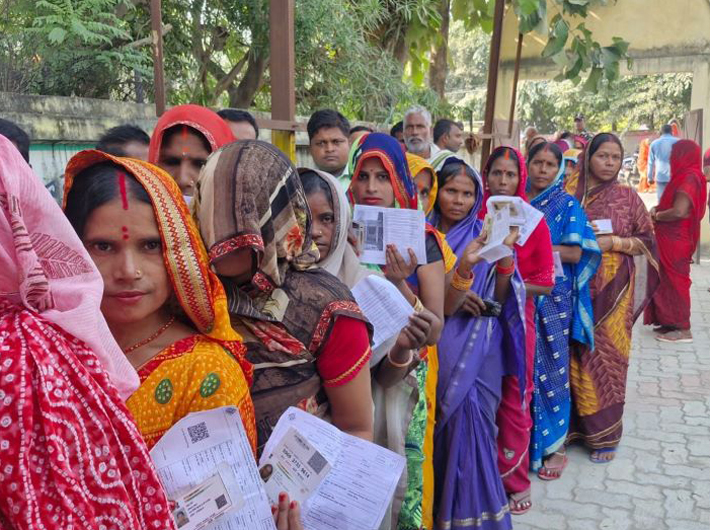
They have earned their place as Bihar’s most influential political force. The next chapter must be about transforming this influence into leadership
The Vedas speak of “Nari tu Narayani” which means woman is divine power incarnate. Bihar’s mandate reflected that wisdom with quiet intensity. Once again, women have proven that they are the real kingmakers of this state. Their overwhelming presence at Nitish Kumar’s rallies, and the even stronger reflection of this in the assembly election results, reaffirm a simple truth: women now hold decisive power in Bihar’s electoral politics. The 2025 outcome is not just a political verdict; it is a social statement. Women voted for a leader who made them feel safe, secure, and confident in their daily lives. For them, this election was not about grand promises; it was about trust, safety, and lived experience.
Women voters did not just turn up; they turned up in historic numbers. According to the Election Commission’s data, women’s turnout touched 71.6%, significantly higher than men’s 62.8%. In fact, more women than men voted in these elections, reversing traditional turnout patterns. This is not an accidental surge. Across the last four election cycles, women in Bihar have consistently outvoted men, marking a quiet but steady revolution at the ballot box. It is clear that when women decide to participate, they do so with seriousness, memory, and purpose.
Rising Above Caste: A New Arithmetic
Bihar’s politics has long revolved around caste numbers: EBCs at 36%, OBCs at 27.1%, SCs at 19.7%, and upper castes at 15.5%. Parties have traditionally built their strategies around this arithmetic. But the 2025 mandate shows a quiet shift. Women, who turned out in record numbers, appear to be voting far more on safety, welfare, and governance than on caste identity.
Exit-poll patterns and constituency-level data indicate that women from EBC, OBC, and SC communities backed performance-oriented politics, creating a cross-caste alignment. In this sense, women are no longer just another segment of the electorate but they are softening old caste boundaries and pushing a new criterion of evaluation: trust, delivery, and everyday experience.
Caste still matters, but the women-led vote is introducing a parallel logic in which development competes with identity. And that shift may be the most significant story of this election.
Nitish Kumar’s Long Arc of Women-Focused Governance
A major reason behind this sustained trust is the long arc of women-centric governance that Nitish Kumar has pursued. From as early as 2006, his policies placed girls and women at the centre of Bihar’s developmental agenda. The free bicycle scheme for school-going girls transformed mobility, attendance, and parents’ willingness to send daughters to school. Cash incentives for girls clearing their Class 10 and 12 board exams opened doors that had long been shut due to financial constraints. The expansion of women’s self-help groups created a silent revolution where thousands of women who had never stepped out alone began earning, saving, and contributing financially to their households.
Equally transformative was his decision to reserve 35% of government jobs for women and to push for one-third reservation in Panchayati Raj institutions and urban local bodies. This was not symbolic politics. It fundamentally changed the composition of Bihar’s public workforce and grassroots leadership. Women who had grown up with limited visibility in public roles suddenly found themselves as teachers, police officers, ward members, mukhiyas, councillors, and administrators. For many, this was the first moment they felt the state actively opening doors for them.
More recently, schemes like the Das Hazari assistance have shown women the possibility of scaling their income and investment capacities. Many now see a path that could lead them to access benefits worth up to two lakh rupees, a life-changing amount for rural women. For the first time, countless women no longer need to wait for their husbands, fathers, or in-laws to fund their ambitions. They are being given tools to build opportunities for themselves and their children.
This is not just economic empowerment. It is political empowerment. Women who benefitted from these policies during their school years did not forget. Today, these same girls are adult women, voters, workers, and contributors to household cash flows. Their voting choices came from lived experience, not rhetoric. They rewarded a government that made them feel safer, more respected, and more capable. No amount of political commentary can discount what memory and gratitude look like when expressed through the ballot.
From Kingmakers to Queens!
Yet, as inspiring as this mandate is, it also reveals a glaring gap. Women may be kingmakers, but they are still far from being queens, far from occupying authority and leadership themselves. Despite being nearly half of the electorate, women remain shockingly under-represented as candidates. In this election, women constituted barely 9.86% of all contestants, the lowest women’s representation in fifteen years. Across major alliances, the numbers remained dismal. Even the NDA, which benefitted immensely from women’s votes, fielded only about 12% women candidates.
The contradiction is sharp. Women who shape outcomes are not allowed to shape the choices. Many of the women contesting are still introduced primarily as someone’s wife, someone’s daughter, someone’s relative, their own identity fading behind a male reference point. If Bihar could produce strong male political icons like Dr. Rajendra Pasad, Jayaprakash Narayan and Karpoori Thakur, why could it not produce their female counterparts? Why don’t we have female leaders of the calibre of Kanhaiya Kumar, Prashant Kishore and Nitish Kumar in today’s times? Why must women’s influence remain indirect? The time has come for women to emerge from the supporting shadows and take positions at the forefront of decision-making.
Memory, Fear and the Vote
A large part of women’s political preference continues to be driven by their sense of safety. When election commentators suggested that young voters who never saw the Lalu era might turn towards a new political narrative, they underestimated the collective memory carried by women of older generations. Even those of us who left Bihar after school still recall the unease, the rush to be home before dark, the imposed boundaries on movement. Younger girls today are fortunate to not experience that fear, and that itself is a mark of progress. Women voted, in large numbers, for the environment of relative safety they now feel.
This election was also shadowed by alarming discrepancies in electoral rolls. During the Special Intensive Revision, nearly 22.7 lakh women were deleted from the voter list, almost twice the rate of deletion for men. In at least six constituencies, the number of women voters declined between the draft rolls and the final rolls. Such patterns raise unavoidable questions about fairness, accuracy, and the inadvertent silencing of the very group that has reshaped Bihar’s political destiny. At a moment when women’s political voice is at its loudest, its systemic suppression, intentional or not, must be taken seriously.
Bihar’s Uneven Journey Forward
It is easy to say that more should have been done for Bihar. But progress must be judged from where we began. When the state suffered twenty years of lawlessness, we did not remain stagnant. We fell behind. A state that begins from minus twenty cannot be expected to match the indices of states that enjoyed stability for decades. Yes, Bihar still struggles with multidimensional poverty and remains among the poorest states in India. Yes, its indicators on education and employment need urgent attention. But the direction has clearly changed.
The choice voters made in this election reflects the importance they attach to education. When presented with candidates from privileged backgrounds who did not prioritise schooling and others who had credible educational qualifications, Bihar chose the latter. This is the same state whose youth consistently feature on UPSC result boards. Education is not ornamental here. It is aspirational, transformative, and deeply valued.
Bihar today stands on the strength of a demographic dividend, a young and energetic population that wants to work, earn, and contribute. Add to this the growing base of women with newfound confidence, financial access, and mobility, and the potential becomes extraordinary. But this potential will remain unrealised unless Bihar urgently increases the quality of its education system. Scholarships and cash transfers help, but they cannot substitute for good teachers, stimulating classrooms, and genuine learning. Parents must also look beyond the financial benefits deposited into their accounts and ask substantive questions about what their children are actually learning.
The Future Belongs to Women Who Lead
Bihar today stands at an inflection point. Women have proven repeatedly and decisively that when they side with a political leader, that leader cannot be defeated. This makes them the most powerful electoral constituency in the state. But the full promise of this power will only be realised when women no longer remain kingmakers alone, but begin to claim the throne.
Women must aspire to be the ones shaping policies, signing files, contesting elections, and leading the change they have already sparked. Bihar needs women MLAs, women party strategists, women district leaders, and women chief ministers, not as tokens but as equals.
As the dust settles on the election results, one fact stands beyond dispute. Nitish Kumar has once again earned the goodwill of women voters. But the greater story is this: Women have earned their place as Bihar’s most influential political force. The next chapter must be about transforming this influence into leadership.
If women stand with you, nothing can defeat you. But when women stand for themselves, nothing can limit them.