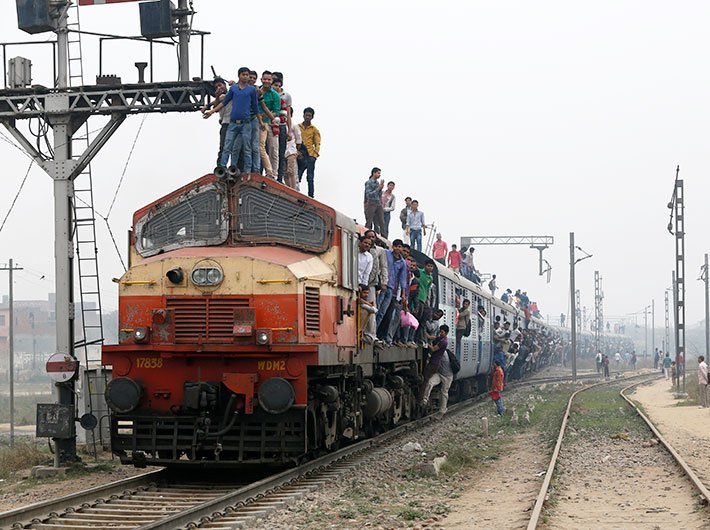
Complete data of all the trains was not available in Integrated Coaching Management System (ICMS)
“Accuracy and real time updation of arrival/departure timings of trains may be ensured to provide accurate and reliable information to the passengers,” recommended the Comptroller and Auditor General (CAG) in its report on railways’ integrated coaching management system (ICMS).
ICMS application was developed by railways with the objective of monitoring punctuality of mail express/passenger trains, monitoring status of coaching stock in real time and online, facilitating augmentation of train composition and planning and running of special trains on the basis of traffic demand to maximise revenue, managing asset maintenance, minimise manual intervention and to provide fool proof service to enhance the image of railways.
The CAG report said that “complete data of all the trains was not available in ICMS as movement of some of the trains including Exceptional trains, Extended/Special Trains, Pilot and Unscheduled Trains was not reported/available in ICMS for monitoring punctuality. There were delays in capturing train movement details which resulted in non-availability of train movement information in real time to the users of the information”.
It added that the data related to train/coach movement, their arrival/departure, etc., was captured in ICMS manually. Where data was captured/updated from other applications, the same was captured in other applications (like Control Office Application etc.) through manual processes/means. This data is finally reflected in National Train Enquiry System (NTES) where passengers can see arrival and departure timings of the trains in real time.
Audit noticed differences between train arrival/departure data maintained in ICMS and manual records/data maintained over nine zonal railways.
“Delay in reporting and lack of accurate data of arrival and departure timings of trains led to inconvenience to passengers. This also led to generation of wrong Management Information System (MIS) reports for Railways which affects monitoring of train punctuality.”
The report went on to say that comparison of the trains/coaches placed at platform/station lines with the actual position of trains/coaches over five zonal railways showed that actual placement of the trains/coaches at different lines of a station was not reflected in ICMS. Test check showed that rake composition position available in the ICMS was not accurate and reliable as data pertaining to attached/detached coaches was not found updated in ICMS. ICMS details captured in respect of condemned coaches were neither complete nor accurate and the data did not match the manual records maintained by the zonal railways.
“There was no provision to capture traffic demand in ICMS. The system is not integrated with Unreserved Ticketing System (UTS). Though ICMS has been integrated with Passenger Reservation System (PRS), it does not get details of traffic demand (in the form of wait list passengers etc.) from PRS. The integration of system with PRS/UTS could assist railways in augmenting train composition as per the requirement of traffic demand.”
Incidentally, a test check of the loco position at various stations of five zonal railways showed that ICMS did not depict actual physical position of the locos. As per ICMS, there were 3165 Electric Locos and 5088 Diesel Locos in these railways, but manual records indicated that there were 3408 Electric and 3743 Diesel Locos in these zonal railways during the same period.
“Audit check at selected locations showed that railways themselves did not rely on ICMS data and various Departments viz. Operating (Coaching) Department, Mechanical Control Section and Mechanical Loco Control Section at Zonal Headquarters, Train Branch/Control Offices/Yards and Statistical Department continued to use manual data for the purpose of their operations.”
The CAG in its report recommended that inconsistencies in arrival/departure timings in different modules of ICMS may be rectified to have accurate position of coaches.
Accuracy, completeness and timely updation of all coach data and their movement details may be ensured and dependence on manual records may be gradually reduced.
“Availability of the traffic demand (such as position of waitlisted passengers) may be facilitated in real time environment through ICMS so as to help railways in augmentation of train composition on the basis of traffic demand, facilitate planning and running of special trains.”
Read the complete report here