
The IRNSS 1-G launch will help in many ways, from disaster to development
GN Bureau | April 29, 2016
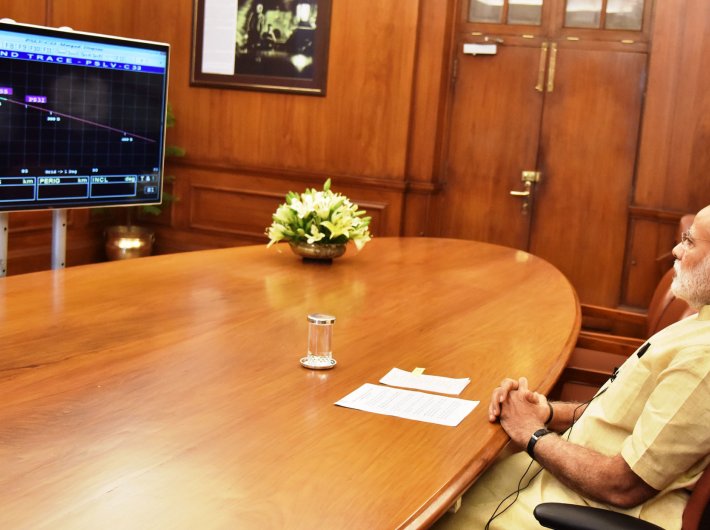
From finding directions to checking traffic and locating nearby cool hangout places, we cannot imagine our lives without the old and faithful buddy GPS. But so far we had to depend on the US’s global positioning system (GPS) for such a ubiquitous application. Now, the Indian Space and Research Organisation’s (ISRO) determination to provide us an alternative has finally come true. With the IRNSS 1-G launch on Thursday India can now boast of having its own positioning system. The IRNSS 1-G launch was the seventh and final satellite in the Indian Regional Navigational Satellite System (IRNSS) series.
This series of satellites aims to provide accurate position information service to users across the country and the region, extending up to an area of 1,500 km. IRNSS will be to the subcontinent what the US’ GPS is to its users worldwide, but with far greater precision and in Indian control, according to ISRO.
It will help in everyday uses and provide greater precision for aerial and marine navigation, disaster management, among others. It will be of great use for Indian military and defence services. With our very own positioning system we can make highly accurate and precise digital maps, pinpointing every nook and corner. The constellation of satellites will not only improve positional and navigational accuracy on land but also on sea and air.
Also, it can help the government in achieving its Digital India mission. Read more here.
Read our special issue on GIS click here

About forty people walked the roundabout on Teen Murti Marg to the gate of Chanakyapuri police station, a distance you could cover in under a minute, on Friday to protest against Elon Musk’s Starlink. The walk was called by the Swadeshi Jagaran Manch. Nobody joined them on the way, and nobody seeme
The Golden Chisel: The Story Behind the Making of Ram Lalla By Seethalakshmi S. and Rahul Nandan Rupa Publications, 168 pages, Rs 395
Mumbai’s real estate market keeps growing, yet homeownership remains out of reach for much of its population. Three experts – urban researcher Hussain Indorewala, urban planner Vidyadhar Phatak and developer Kamlesh Thakur of NAREDCO Maharashtra, agree that simply constructing more apartments
US secretary of state Marco Rubio has said he was unfamiliar with the Wall Street Journal report suggesting Elon Musk had decided to throttle Starlink services in Ukraine, but rejected claims that Washington had ordered the restrictions to pressure Kyiv. “There was no
Breast cancer has become a public-health challenge in India. The greatest opportunity is to find cancers earlier. Artificial intelligence (AI) is opening a new era in breast cancer detection. AI systems can analyse mammograms and other breast-imaging studies, identify subtle abnormalities and assist radi
Indian agriculture is experiencing significant climate volatility, while the world economy seems to be in a highly volatile situation. Economic indices from various countries show that they need to recalibrate their strategies to withstand economic headwinds. In such a challenging situation, a country li










