
It alone accounts for little less than one-third of the global deficit
GN Bureau | October 31, 2017
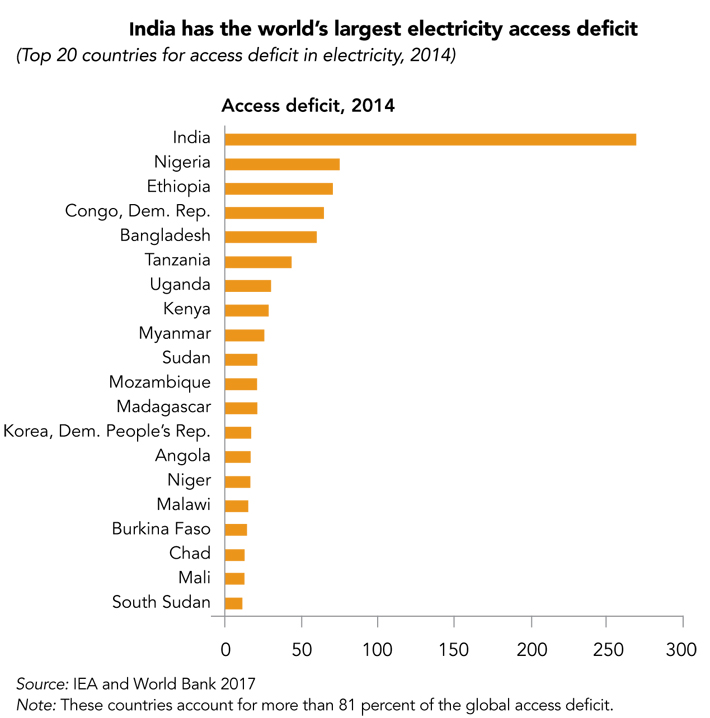
India alone has a little less than one-third of the global deficit (270 million for electricity), followed by Nigeria and Ethiopia for electricity—and the 20 highest access-deficit countries for electricity account for 80 percent of the global deficit, said a World Bank report.
The state of electricity access report 2017 said that countries with the highest levels of poverty tend to have lower access to modern energy services—a problem that is most pronounced in Sub-Saharan Africa and South Asia, where a large share of the population depends on traditional biomass for cooking and heating and lacks access to electricity.
“Poor households lack the resources to purchase modern energy services (especially when there is a connection charge to obtain the modern energy source, as with electricity). At the same time, households lacking access to electricity and other modern energy sources have fewer opportunities for income generation (especially from agriculture).
 “These households earn less, spend more time collecting biomass and less time on education, and pay more per unit for the limited amounts of modern energy that they can purchase (such as batteries for lighting and phone charging),” said the report.
In addition, households using solid fuels and traditional cooking methods are subject to high levels of indoor air pollution, which is associated with high rates of mortality and morbidity, especially for women and children who have the greatest exposure to this pollution.
Read: Our story on Rural Electrification
The report said that access to modern energy services, either through the form of advanced combustion cook-stoves using biomass, or through a switch to the use of LPG, can substantially reduce the long-term costs to the household from diseases associated with high levels of indoor air-pollution.
Several studies estimating the benefits of electrification on households or small businesses suggest that electrification results in higher household income, with the magnitude varying considerably among countries. In Bhutan, non-farm income increased by 63 percent, while farm income was unaffected, and in India, non-farm income rose by 28 percent.
The report goes on to say that in 2014, 1.06 billion people still lived without access to electricity—about 15 percent of the global population— and about 3.04 billion still relied on solid fuels and kerosene for cooking and heating.
The electricity access deficit is overwhelmingly concentrated in Sub-Saharan Africa (62.5 percent of Sub-Saharan Africa population ) and South Asia (20 percent), followed by East Asia and the Pacific (3.5 percent), and Latin America (3 percent) and the Middle East and North Africa (3 percent). In Sub-Saharan Africa, 609 million people (6 out of 10) do not have access to electricity, and in South Asia, 343 million people do not have access to electricity.
“Between 2000 and 2014, there were advances in electrification, with the global electricity deficit declining from 1.3 billion to 1.06 billion—and the global electrification rate rising from 77.7 percent to 85.5 percent. Progress with rural electrification is evident, with the global rural electrification rate increasing from 63 percent in 2000 to 73 percent in 2014. Urban areas across the world are already close to universal access at 97 percent. Although urban access rates have risen relatively little in the past 25 years, this level remains a major achievement when viewed against the rapid urbanization that has brought an additional 1.6 billion people into the world’s cities during this period.”
The report observed it is true that the huge potential for electricity access using mini-grids is hindered by numerous challenges— including inadequate policies and regulations, lack of proven business models for commercial roll-out (notably for pico-solar systems), and lack of access to long-term finance. But many countries are currently developing minigrid policies to address these problems.
“India has released a draft national policy for mini and micro grids, which, if adopted, will create the proper framework and environment for developing 500MW capacity over the coming decade. Kenya’s Energy Regulatory Commission has licensed Powerhive East Africa Ltd. to generate, distribute, and sell electricity—the first private company in Kenya’s history to receive a utility concession. Powerhive will develop and operate solar mini grids of a total capacity of 1MW to power 100 villages.”
The Indian Navy’s sail training ship, INS Sudarshini, set sail from Livorno, Italy, on Saturday on completion of a successful port call. During her stay, the ship participated in a series of professional interactions and cross-training visits, strengthening bonds of friendship and maritime partners
September 12 marks the International Day for South-South Cooperation, commemorating the 1978 Buenos Aires Plan of Action (BAPA). Forty-eight years later, its central proposition remains relevant: countries of the Global South can draw on their own knowledge, experience and innovations to address shared d
As India prepares to host the 18th BRICS Summit this weekend, and as prime minister Narendra Modi is set to hold a bilateral meet with president Xi Jinping, China’s growing global influence and the changing dynamics of India-China relations will be under focus. But to understand where China is head
This year marks 20 years of BRICS, with India set to host the grouping’s leaders’ summit this weekend. The anniversary offers an opportune moment to assess BRICS’ growing importance at a time when the effectiveness of global governance and the credibility of multilateralism are under in
Triumph of the Indian Republic: My Life, My Struggles By Ram Nath Kovind Rupa Publications, 400 pages, Rs 795 All our presidents so far stand out, each for a different reason. Ram Nath Kovind, the 14th president of India, from 2017 t
Pathbreakers: How 10 Visionary Leaders Transformed India by award-winning journalists By Sucheta Dalal and Debashis Basu Rupa Publications, 304 pages, Rs 695











