Year 2018 will also be marked with major events like ASEAN and International Solar Alliance summit
Although the year 2017 remained tense for India because of its cantankerous neighbours-Pakistan and China, the coming year is expected to be good and eventful for the country. First of all, the year is opening up with the high profile visit of Israeli prime minister Benjamin Netanyahu. He is landing in India in the second week of January. Close on the heels of the Israeli prime minister, all 10 heads of ASEAN countries are trooping into India for ASEAN summit and to become chief guests at the country’s Republic Day.
Prime ministers and head of states of around two dozen nations, including French president Emmanuel Jean-Michel Frederic Macron are arriving in March to attend two-day conclave on international solar alliance. Russian president Vladimir Putin, Japanese prime minister Shinzo Abe are also expected to visit India for their respective annual summits. There is also a buzz in New Delhi’s diplomatic corridors about the possible visit of US president Donald Trump in the first half of 2018, although it has not been confirmed by the ministry of external affairs.
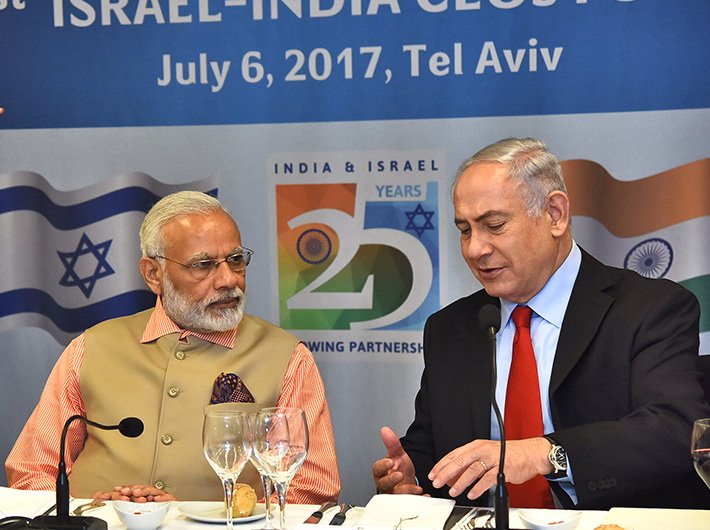
With regard to the Israeli prime minister’s visit, it should be remembered that it will be the first official trip of the head of Jewish state’s government to India in 15 years. In 2003, Ariel Sharon was the first Israeli prime minister to visit India. Netanyahu’s four-day visit begins from January 14 and it is taking place in response to the first ever prime ministerial visit from India to Israel in July 2017.
Officials involved with the Israeli prime minister’s visit say that the most of official engagement between India and Israel will take place the day he arrives in New Delhi. He is expected to visit Agra to see iconic Taj Mahal next day; together with the Indian prime minister, he will fly to Ahmedabad in the third day of the visit, and from there he is likely to fly to Mumbai where, apart from visiting Chabad House, the site of the November 2008 terrorist attack in which six Jews were killed, he will address a business meet. During his New Delhi stay, he will also participate in MEA-Observer Research Foundation organised Raisina Dialogue-III.
If sources are to be believed, during the Israeli prime minister’s visit, India and Israel are likely to sign five to six agreements on agriculture, water conservation, education, homeland security and others. A hint to having an engaging talk on defence purchase was given during the recent visit of Israel’s director general of foreign ministry Yuval Rotem. He had come for India-Israel foreign office consultations.
It should be noted that under a tripartite deal between India, Israel and Russia in the early 2000s, it was agreed that Russia will sell Ilyushin-76 aircraft to India to be fitted with Israel’s AWACS. In consonance with this tripartite deal, India acquired three Ilyushin-76 aircraft fitted with three Israeli AWACS in 2003. It needs five more. But it requires two AWACS urgently to meet Indian Air Force’s immediate demand to balance its depleting high-tech strength. However, despite India and Russia sharing very warm relations, Moscow is unwilling to confirm to India’s purchase price. Russia hiked many times its Ilyushin-76 aircraft’s price from its 2003 price.
During the just concluded visit of Russia’s deputy prime minister Dmitry Rogozin, the issue was broached between the two sides. Following the talks, some moves on the issue have been made, making Indian authorities feel that they may give AWACS deal a logical conclusion during Prime Minister Netanyahu’s visit. Yet all eyes are focused on the commemorative India-ASEAN summit to be held on January 25. Even while experts are gung ho on India-ASEAN connectivity programme, they appear to be despaired with the two sides’ economic engagement so much so that a low, muffled voice on India’s unhappy trade situation with ASEAN is now getting louder. And with this, it has been left to prime minister Narendra Modi to take a final call on India’s Free Trade Agreement with the Regional Comprehensive Economic Partnership (RCEP), trade bloc in which all ASEAN countries and the group’s six associates, including India are participants.