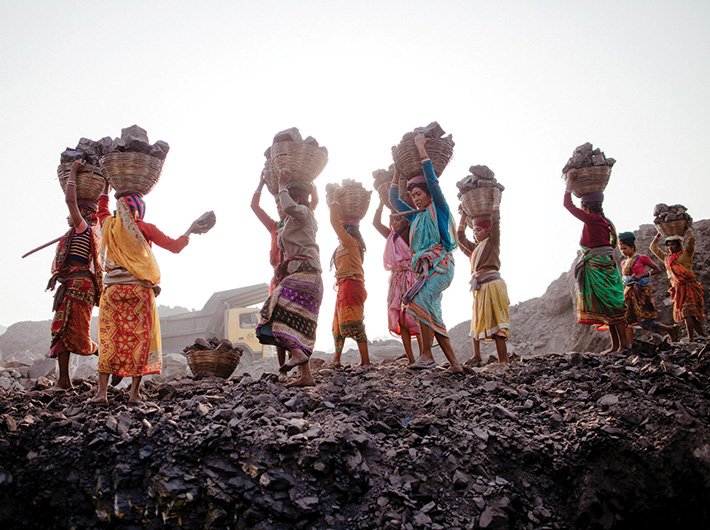
Shramev Jayate (Labour Prevails), the slogan coined by prime minister Narendra Modi, is not as seductive as Karl Marx’s exhortation, “Workers of the world unite”. But the essence of both emphasises the ultimate triumph of the proletariat as sine qua non for the evolution of a new political order. Is labour recognised as an input as critical as capital and treated on a par?
Noted Marxist historian Eric Hobsbawm’s critical appraisal of the international situation in his book “How to Change the World: Tales of Marx and Marxism” points out that communist regimes after the second world war practically abolished the labour movement. “It is possible to write the history of the working class in the communist world and even a history of the labour conflicts, but not the history of labour movements, with major exception of solidarity in Poland in the 1980s.” Ironically, Poland’s Solidarity movement led by redoubtable Lech
Walesa subverted the communist regime which drew its inspiration from the Marxist maxim, “dictatorship of the proletariat”.
Back home in India the economic planning was much inspired by the socialist model of the Soviet Union. Successive five-year plans created a robust public sector which, in Nehru’s words, was supposed to take over the “commanding heights” of the Indian economy. Along with it emerged trade unions and their gradual radicalisation. In the post-independence phase, trade unions fought several valiant battles for workers’ rights and were treated with respect by benign regimes.
The right to collective bargaining acquired a constitutional legitimacy till it degenerated into a tool of coercion and blackmail at the hands of trade unions. “Cholbe na” in West Bengal and “Bol Majoora Hulla Bol” in the Hindi heartland became reigning slogans of the working class in the organised sector. Life used to get paralysed at the slightest pretext. In the 1980s and 1990s, the legendary railway strike led by George Fernandes and Bombay being brought to a halt by Datta Samant could now be recounted as folklore in the history of Indian trade unionism. Unions of state employees, teachers and bank employees functioned like an autonomous state.
It did not take long for political leaders to understand that the clout wielded by these unions was far disproportionate to their numerical strength in a democracy. Workers of the organised sector formed less than 8 percent of the total workforce. Though they enjoyed a better life and entitlements, their proclivity to strike work was frowned upon by people. In the post-liberalisation phase, the wheel has come to a full circle. Much of the services provided by the state are outsourced. The “commanding heights” position of state capitalism has been vacated for market forces to encourage private enterprise.
For the past three decades, trade unions have almost become a relic. Their clout has substantially declined and their bargaining power is grossly undermined. Labour is considered to be expendable while capital is the most sought after input for development. Modi’s ‘Make in India’ is sought to be made attractive on the basis of the availability of cheap labour in India. Even the only Marxist regime, of Tripura, a small state in the northeast, is vying with the developed states to attract capital. Marxists in India have been gradually adapting to a new variant of communism. If there was any doubt, the election of a pragmatic Sitaram Yechury as general secretary of the Communist Party of India (Marxist) in the recently concluded Visakhapatnam congress would put it to rest.
But these are not healthy signs in the long run. There have been cases of sporadic violence erupting across the nation, most prominently in the industrial estates of the national capital region (NCR), in the recent past. Most of these incidents relate to oppressive exploitation of labour by multinational corporations which are taking advantage of an anti-trade union atmosphere created by liberalisation. In this context, Modi’s clarion call for making India a manufacturing hub would assume enormous importance. How would labour be treated in it? If labour continues to be as expendable as it is now, it would be a recipe for great social discontent. As we go to celebrate May Day, Hobsbawm’s advocacy of a modified Marxism sounds tenable and practical in the present context. Will the disciples of Marx listen?
[email protected]
(The article appears in the May1-15, 2015, issue)