
Concerned over another ‘encroachment’ at the Yamuna bed, public intellectuals and social activists raise an alarm about a to-be event of the Art of Living foundation
GN Bureau | February 17, 2016

A group of public intellectuals and social activists have written a letter to the president, the prime minister and concerned government representatives urging them to stop encroachment and destruction of Yamuna floodplains. Their concern has stemmed from the announcement of an event, scheduled on March 16, to celebrate the 35th anniversary of the 'Art of Living' foundation, a private organisation formed by Sri Sri Ravi Shankar.
The intellectuals and activists have said that construction work which has already started at the Yamuna bed is destabilising and destructing the ecosystem of the river. The floodplains are getting encroached and damaged largely, which used to play a crucial role in maintaining biodiversity and health of the river, they add.
Addressing the letter to the president and the prime minister who apparently have plans to attend the event, the group says that their participation might appear to lend legitimacy to an illegal activity. They support their argument by writing, “the event is being planned after clearing, compacting, dumping of earth and construction underway over some 1,000 acres of the active flood plain of river Yamuna in Delhi, and the matter being sub-judice at the National Green Tribunal … as prima facie the said preparations are in violation of the NGT judgment of 13 January, 2015 …”
To further back their argument, the group has attached a pictorial report highlighting through comparative photos of September 15, 2015 and February 5, 2016, on how “a verdant flood plain has got systematically destroyed and is being converted for the event.” This additional encroachment, the group said, will only make the situation worse. In the past, construction activities for the commonwealth games, millennium bus depot, Akshardham temple and others have been in controversies for alleged encroachment of the Yamuna plains.
The letter adds that according to India’s current national water policy, “Conservation of rivers, river corridors, water bodies and infrastructure should be undertaken in a scientifically planned manner through community participation… Environmental needs of Himalayan regions, aquatic eco-system, wet lands and embanked flood plains need to be recognized and taken into consideration while planning.” The group contends that in the current case, national water policy stands violated.
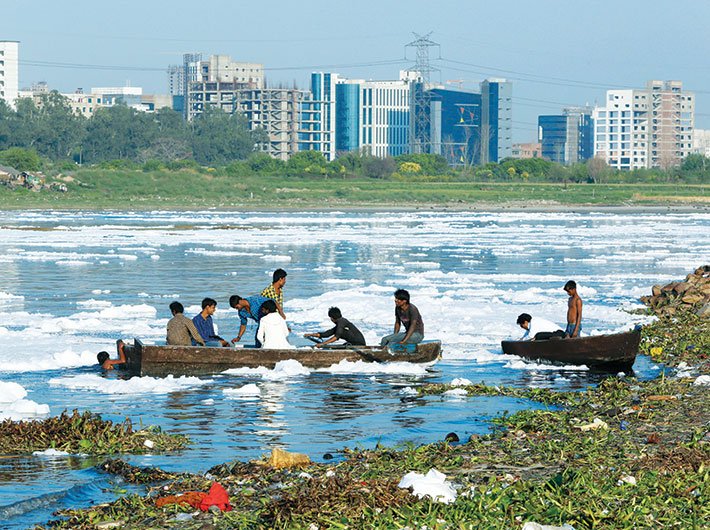
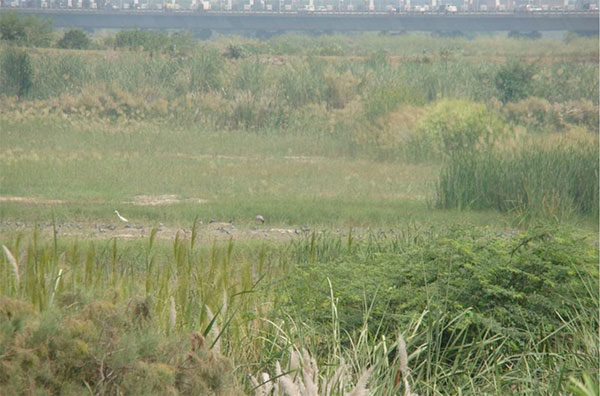
September 15, 2015 February 5, 2016
The group feels that even though the event would run for a few days, the devastation resulting from its preparatory and operational phase (some 35 lakh persons are expected to participate with a stage planned to be constructed over some seven acres of land) would outlast decades in terms of river Yamuna's health, which already is in no great shape.
People who have written the letter:
1. EAS Sarma, former secretary
2. Medha Patkar, Narmada Bachao Andolan
3. Madhu Bhaduri, former ambassador of India
4. Paritosh Tyagi, chairman & managing trustee, IDC Foundation
5. Bharat Jhunjhunwala, former professor, IIM-B
6. Dr Latha Anantha, River Research Centre
7. Samir Mehta, River Basin Friends
8. Dr Sudhirendar Sharma, Ecological Foundation
9. Vimal Bhai, Matu Jan Sangathan
10. Malika Virdi, Himal Prakriti
11. Emmanuel Theophilus, Himal Prakriti
12. Ramnarayan. K, Himal Prakriti
13. Parineeta Dandekar, South Asia Network on Dams, Rivers and People
14. Himanshu Thakkar, South Asia Network on Dams, Rivers and People
India’s southwest monsoon ended with a 13% rainfall deficit in 2026, its weakest performance in a decade, raising concerns over agricultural production, water security and the upcoming rabi season. With El Niño expected to persist into early 2027, experts warn that declining soil moisture, dep
For over a decade, India’s e-commerce story has rested on a simple premise: platforms connect buyers and sellers, while data fuels efficiency, personalisation, and scale. However, as the market matured, its structure has revealed a growing imbalance. E-commerce platforms, especially marketplace ent
The interaction between active Western Disturbances, increased atmospheric moisture and the region’s complex topography aswell as global warming are important factors behind intense rainfall in the Himalayas, leading to flash floods in Nepal, according to meteorologists. Nepal
Last summer, the two of us spent several weeks in rural Madhya Pradesh with a non-profit that works on gender justice through women’s self-help groups. We went in with a notebook full of laws. The Protection of Women from Domestic Violence Act. The Dowry Prohibition Act. Free legal aid for every wo
Digital payments have become a reflex for urban India, but the confidence earned in paying has not yet carried over to borrowing. That is the central finding of `How Urban India Pays Report 2026`, released by Pahlé India Foundation in collaboration with Amazon Pay. Based on a survey of 5,149 consu
Commerce and industry minister Piyush Goyal has called upon businesses in India and the United Kingdom to translate the opportunities created by the India-UK Comprehensive Economic and Trade Agreement (CETA) into expanded trade, investment, partnerships and job creation. Addressing the Bu










