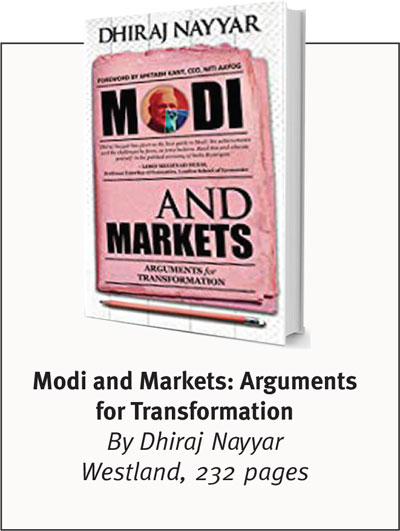
Dhiraj Nayyar’s book, Modi and Markets: Arguments for Transformation (published in October by Westland) came a bit too early. The title would have made for seductive reading had it coincided with RBI deputy governor Viral Acharya’s rant against the government in which he cautioned, “Governments that do not respect the central bank’s independence will sooner or later incur the wrath of financial markets.”
Unfortunately Nayyar, a journalist-turned economist, could not incorporate this theme into his book, which is a collection of his articles published in various publications. Though Nayyar is a trained economist, the book is devoid of academic jargon and reads in an easy flowing manner, comprehensible to those who are not initiated into even elementary economics. But the accessibility of the text has not diluted the seriousness of the content.
Right from the word go, it appears quite clear that Nayyar favours what is called “Modinomics” without being uncritical. He examines policies initiated by prime minister Narendra Modi through his own understanding of economics and quite critically and explains them threadbare in a lucid and interesting manner. For instance, the second chapter, ‘The real importance of Modi’s rise: A CM as PM’, elucidates the advantages Modi had on account of serving 13 years as the chief minister of an economically prosperous state like Gujarat. In the next chapter, he claims that the paradigm of governance that Modi pursued was radically different from that of previous regimes.
Nayyar’s words need to be taken seriously as he has also served the NDA government in the capacity of head of economics, finance and commerce at the NITI Aayog, the policy planning body which is now entrusted with the task of encouraging development through ‘cooperative federalism’. Ever since the planning commission was wound up, the NITI Aayog has devised various schemes to initiate competition among states and even districts to grow faster. The author is quite upfront about his prognosis when he says, “The Modi model is a delicious prospect for India’s democracy, federalism and governance. That will remain Modi’s real legacy.”
Nayyar unhesitatingly sees hope for India in the BJP’s politics when he argues his case in yet another chapter, ‘For Moral Capitalism’. His erudition as an economist comes through as he deals with the topic by referring to Nehruvian fascination for Fabian socialism and the Soviet model of command and control economy and the inability of PV Narasimha Rao to do a Deng Xiaoping in opening up India. At the same time, he also contextualises Deendayal Upadhyaya’s integral humanism in the ongoing economic debate and says, “Modi has an intellectual anchor in his (Deendayal Upadhayay’s) quest.” This description of Modi, though it may fall foul of many within the Sangh Parivar, is nevertheless an acknowledgement of his adherence to an economic path suited to India and also not divorced of the party’s ideology.
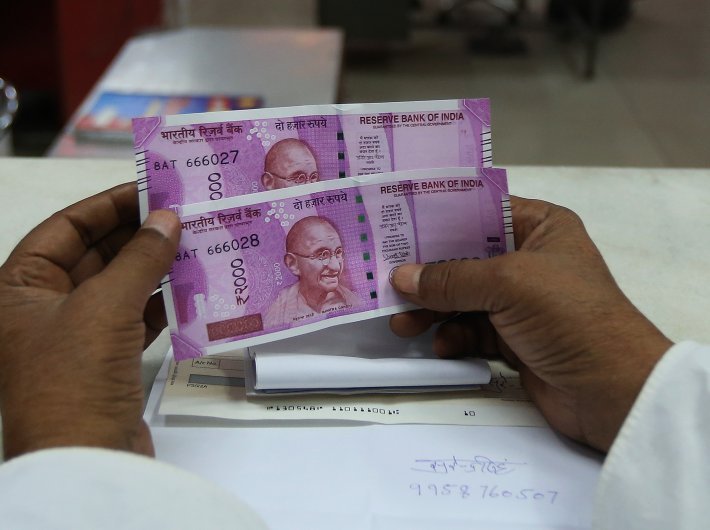
Unlike his peers in academics and even in financial journalism who run down the Modi government’s demonetisation move and GST roll-out, Nayyar sees them as “radical reforms” intended to benefit the economy in the long run. At the same time, he is conscious of Keynes’ famous saying: “In the long run we are all dead.” Politics is all about short term while the nation-building is a long-term goal. Here he finds an amalgam of both the traits in the making of Modi which he sees auguring well for the nation. For instance, he refers to Modi’s “unpopulist measures” in his role as the chief minister but also notes that they were not unpopular in political terms. In essence, Modi can take unpopulist decisions and yet score political victory.
In yet another place in the book, Nayyar refers to a “third India” – other than Bharat and India – which is often categorised as Poor vs Rich in political context. He points out that over 700 million Indians could be called “neo-rich” who are neither rich nor poor. They belong to a class which is constantly aspiring to break the economic ceiling to scale up the ladder. In Nayyar’s understanding, any politician who could read the mood of this class would hold the key to power. And Modi is apparently more qualified than Rahul Gandhi, Arvind Kejriwal and others, to understand the pulse of this class because of his own social and economic background. Coming from a background of abject poverty, Modi’s persona find much more acceptance in this class as compared to the others. At the same time, this class which has moved ahead with the time is not fascinated by worn-out socialist slogans of glorifying poverty for politics’ sake.
The best part of the book is that the articles in it are so lucid and readable that it would not be easy to put it down once you start reading it. In a complex subject like political economy, the book carries on in a story-telling manner. There is no doubt that some readers may draw their own conclusions about the book being an outright eulogy on Modi’s policies, but that’s not true as Nayyar is also critical of the government’s prevarication on certain economic reforms and conservative Hindu political agenda.
However, the first reading of the book clearly reveals that the Modi government’s understanding of the market is certainly not inferior to Viral Acharya’s whose caution has acquired more of an undertone of politics than economics. I wish Nayyar could have included this aspect in his book.
(This book review has appeared on FirstPost.com)