
Obama sees climate change, especially in Indian subcontinent, as threat No 1

“If you start seeing more severe drought; more significant famine; more displacement from the Indian subcontinent and coastal regions in Africa and Asia…”

GN Bureau | March 17, 2016

#Pakistan   #foreign policy   #diplomacy   #environment   #climate change   #Barack Obama   #terrorism  


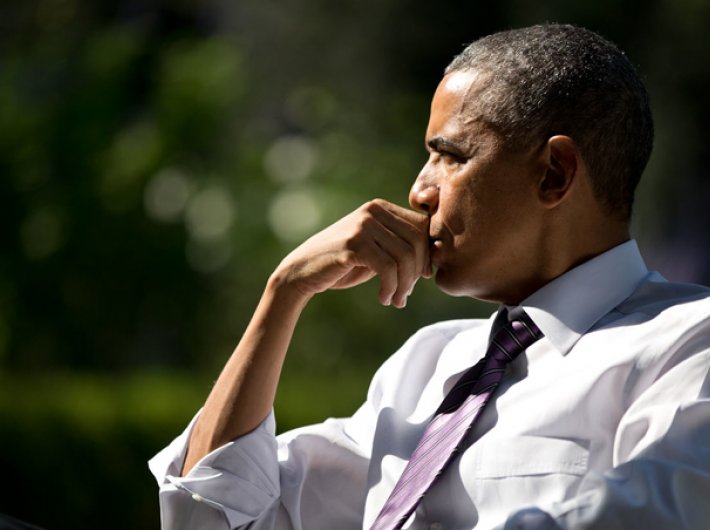
Late in his presidency, Barack Obama looks at the future and finds climate change as the most worrisome factor – and he is also worried about drought, famine and “displacement from the Indian subcontinent”.

“As I survey the next 20 years, climate change worries me profoundly because of the effects that it has on all the other problems that we face,” Obama told Jeffrey Goldberg of the Atlantic monthly. “If you start seeing more severe drought; more significant famine; more displacement from the Indian subcontinent and coastal regions in Africa and Asia; the continuing problems of scarcity, refugees, poverty, disease—this makes every other problem we’ve got worse. That’s above and beyond just the existential issues of a planet that starts getting into a bad feedback loop.”

These remarks are part of the Atlantic magazine’s April cover story, The Obama doctrine, a long overview of the US foreign policy during his presidency.

The comments come at a time when large parts of India have suffered drought.

He assigns so much weightage to climate change that he says, “ISIS is not an existential threat to the United States… Climate change is a potential existential threat to the entire world if we don’t do something about it.”

Climate change worries him in particular, the report notes, because “it is a political problem perfectly designed to repel government intervention. It involves every single country, and it is a comparatively slow-moving emergency, so there is always something seemingly more urgent on the agenda.”

The president also mentions terrorism as a long-term problem “when combined with the problem of failed states”.

The report has no other direct reference to India, but it may interest Indian readers that, according to Goldberg, Obama “privately questions why Pakistan, which he believes is a disastrously dysfunctional country, should be considered an ally of the U.S. at all.”

Comments


Other News

PM announces fast-track courts for paper leak cases

Prime minister Narendra Modi on Thursday stated that the government has decided to set up fast-track courts to ensure swift and stringent punishment for those involved in paper leaks. Emphasising that nothing is more important than the welfare and future of the youth, he noted that h

Making India’s textile & apparel sector sustainable

India’s textile and apparel sector sits at the heart of the economy but is constrained by traditional manufacturing approach. It contributes close to 2% of GDP and around 11% of manufacturing gross value added, with GDP share expected to reach 5% by the end of the decade. The sector employs around 45

Caring for cancer patients: the expanded network of facilities

Health is a State subject, and the primary responsibility for providing healthcare services, including cancer care, rests with the respective state governments. However, the Department of Health and Family Welfare provides technical and financial support to States and Union Territories across the country

Capabilities, aspirations of India’s youth limitless: Modi

The capabilities and aspirations of India’s youth are limitless, prime minister Narendra Modi said in his remarks to the media at the start of monsoon session of the parliament on Monday.  "In the past month, the country has achieved many milestones, filling citiz

India gets the first hydrogen train

Prime minister Narendra Modi on Friday laid the foundation stone and dedicated to the nation various development projects worth around ₹14,700 crore in Jind, Haryana.   The PM positioned the city as a shining reflection of the good governance model. Emphasizing that the entire Haryana

Climate change is stealing sleep

Climate change has at least doubled the temperature-related sleep loss across 1,338 major cities worldwide over the past five decades, highlighting an emerging but often overlooked public health consequence of rising global temperatures. A new study by Climate Central estimates that between 2020 and

Upcoming Conferences


Archives

Current Issue

Opinion

Facebook Twitter Google Plus Linkedin Subscribe Newsletter

Twitter






