
UK wants Indian legal sector to be opened for British law firms

In India on three-day visit, UK law minister Shailesh Vara wants India to welcome British law firms

deevakar

Deevakar Anand | September 2, 2014 | New Delhi
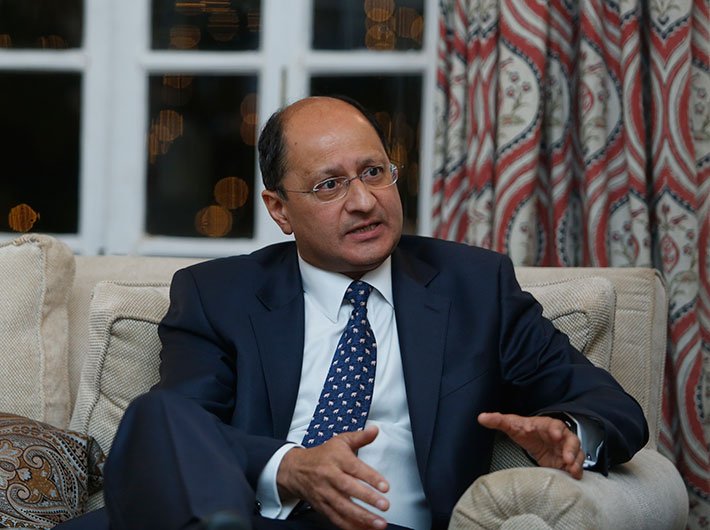

UK law minister Shailesh Vara

British law minister Shailesh Vara is in India to “explore possibilities if UK lawyers could be allowed to do business in India”. On a three-day visit, Vara met his India counterpart Ravi Shankar Prasad, chief justice RM Lodha and bar council of Delhi president KK Manan, besides power minister Piyush Goyal and minister of state for home Kiren Rijiju, on Monday.

Later in the day, talking to reporters at the British high commissioner’s residence in Delhi, Vara said, “We allow Indian lawyers to practice in the UK. Also, I am hopeful as prime minister Narendra Modi has said he wants to open up India for foreign investment. I have also met ministers as well as members of legal sector to see if there can be any movement on allowing oversees lawyers to practice in India”.

He, however, clarified that he was only seeking advisory role for the UK lawyers in India. “I am not saying that UK lawyers should get rights of advocacy in courts (Indian courts). Nor am I suggesting that UK lawyers should come to India and advise on Indian laws,” he said.

Vara advocated that India could emerge as a centre of legal excellence on the lines of London which allows oversees lawyers to set up business there.


So far, India has rejected liberalisation of the legal sector. While corporate law firms in India have been supportive of the opening up of the Indian legal market, private practitioners and bar councils have opposed it saying it will hamper the legal profession. Their main contention is that Indian firms would find it difficult to compete with foreign firms.

The first Indian-origin politician to become a British government minister under the Conservative Party, Vara, however, pointed towards the growing need for international legal advice for Indian firms and for which “they spend thousands of pounds and time going to the UK when they could have the same advice in India”.

“I see no reason why there can’t be partnership between Indian and UK lawyers. There can be rules. It could be made clear that UK lawyers can only advise on international matters. At the moment, that is not allowed. UK lawyers are simply not allowed to practice in India or any other country. So, I am just asking if we can review that,”  Vara said.

Asked about the response he got at his meetings with Prasad and members of the judicial fraternity, he said, ““I didn’t expect an instant answer. But I am encouraged that we are engaging in a dialogue which had lately fizzled out. There is now a new and ambitious government. I have opened up the dialogue which will continue and I very much hope that it will end with the opening up of the sector.”

The UK minister, who has his roots in Gujarat and was awarded the Pravasi Bharatiya Samman by the Indian government earlier this year, is slated to visit the national law universities in Delhi and Ahmedabad.

Vara is here also to promote the Global law summit slated for next February in London. “It will be the 800th anniversary of the signing of 'Magna Carta' next year. That important landmark in the history of world should be celebrated. So, we are having this one-off conference to which we will attract legal fraternity from all sectors,” he said.

Magna Carta (or the Great Charter) was the first official document issued in 1215 that led to the evolution of constitutional law in England, and elsewhere.

Refusing to be drawn into a conversation on the controversy over the National Judicial Appointments Commission Bill, passed by the Indian parliament, Vara said, “In the UK, we have an independent judicial appointments commission. It is open and transparent. If people wish to look at that model, they are welcome to do so”.

Comments


Other News

Wisdom stories that don’t preach but encourage reflection

The Foundation Of A Fulfilling Life: Lessons from Indian Scriptures Deepam Chatterjee Aleph Books, 264 pages, Rs 899  

Citizens of the Bay: Why BIMSTEC matters now

The international order is drifting into a dangerous grey zone as the very powers that built today`s multilateral system begin to chip away at it. The United States has increasingly walked away from global rules and forums when they no longer suit its interests, while China has rushed to fill the vacuum on

PM salutes armed forces on one year of Operation Sindoor

Prime minister Narendra Modi on Thursday saluted the courage, precision and resolve of the armed forces on the completion of one year of Operation Sindoor.   The PM said that the armed forces had given a fitting response to those who dared to attack innocent Indians at Pahalgam.&

Supreme Court judge strength to go up by four to 37

The strength of the Supreme Court is set to go up from 33 judges to 37 judges, paving the way for a more efficient and speedier justice. The Union Cabinet on Tuesday approved the proposal for introducing The Supreme Court (Number of Judges) Amendment Bill, 2026 in Parliament to amend The Sup

BJP set to capture West Bengal

The political map of the country is set to be redrawn with the BJP set to win the West Bengal assembly elections, apart from Assam and the union territory of Puducherry. In Kerala, meanwhile, the Congress-led UDF is set to regain power. The filmstar Vijay-led TVK has emerged as the front-runner in Tamil Na

Beyond LPG: Is PNG ready for India’s next cooking fuel transition?

India, the second-largest importer and consumer of LPG after China, faces growing pressure due to supply constraints. Most of India`s LPG imports transit through the Strait of Hormuz, a focal point of global turmoil. Given that LPG forms the backbone of household kitchens and the restaurant industry, any s


Archives

Current Issue

Opinion

Facebook Twitter Google Plus Linkedin Subscribe Newsletter

Twitter






