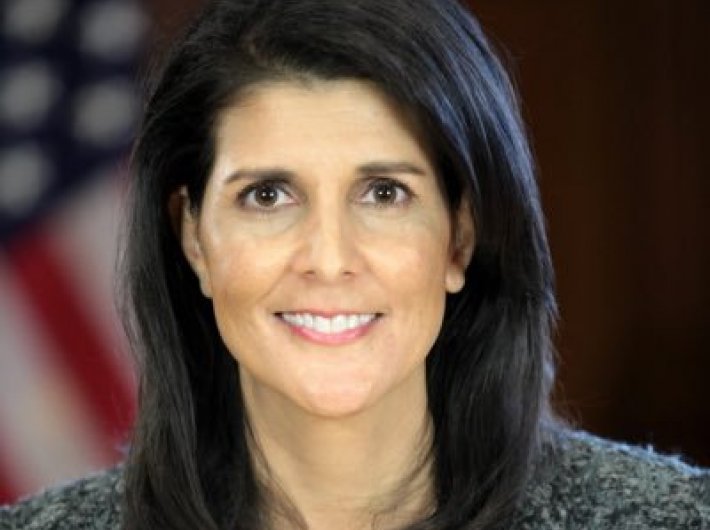
We have to see actions of member states to decide whether we are going to do that or not and so we will wait and see, said Nikki Haley, US ambassador to the UN.
The US has threatened to withdraw from the UN Human Rights Council (HRC) unless its demands of reforms to the world body are met, including removing an agenda item that discusses Israel’s human rights abuses, thereby addressing the “pathological” anti-Israel bias against a country that “actually has a strong human rights record”.
“I am not going to commit today on whether we are going to stay in or out of the Human Rights Council because we haven’t seen it [the reforms] yet,” said Nikki Haley, the US ambassador to the UN, in a speech at the Graduate Institute of Geneva on Tuesday.
“We have to see the actions of the Council, we have to see actions of member states to decide whether we are going to do that or not and so we will wait and see. What I can tell you is we have come here in good faith,” she added.
Haley was responding to a question from the audience who asked if the Donald Trump administration would be able to make the same commitments to human rights issues as it was asking other countries to do.
“Since the Trump administration has come in, as an American it’s been embarrassing to be abroad. I don’t’ see the US government, as led by someone who brags about assaulting women, who lies about immigration and globalization and calls Mexican immigrants rapists, as committing to the kinds of things you are talking about,” asked a researcher who studies the HRC.
“I also see some kind of hypocrisy in the fact that you worry about children in Syria but we don’t accept them in as refugees. Can you commit, yes or no, on that the US will not withdraw from the HRC,” he added.
The American researcher also asked whether the US will be will be amenable to HRC—the 47-member intergovernmental body that is supposed to promote and protect human rights worldwide— investigating human rights violations within the US, particularly in the case of Guantanamo Bay, and the general abuses during the Iraq war.
Before this question came, Haley had said, “America does not seek to leave the Council but we seek to re-establish the Council’s legitimacy”.
Specifically, the American administration wants three changes.
It wants changes in the elections “so countries are forced to make their case for membership based on their records not their promises” and also keep the “world’s worst human rights abusers” out of membership.
Secondly, the secret ballot must be replaced with open voting so those who support human rights violators would “show their faces”.
Thirdly, and most emphasized by the US is the removal of agenda item 7—human rights in Palestine and other occupied Arab territories—which is a permanent feature in every Council session calling it “the scandalous provision that singles out Israel for automatic criticism”. It is “the central flaw” that turns the HRC into an “organization overwhelmed by political agenda”, Indian-origin diplomat said, and that “there is no legitimate human rights reason for this agenda item to exist”.
Since its creation, there have been 70 resolutions against Israel and only seven against Iran. It is an attempt to give “an international stamp of approval to the anti-Semitic BDS (Boycott, Divestment, Sanctions) movement”. It would be appropriate to have agenda items against Iran, Syria and North Korea, Haley said. Claims against Israel could still be brought under agenda item four, just as claims can be brought there against any other country, the US suggested. Having a permanent agenda item at the Council against Israel –with its “strong” human rights record”—is like having an agenda item against the US, the UK, Canada or France. “More appropriate” would be to have an agenda item against Iran, Syria or North Korea.
The top US diplomat called these changes “minimum necessary to resuscitate the Council”.
“The Human Rights Council must change. If it fails to change then we must pursue the advancement of human rights outside of the council,” she warned.
The US had boycotted discussions under agenda item 7 in the last HRC session in March.
“As an expression of our deeply-held conviction that this bias must be addressed in order for the Council to realize its legitimate purpose, the United States decided not to attend the Council’s Item Seven General Debate session,” said a press release from the US’ Secretary of State office.
Haley’s statements made the UN and governments further nervous after Trump’s recent announcement of withdrawal from the Paris climate accord that was reached after tough negotiations with 195 countries, and accommodating American interests.
The former South Carolina governor lashed out at the Council accusing it from suffering from a “credibility deficit”—a term used by former UN Secretary General Kofi Annan—an “awful lot like the discredited” the Human Rights Commission, the predecessor of HRC.
“It reinforces our growing suspicion that the HRC is not a good investment of our time, money and national prestige,” she said.
More than half of the Council members fail to meet basic human rights standards as measured by Freedom House, Haley accused, specifically mentioning Venezuela, Cuba, China, Burundi and Saudi Arabia. That Cuba “uses” its membership in the Council to appear as a supporter of human rights rather than a violator is a “reversal of the truth that would make George Orwell blush”.
“In case after case, it has been a forum for politics, hypocrisy, and evasion – not the forum for conscience that its founders envisioned,” Haley said.
Earlier in the day, in a statement at the opening session of the HRC, Haley said that “the United States is looking carefully at this Council and our participation in it”.
The American politician-turned-diplomat in her Geneva speeches made several references to Venezuela: in her statement to the HRC, a side-event at the HRC hosted by the US on human rights situation in Venezuela and in her speech at the Graduate Institute of Geneva.
“The US is always going to be strong on human rights,” she said.
“America did not invent these rights (rights to life, liberty and pursuit of happiness), God did,” she stated.