
Wealth of poor fascinates PM, asks RBI for financial inclusion roadmap

Jaitley promises credibility of decision-making, easing processes to make India's tax structure non-adversarial

GN Bureau | April 2, 2015

#prime minister   #Narendra Modi   #Arun Jaitley   #RBI   #Raghuram Rajan   #jan dhan yojana  


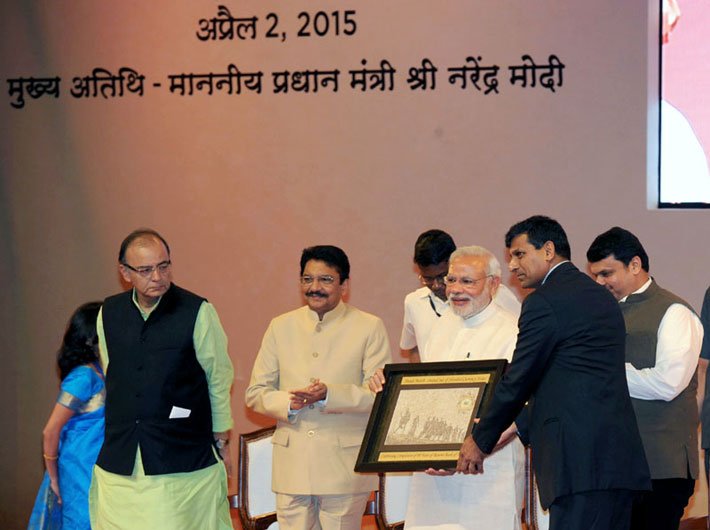
Prime minister Narendra Modi on Thursday asked the Reserve Bank India to prepare 20-year roadmap for financial inclusion while focusing on the success of the prime minister’s jan dhan yojan, which has Rs 14,000 crore deposits. The jan dhan yojana has made the country see the wealth of the poor. "We have only seen the prosperity of the rich but the Jan Dhan Yojana makes us see the wealth of the poor," said Modi.

Modi said he will meet RBI Governor Raghuram Rajan once in every two months and informed that the RBI has taken up the issue of financial inclusion in a very big way.

Speaking at the financial inclusion conference of the RBI in Mumbai, Modi asked banks to take a considerate view in lending to the poor."We should target to make paper and ink used to print Indian currency within the country as part of ‘Make In India’, he said.

He spoke on the farmers problems and said the farmers should not have to resort to suicides because of a lack of funds in a speech delivered in Hindi at an event on financial inclusion at the apex bank.

Over a dozen debt-laden farmers in the country have committed suicide in recent weeks, and discontent in many rural areas against government policies is turning into anger against Modi less than a year after he swept into office.

The Prime Minister also said that the RBI's thinking on financial matters was often quite similar to the government's.

Union Finance Minister Arun Jaitley, addressing the conference, said the government would restore the credibility of decision-making, while easing processes and making India's tax structure non-adversarial.  It reiterates government promises to make India more business- and investor-friendly.

Governor said the country's push to finance infrastructure should not override the need for financial stability. India is keen to ramp up infrastructure investment to help support economic growth, which will require a big push to fund projects.

RBI governor's speech: http://www.rbi.org.in/scripts/bs_viewspeeches.aspx

Comments


Other News

Dharmendra Pradhan tenders resignation

Dharmendra Pradhan, education minister at the centre of the storm of the NEET paper leak, offered his resignation to the prime minister on Saturday.   He posted a two-page letter on X, saying he was pained by the events of the last ten days. "This is not a matter of personal

Cabinet approves scheme of chemical parks

The union cabinet chaired by the PM has approved Bharat Audyogik Vikas Yojana Rasayan or BHAVYA - Rasayan Scheme for establishing three dedicated Chemical Parks in the country. The Scheme was announced in the Union Budget of FY 2026–27.   The Scheme will have a total financ

Anurag Jain, IAS appointed as Chief Executive Officer, NITI Aayog

 Anurag Jain, a 1989-batch IAS officer of the Madhya Pradesh cadre, has been appointed as the Chief Executive Officer (CEO) of NITI Aayog for a two-year term after serving as the Chief Secretary of Madhya Pradesh. A distinguished administrator with extensive experience in infrastructure, industrial de

Shri Ashok Barnwal, IAS has been appointed as the Chief Secretary of Madhya Pradesh

 Ashok Barnwal, a 1991-batch IAS officer of the Madhya Pradesh cadre, has been appointed as the Chief Secretary of Madhya Pradesh, succeeding Anurag Jain following his appointment as CEO of NITI Aayog. Prior to assuming the state`s top bureaucratic position, Barnwal served as Additional Chief Secretar

PM announces fast-track courts for paper leak cases

Prime minister Narendra Modi on Thursday stated that the government has decided to set up fast-track courts to ensure swift and stringent punishment for those involved in paper leaks. Emphasising that nothing is more important than the welfare and future of the youth, he noted that h

Making India’s textile & apparel sector sustainable

India’s textile and apparel sector sits at the heart of the economy but is constrained by traditional manufacturing approach. It contributes close to 2% of GDP and around 11% of manufacturing gross value added, with GDP share expected to reach 5% by the end of the decade. The sector employs around 45

Upcoming Conferences


Archives

Current Issue

Opinion

Facebook Twitter Google Plus Linkedin Subscribe Newsletter

Twitter






