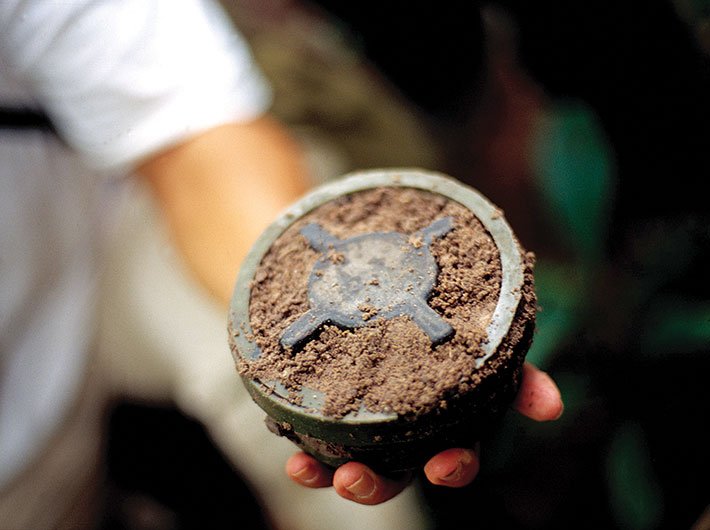
Anti-personnel landmines continue to kill innocent civilians long after the conflict. India, among its largest stockpilers, should rethink its strategy
A woman was woken by the army in the middle of the night after a 500-pound bomb was discovered a few hundred feet from her home in a leafy neighbourhood in London. This was in August 2015. The bomb was dropped on the neighbourhood – which had not seen active conflict for more than a couple of decades – during World War II. Construction workers in bustling Berlin routinely come across unexploded bombs tucked away in farming fields or city streets seven decades after the war that planted them has been over. France’s Zone Rouge – a 42,000 acre land – has no human inhabitants. It was ravaged by the Battle of Verdun, the longest sustained conflict of World War I, where millions of munitions were planted in the area. The only “positive” – perhaps – in the story is that “remembrance tourism” has sprouted there, presumably, providing a miniscule amount of revenue to the French government.
Closer home, one of the largest deployments ever of anti-personnel landmines in recent times was by India and Pakistan between December 2001 and July 2002 after the 2001 attack on the Indian parliament. Anti-personnel landmines have been used in wars fought by India in 1947-48, 1965, 1971, 1999 and the 1962 Sino-Indian war.
According to the International Campaign to Ban Landmines (ICBL), a Nobel Prize-winning coalition of non-government organisations working to ban anti-personnel landmines, during the 2002 Operation Parakram, about two million mines (though the Indian army said there were more) were placed along India’s northern and western borders that cover Rajasthan, Punjab and Jammu & Kashmir. These mines continue to claim limbs and lives as people visit their farm lands or children run along hills. Moreover, these are plastic (M14) mines, which have low metallic content, making them difficult to detect during demining operations and also making it easier for them to shift due to rains or wind (something that is banned under an international protocol).
Landmines, a globally condemned weapon, do not distinguish between a combatant and a civilian and explodes by the presence of, proximity to or contact with a person (as opposed to command-detonated mines).
According to an Economic Times report, the Indian military had threatened to lay landmines along the Line of Control (LoC) after the recent
heightened tensions between India and Pakistan, drawing anxious statements from activists across the world.
The catch is that India has not signed the 1997 Mine Ban Treaty (MBT), a key disarmament measure that has saved thousands of lives. It is one of a small group of ten countries to have signed the Amended Protocol II of the Convention on Conventional Weapons (CCM), also aptly known as the Inhumane Weapons Convention, but not the MBT. Amended Protocol II (AP II) of CCW contains rules, which regulates, but does not ban the use of landmines, booby-traps and other explosive devices. AP II, however, prohibits the use of non-detectable anti-personnel mines and their transfer. MBT, on the other hand, bans the use, production, stockpiling and transfer of anti-personnel mines and places obligations on countries to clear affected areas, assist victims and destroy stockpiles. About 35 countries, including all the influential ones, like India, Pakistan, the US, Israel, Saudi Arabia, China, Russia, Palestine, remain outside the treaty.
The obvious question to ask is how effective the treaty is, given the fact that the world powers choose to remain outside it. The good news is that there are 162 states parties that the MBT encompasses which make up for more than 80 percent of the countries in the world.
“The 35 states that have not banned landmines nonetheless are almost all complying with key provisions of the treaty by not using anti-personnel mines, ceasing production, and destroying stockpiles,” says Mary Wareham, the advocacy director of the Arms Division of Human Rights Watch (HRW). The Division works towards advocacy against particularly problematic weapons that pose a significant threat to civilians.
“The greatest challenge to the treaty comes not from the countries yet to ban these weapons, but from non-state armed groups (NSAGs) making and using victim-activated improvised explosive devices, which fall under the definition of anti-personnel mines prohibited by the treaty,” she adds. (See interview)
According to Landmine Monitor 2016, a report released on November 22, casualties due to the use of landmines increased by 75 percent in 2015. The Landmine Monitor is the research wing of ICBL and Cluster Munition Coalition (ICBL-CMC) – the de-facto monitoring regime of the 1997 Mine Ban Treaty. There were 6,461 mine/explosive remnants of war (ERW) casualties in 2015, of which at least 1,672 people were killed marking a 75 percent increase as compared to casualties recorded in 2014. This increase has mostly been attributed to active conflicts in Yemen, Syria, Libya and Ukraine. Loren Persi, the global coordinator for Casualties and Victim Assistance for the Landmine Monitor Report, said that the high casualty rate is “a wake-up call really”. (see interview)
The governments of Myanmar, North Korea and Syria have used anti-personnel landmines last year. However, most of the casualties have been attributed to NSAGs.
“We are not aware of state parties using anti-personnel landmines in Libya, Syria or Ukraine, while Houthi forces in Yemen have laid anti-personnel mines in 2016,” Wareham says.
About 65 NSAGs, including the Kurdistan Freedom Party of Iran, however, have committed to stop using anti-personnel mines. “NSAGs in countries including Afghanistan, Colombia, Iraq, Myanmar, Nigeria, Pakistan, Somalia and Syria fabricate anti-personnel mines and victim-activated IEDs,” the Landmine Monitor states. ISIS is deploying anti-personnel mines on a large scale.
The states with the greatest numbers of casualties reported from anti-vehicle mines in 2015 were Ukraine (147), Pakistan (73) and Syria (68).
Tehrik-e-Taliban Pakistan, Balochistani insurgent groups, Taliban, the Haqqani Network, Hezb-e-Islami, the Kachin Independence Army (KIA), the Myanmar National Democratic Alliance as well as other NSAGs in Myanmar, the Revolutionary Armed Forces of Colombia, Boko Haram, among other NSAGs have all used landmines last year.
Afghanistan remains one of the most anti-personnel mines-contaminated places (more than 100 square kms of mined area) in the world along with Iraq, Turkey, Bosnia and Herzegovina, Cambodia and some African nations.
India was the third largest stockpiler of anti-personnel mines in 2015, says the report, with an estimated stock of about 4-5 million. Its count is exceeded only by Russia (26.5 million) and Pakistan (estimated 6 million) and followed by China with (“less than” 5 million) and the US (3 million).
Also, India, Pakistan, Myanmar and South Korea, are “most likely” to be producing anti-personnel landmines while China, Cuba, Iran, North Korea, Russia, Singapore and Vietnam only keep the channels open for producing them.
“Those countries with stockpiles of anti-personnel mines would do better to join the treaty and ensure the full destruction of stockpiled mines – the consequences of use are too great and the international stigma against using mines is very strong,” said Persi.
“It is extremely disappointing that the world’s largest democracy is reportedly contemplating the use of landmines again,” said Megan Burke, director of ICBL, in response to India’s recent threat of planting landmines along the LoC. “New laying of anti-personnel mines by government forces anywhere in the world is almost unheard of, as the use of the weapons is clearly at odds with the most basic principles of International Humanitarian Law. Why would India want to lay minefields that will threaten the security of its own people?” she asked.
However, India does not seem to be in a mood to join the MBT if its voting pattern since 1997 in annual UN General Assembly (UNGA) resolutions on the matter is an indication. On December 7, 2015 UNGA Resolution 70/55 calling for universalisation and full implementation of the MBT was adopted by a vote of 168 states in favour, none against, and 17 abstentions. India is one of the core group of 14 countries (others including Cuba, Egypt, Iran, Israel, Myanmar, North Korea, Pakistan, Russia, South Korea, Syria, Uzbekistan, the US and Vietnam), that have almost consistently abstained from voting on the resolution.
Indian experts have argued that there are a number of constraints that explain why India does not want to sign the treaty (over and above its volatile relations with Pakistan). A legal clause in the MBT that binds its signatories to demine contaminated areas within five years is a stumbling block given India’s difficult terrains. Forest fires and thick vegetation growth often remove markings. Considerable investment and coordination between agencies are also required. But these seem to be issues that can be addressed if sufficient attention and emphasis are given to the problem. However, the requirement for use of anti-personnel landmines and its impact is perhaps one of the least discussed concerns in the security narrative in India.
“[The] US responsibility for clearing landmines and explosive remnants of war from Vietnam has been described as part of a ‘growing moral obligation’ and president Obama affirmed that when he visited Lao PDR in September. There is an expectation that those who produced, exported, and used them should contribute funds towards clearance and victim assistance,” Wareham said.
Though there is no thorough estimate of the areas mined during Operation Parakram, the Indian army in 2004 said that around 3,00,000 mines along 400 kilometres on the northern and western international border of India were untraceable. While there is no official count, an NGO estimated that there were more than 1,200 civilian casualties by 2004 from the Parakram mines. Civilians and soldiers in Kashmir routinely get killed and injured from anti-personnel mines, many of them laid by India.
It is high time India rethinks its landmine policy. Ethically as well as from a utilitarian point of view, anti-personnel landmines are not considered legitimate weapons of war anymore.
[email protected]