
Winter session 2016 has been one of the least productive sessions for both Houses in the last 15 years, with repeated disruptions on the issue of demonetisation
GN Bureau | December 22, 2016
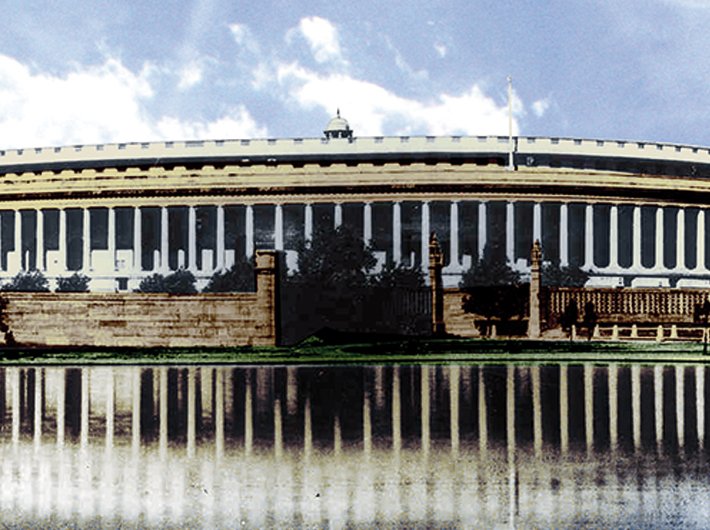
At the beginning of the session, 19 bills were listed for consideration and passage; none of these were passed. Out of the nine bills listed for introduction, three were introduced. Only two bills were passed during this Session.
“Lok Sabha passed the Taxation Laws (Second Amendment) Bill, 2016 within an hour of introduction. The Bill was passed as a Money Bill and is deemed to be passed by Rajya Sabha. Rajya Sabha passed the Rights of Persons with Disabilities Bill, 2014 with about an hour of discussion while Lok Sabha discussed it for over two hours before passing,” said PRS on the parliament functioning in the winter session.
 PRS said that a majority of the productive time in both Houses was spent on non-legislative business.
“This includes discussion on matters of urgent public importance, and other short duration discussions. In both Houses, the impact of demonetisation of currency was discussed the most. However, this discussion lasted for about eight hours, and did not conclude in either House.
 “The Supplementary Demand for Grants, which was also on the agenda this session, was passed within an hour with nine MPs participating. Supplementary Demand for Grants is the additional expenditure proposed by the government.”
In fact, the winter session 2016 has been one of the least productive sessions for both Houses in the last 15 years, with repeated disruptions on the issue of demonetisation of currency. While eight Bills were introduced in this session, only two were passed. Legislative business this session has been the lowest so far in the current parliament (16th Lok Sabha).
The winter session was Lok Sabha’s least productive session in the 16th Lok Sabha. Lok Sabha worked for 15 percent of the scheduled time and Rajya Sabha for 18 percent. So far in the 16th Lok Sabha, the average productivity of Lok Sabha is 92 percent and that of Rajya Sabha is 71 percent.
Both Houses of Parliament saw repeated disruptions on the issue of demonetisation. While Lok Sabha lost 107 hours of scheduled time to disruptions, Rajya Sabha lost 101 hours.
There`s a certain moment in diplomacy that`s too personal to be captured in a communiqué, too small to make the front page, but more revealing than the front page. This week, prime minister Narendra Modi reached Tashkent and, amid the pomp of state visits, managed to evoke the old Bollywood tunes
India became the 123rd WTO member to ratify the multilateral Agreement on Fisheries subsidies (AoFS) when it deposited the Instrument of Acceptance for Phase 1 on July 20, 2026. The ratification is restricted to disciplining Illegal, Unreported and Unregulated fishing (IUU), protection for overfished
India has become accustomed to hearing the 7% growth number. It is now less a milestone than an expectation. Yet the paradox is becoming clearer: maintaining 7% growth may be considerably harder than achieving it once. India’s real GDP grew 7.7% in FY2025–26, following growth of 6.5% in FY202
Justice Abhay Oka, who retired from the Supreme Court in May 2025, has said that the Constitution of India cannot be altered. Explaining the landmark Kesavananda Bharati judgment (1973) on the basic structure of the Constitution, he said, “This is one judgment that has saved democracy in India.&rdq
Mammals of India By A.J.T. Johnsingh and P.O. Nameer HarperCollins India in association with Bombay Natural History Society
When Shell bought Sprng Energy in 2022, India`s renewable energy market appeared to offer precisely what global energy majors were seeking: scale, growth and a place in one of the world`s largest energy transitions. Four years later, Shell is selling the same business to Aditya Birla Group for an enterpris











