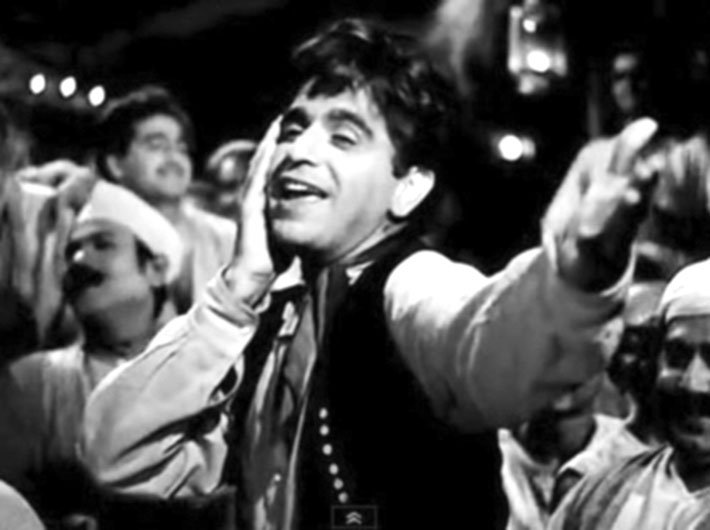
Being an unabashed admirer of Dilip Kumar, it is quite difficult for me to cast a critical eye at his work. Though limited in my understanding of cinema, Dilip Kumar remains the ultimate superstar; his dialogue delivery and mannerism still hold me in trance. My training as a journalist dissuades me to get overawed by any personality, particularly with those in power. But this training failed when I first saw Dilip Kumar in parliament more than a decade back. He was waiting for his car when I encountered him. I looked at him and was so engrossed in watching his understated mannerism and quiet demeanour that I came out of my reverie only when his car took him away. I still regret that I lost a chance to introduce myself to him and tell him about my unqualified adoration for him.
Thus, at the outset, I concede that I am not equipped to write about Dilip Kumar. Yet I chose to do so following his recently released autobiography for a strange reason: to analyse my infatuation with a man well past his prime. In the 1970s, when I was of impressionable age, there were many superstars that dominated the film world. Dharmendra, Rajesh Khanna and later Amitabh Bachchan were the craze of the younger generation. Then why did I choose Dilip Kumar as my hero?
The answer lies in the political trajectory of India after independence, passing through tumultuous phases to emerge as a coherent nation. Dilip Kumar belongs to a dying generation that represents a pre-partition India, before the creation of Pakistan. In his autobiography, his childhood memories of Peshawar, a hotbed of the Taliban now, are reminiscences of a past that cannot be recreated even in an imaginary or filmy world. Those were the times of Mahatma Gandhi, Jawaharlal Nehru and Khan Abdul Ghaffar Khan (affectionately called ‘Frontier Gandhi’). Mohammad Ali Jinnah, too, was there, though Dilip Kumar avoids mentioning him in his memoirs – and rightly so, since his idea of India was in conflict with the idea of Pakistan.
Dilip Kumar’s father (fondly referred to as Agha-ji) shifted his base to Bombay for better business opportunities in his fruits and dry fruits trade. But Dilip Kumar decided to make Bombay his own city when the country was partitioned. His illustrious and enlightened colleagues from the cinema and literary world like Noor Jehan, Saadat Hasan Manto and Faiz Ahmed Faiz chose to migrate to Pakistan yet Dilip Kumar remained steadfast in his decision to remain an Indian.
Despite an atmosphere of fear and communal hatred in the wake of the partition, his films were successful and his fan following increased. It did not matter to them that Dilip Kumar is an assumed name of a pathan from the frontiers of Pakistan and his real name was Yusuf Khan.
Perhaps Dilip Kumar symbolised an India which was inclusive and tolerant in its spirit despite the trauma of partition. He showcased his talent in the film industry which was then largely dominated by Hindus. In popular consciousness his religious identity was largely invisibilised. Remember the bhajan from one of his acclaimed films, Gopi, in which he emotes on “Sukh ke sab saathi dukh me na koi...” like a perfect Hindu devotee engrossed in bhakti ras?
The dominant theme of his early movies was invariably tragedy. Devdas and Daag were two movies which won accolades for different reasons. Daag is the story of an incorrigible alcoholic who is ultimately restored to the right path. The movie was so replete with melodious songs in the voice of Talat Mehmood that the acting plays second fiddle to the music. Yet the story contains a powerful social message about dangers of alcoholism. On the other hand, Devdas was a powerful commentary on a decaying social order of feudalism, not yet replaced by a new order.
In his early films Dilip Kumar was known as “tragedy king”, much for political and sociological reasons than merely for his penchant of taking up such roles. Lord Meghnad Desai, a die-hard fan of the thespian and the author of Nehru’s Hero: Dilip Kumar, once explained that his acceptance of such roles was related to the birth of a nation whose survival was not assured. In the atmosphere of distrust, doubt and depression, the film industry seemed to reflect society. In his memoirs, Dilip Kumar recalls consulting psychiatrists and getting out of the groove by accepting other roles which once again carried powerful messages.
Several of his movies, such as Andaaz in which he appeared along with his childhood friend Raj Kapoor and Nargis, were beautiful portrayals of intricate interpersonal relations. But films like Leader and Naya Daur reflected a deep churning in society. Naya Daur was about the perpetual conflict between man and machine. Another film, Ganga Jumna, told the story of exploitation in the hierarchal social order, resulting in rebellion. In the ’60s and ’70s, gangs of dacoits known as baaghi (rebels) in the Chambal and Yamuna ravines of Uttar Pradesh and Madhya Pradesh had unleashed a reign of terror. The movie was a sensitive portrayal of a social problem treated by the state as rank outlawry.
He essayed a variety of roles with ease and the gait of an accomplished actor. But his acting in Sagina Mahato blew me over. Those were the times of Naxalism. The ideology propagated violent overthrow of the State and was subversive in its content, yet it had attracted the brightest of the young by promising a utopia after a revolution.
Sagina materialised at a time when the conflict between capital and labour was quite intense. The delicate balance that the film maintained in its story and Dilip Kumar’s acting as a rustic leader with a practical sense of justice and morals reflected the distortions that affected Naxalism.
In his autobiography, Dilip Kumar explains one of the most memorable scenes in Sagina. He used his athletic skills to do a scene of running parallel to a moving train on the tracks. The synchronisation of running along the train was so perfect that it gave the impression of the use of a stunt man. However, the book reveals that Dilip Kumar was a good athlete, a footballer, and the scene was inserted at his advice.
What is interesting is that the book skirts the contentious issue of Ayodhya or the communal divide that the country witnessed after December 6, 1992. Perhaps the actor, given his emotional trauma of partition, found the issue too sensitive. Though he fondly remembers his association with Bal Thackeray and eulogised him as a “lion not tiger”, he also recalls seeking endorsement from Atal Bihari Vajpayee before accepting Pakistan’s highest civilian award, Nishan-e-Pakistan. Indeed, he is a legacy of pre-partition India in which the spirit of inclusiveness was of the essence. The fact that his legacy continues is something to be proud of in India.
(The book review appeared in the July 16-31 issue of the magazine)