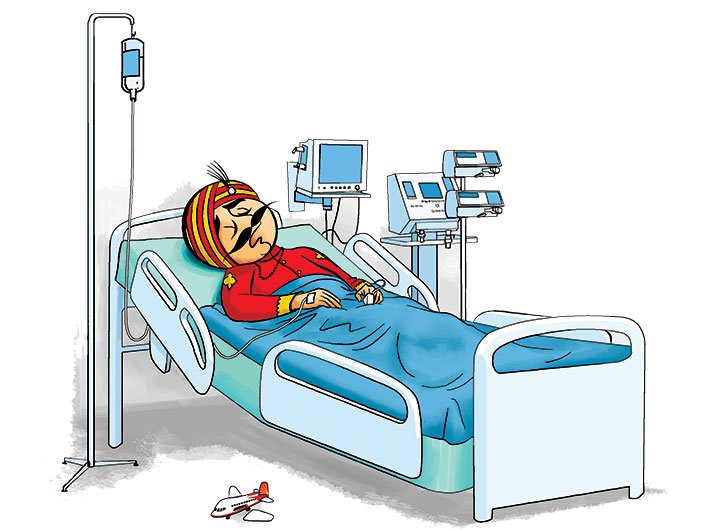
The national carrier is ready for privatisation. Will it lead to a fundamental change in its corporate culture?
The imminent sell-off of Air India (AI) has evoked a wave of nostalgia, particularly in people of the older generation. There was a time in the 1950s and 1960s when Air India and its country cousin, Indian Airlines, were the pride of the nation; AI was our own airline which was giving tough competition to first-world airlines. Though few Indians could afford to fly then, all Indians took immense pleasure in the antics of the moustachioed Maharaja. Air India hostesses were justly famed for their beauty and poise; at least some of them married industrialists whom they had met on flight. When it was flying high, Air India helped a number of airlines of Asian countries, such as Singapore Airlines and Malaysian Airlines, to come up. Airlines of Gulf nations were set up with expertise from Air India personnel hired privately.
Alas, the golden days are gone now. Dubai airport, not Delhi or Mumbai, is the hub for Indian flyers. The centaur, a mythical creature that is half horse and half human, till recently portrayed on the logo of Air India aptly describes Air India, which is an entity that’s half government and half private business: beautiful, but not of much use to anyone.
The reasons for the downfall of Air India are myriad – too many to be enumerated in a magazine article. Suffice it to say that the top people always looked upon Air India as a milch cow. In a famous incident, prime minister Rajiv Gandhi, who was once an Indian Airlines pilot, took two Air India jets to Vancouver for a meeting of the Commonwealth heads of government; the Sultan of Brunei was the only other leader to come by his personal jet. Till today, Air India’s jets are requisitioned by the government at short notice and bills are not paid for years.
After the opening up of Indian skies, the leadership of Air India took hugely innovative steps to hobble Air India. The top bosses completely abandoned Indian interests while signing bilateral agreements which have ensured that foreign carriers dominate Indian skies and the share of Air India keeps falling steadily in overseas travel. Then there was the hare-brained scheme to add aircraft without any specific plan for deployment. In 2006-07, Indian Airlines placed orders for more than 40 Airbus aircraft while Air India ordered 50 aircraft from Boeing. No passenger survey was done prior to this massive purchase. There was no staff or infrastructure for flying these aircraft. According to a CAG report, five Boeing 777s and five Boeing 737s were kept on the ground from 2007 to 2009, resulting in a loss of Rs 840 crore. More than 150 foreign pilots were hired at exorbitant salaries to fly these aircraft. It was sheer good luck that the delivery of B 787 Dreamliners was delayed; otherwise there would have been more losses for Air India. The interest on the advance money paid for the purchase of these aircraft accounts for the major share of the losses for Air India. Interestingly, there was no penalty clause for late delivery in the agreements Air India signed with Airbus or Boeing.
The merger of Air India and Indian Airlines (initiated in 2007 and completed in 2011) was the last nail in the coffin of the national carrier. No specific reason was given for the decision to merge the two. It was probably felt that the move would reduce redundancies, with fewer staff and space being required to run the merged airline. However, this did not happen. Scratch the surface and even today you will find Air India and Indian Airlines very much alive; one is Air India (International) and the other is Air India (Domestic). Prior to the merger, Indian Airlines was making modest profits while Air India was making modest losses. Post-merger, losses started ballooning, even after infusion of Rs 25,000 crore by the government. As of today, Air India has a net worth of around Rs 25,000 crore but has liabilities of around Rs 52,000 crore.
This should not have been the case. Air India was established in 1932 as Tata Air Mail, far earlier than any of its competitors. Tata Air Mail made a modest profit in its very first year of operation. Even today, Air India has a vast captive passenger population of government employees. On domestic routes, Air India gives a free baggage allowance of 25 kg compared to an allowance of 15 kg on other airlines; it does not charge for your seat or for payment made by card or net banking. Air India flies better aircraft; it also gives proper training to its crew and pilots. Fares on Air India are often lower than other airlines. Despite all these obvious pluses, Air India is the airline of last choice for passengers.
Even a layman can see that bad management negates all the natural advantages Air India has. To recount: AI has the worst time slots, their counter staff takes the maximum time to check you in and you are likely to miss your flight if you are just in time, checked-in luggage takes ages to reach the belt and flights are often delayed or cancelled without reason. The unhelpful “I don’t care” attitude of the staff completes the AI flight experience. There are myriad passenger complaints on the Air India page on Facebook, to which Air India has not bothered to reply.
There is an abundance of everyday examples of the self-destructive attitude of Air India. While availing LTC, government servants are obliged to fly Air India on special LTC fares, which are much higher than normal fares. From November to January, the Delhi-Port Blair flight is booked months in advance. A rational approach would have been to deploy the best aircraft on this route and if possible increase the number of flights. However, till recently a very small airplane was deployed on this route; it would not fly because of strong winds in December and January. Invariably, Air India would announce the cancellation of the flight only at the last minute. The amount of goodwill and revenue lost could only be imagined.
In 2015, after heavy losses, Air India started to rent out its headquarters at Nariman Point in Mumbai at a mind-boggling rent of approximately Rs 300 per square foot per month. The rent of each floor came to crores of rupees. Despite the clamour of prospective tenants for quick possession, on the pretext of taking out some condemned furniture, Air India took months to move out. Thus, unnecessary loss of crores of rupees was caused to Air India by the lackadaisical attitude of its employees.
Many a time, flights are delayed because of Air India employees not turning up on time; sometimes staff do not report at all, leading to cancellation of flights. This impunity arises from the fact that the entire workforce of Air India is heavily unionised. Pilots, drawing astronomical salaries, are known to strike work at the drop of a hat without any adverse consequence because pilots are classified as “workmen” under the Workmen’s Compensation Act.
With good leadership, the technical and financial aspects of Air India’s working can be slightly improved, but there are serious doubts if the attitude of the employees of Air India can be changed. Trying to rejuvenate Air India without a fundamental change in its corporate culture would only be throwing good money after bad.
The question then is: Should this state of affairs continue? A number of solutions have been suggested: privatisation, part-privatisation, outright sale, etc. I would like to suggest for Air India what Subramaniam Swamy has suggested for Kashmir – depopulation. Swamy’s solution would not work for Kashmir because the entire comity of nations would not allow Kashmir to be depopulated but we can easily give severance pay to all Air India employees and get rid of the whole contentious lot at a cost of a few hundred crore rupees.
After “depopulation”, the assets of Air India can be put on sale. Air India has office buildings and residential colonies at prime locations in all metro cities, mainly Mumbai. The market value of the real estate and aircraft owned by Air India far exceeds the accumulated liabilities of the concern. This solution would take care of the perennial problem that is Air India and gladden the hearts of all – mostly of passengers who would not have to fly Air India again. n
Saksena retired as principal chief commissioner of income tax.
(The article appears in the July 16-31, 2017 issue of Governance Now)