To move beyond "revdi culture" and ensure sustainable development, India must adopt a multi-pronged institutional approach
In the high-stakes theatre of Indian elections, a recurring script has emerged: a cascade of promised "freebies" disguised as empowerment. While these promises offer immediate relief to marginal communities, they often mask a transactional political culture that prioritises short-term electoral gain over long-term economic stability. As state budgets stretch to their breaking points, it is essential to distinguish between genuine welfare, which builds human capital; and fiscal populism, which risks systemic economic pain.
The welfare-freebie distinction
Not all government spending is equal. PRS India’s report, State of State Finances (2023-24), distinguishes between subsidies for "merit goods", like education and infrastructure, and "non-merit goods" that offer no developmental returns. This distinction separates sustainable welfare from short-term political expediency.
Merit-based welfare creates multiplier effects. For example, the Mid-Day Meal Scheme improves nutrition while boosting school enrolment and retention. The Janaushadhi Pariyojana makes generic medicines affordable, supporting both public health and small businesses. Similarly, the Ujjwala Yojana provides clean fuel, reducing indoor pollution and healthcare costs while advancing environmental goals.
Successful schemes target specific developmental objectives with measurable outcomes. In contrast, unconditional freebies prioritise immediate political gains over long-term, sustainable impact.
The freebie playbook across states
State governments have developed a predictable pattern of populist spending that spans multiple categories:
1. Untargeted Cash Transfers: Madhya Pradesh's Ladli Behna Yojana provides ₹1,250 monthly to women aged 21-60 without skill-building or employment generation components. West Bengal's Lakshmi Bhandar offers ₹1,000-1,200 per month in direct cash transfers, without any developmental agenda. These schemes encourage consumption-driven spending with minimal long-term benefits
2. Regressive Social Spending: West Bengal's Rupashree Scheme provides ₹25,000 as a one-time marriage grant for girls, potentially encouraging early marriages and reinforcing outdated social norms rather than promoting education or self-sufficiency
3. Consumer Goods Distribution: Tamil Nadu's distribution of free sarees, pressure cookers, colour TVs, fans, mixers, laptops, and washing machines represents high-cost political giveaways with no developmental multiplier effects
4. Poorly Targeted Utility Subsidies: Punjab and Delhi's promises of 200 units of free electricity monthly extend benefits to high-income households capable of payment, undermining welfare spending rationale while disincentivising energy conservation and straining state distribution companies (DISCOMs)
5. Misaligned Health Priorities: Rajasthan's proposed state-funded IVF scheme offers coverage for a limited population segment while basic healthcare services remain underfunded, raising questions about opportunity costs and resource allocation
The fiscal reckoning
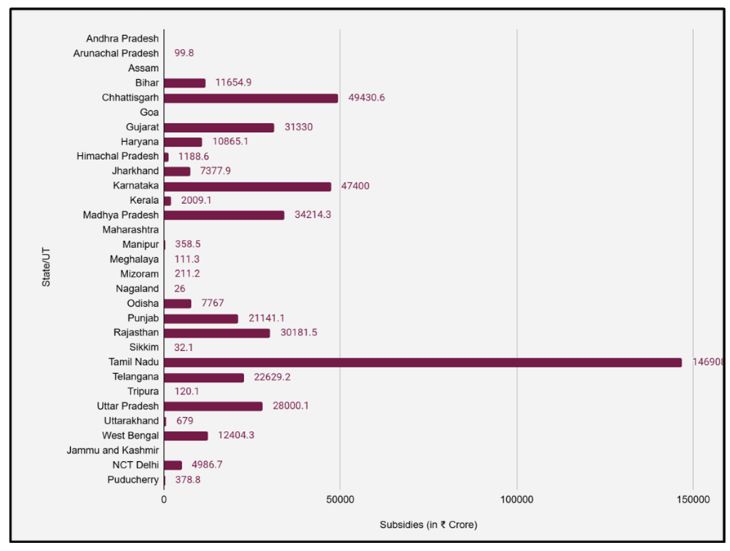
The fiscal consequences are visible in state budgets. According to the RBI, State of State Finance 2024-25, Tamil Nadu recorded the highest subsidy expenditure at ~₹1.47 lakh crore, translating into a per capita subsidy of ~₹19,000. Chhattisgarh followed with subsidy spending of ~₹49,000 crore and a per capita figure exceeding ₹16,000.
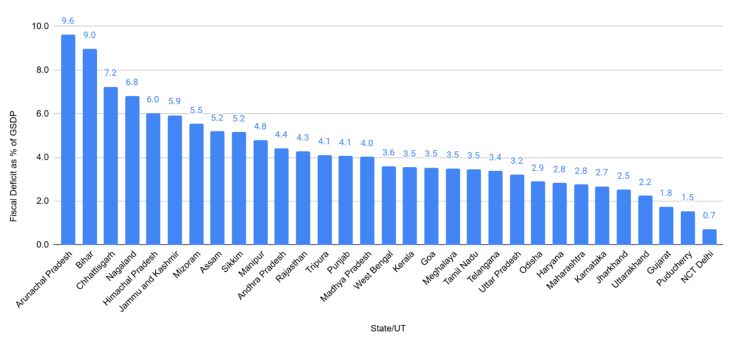
High subsidy spending would be less concerning if it coincided with strong revenue growth or productivity gains. Instead, it often coexists with widening fiscal deficits. In 2023–24, Chhattisgarh’s fiscal deficit reached about 7.2% of its gross state domestic product (GSDP), while Tamil Nadu’s stood at around 3.4%; both well above the 3% benchmark under the Fiscal Responsibility and Budget Management (FRBM) framework. Punjab (4.6%) and Telangana (3.3%) also exceeded this threshold.
Figure 1: Subsidy Expenditure by States 2024-25 (₹ Lakh Crore)
Source: RBI report, State of State Finance 2024-25
Figure 2: Fiscal deficit as a percentage of Gross State Domestic Product (GSDP)
Source: RBI report, State of State Finance 2024-25
These figures represent more than accounting entries. They signal compromised state capacity for infrastructure investment, education, and healthcare: the very sectors that drive genuine development.
The Macroeconomic Ripple Effect
Fiscal extravagance in one state is never isolated; India's macroeconomic stability is deeply interlinked. High state-level debt deters investment, strains the banking system, and influences national budget allocations. International investors may view regional instability as systemic, potentially leading to capital flight or restricted access to debt markets.
An accountability gap compounds these risks. Political entities sanctioning unsustainable schemes rarely face consequences after electoral defeat, leaving successors to manage the fallout. Consequently, policymaking becomes myopic, prioritising electoral cycles over economic responsibility. Currently, no judicial or statutory interventions address politically motivated expenditure that edges states toward fiscal crisis.
The hidden costs for citizens
While freebies offer marginalised communities’ immediate relief, they impose diffuse costs on the broader population. Financed through public borrowing, these schemes eventually necessitate higher taxes. Rather than reinforcing constitutional rights to education or health, they cultivate political dependence where citizens rely on handouts for basic necessities.
Free utilities also encourage waste. Subsidised electricity and water create moral hazards, depleting resources without addressing supply-side constraints. The opportunity cost is substantial; these funds could instead finance infrastructure or healthcare with lasting impact.
Most concerning is the political economy effect. Shifting the state-citizen relationship from rights-based services to transactional payouts reduces the pressure for critical reforms in education, governance, and job creation: true levers for sustainable improvements in living standards.
A way forward: from populism to productivity
To move beyond "revdi culture" and ensure sustainable development, India must adopt a multi-pronged institutional approach:
First, welfare must be judged by outcomes, not intent. All major schemes, i.e. cash transfers, subsidies, and in-kind support, should be evaluated against measurable indicators such as learning outcomes, health improvements, or workforce participation. Programmes that do not plausibly build capabilities within a defined time frame should be tapered or redesigned.
Second, FRBM enforcement needs teeth. Fiscal discipline cannot remain advisory. States that persistently breach deficit targets should face tighter borrowing conditions or reduced access to discretionary central transfers.
Third, subsidies should focus where market failures are largest: nutrition, primary healthcare, childcare, skilling, and urban public transport. Universal free power, water, or cash transfers dilute scarce fiscal resources and undermine efficiency.
Finally, technology can help, but only if paired with discipline. Direct benefit transfers should be time-bound, regularly reviewed, and equipped with sunset clauses to prevent permanent fiscal lock-in.
Choosing sustainability over slogans
India’s welfare debate is often framed as a moral contest between compassion and austerity. In reality, it is a question of design. Blending empowerment with expenditure may win elections, but it weakens state capacity and postpones growth-enhancing investments. Without a shift from populism to productivity, the cost of today’s promises will be borne by tomorrow’s taxpayers; the very citizens these schemes claim to support.
The authors are, respectively, Research Assistant and Senior Visiting Fellow, Pahle India Foundation.