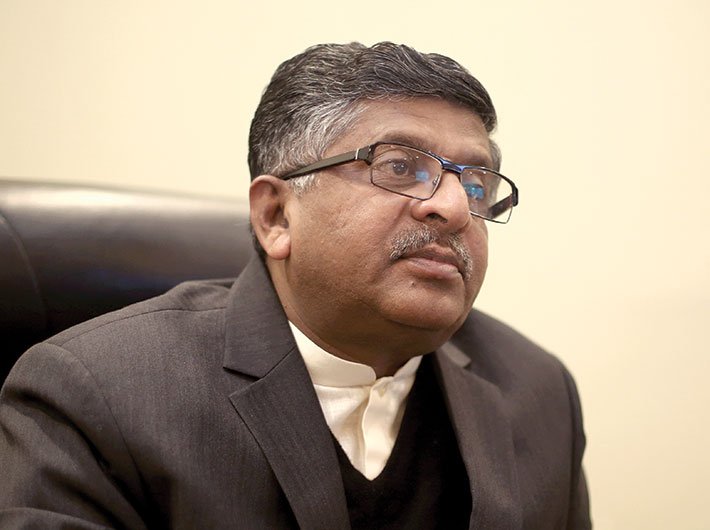
In an interview with Sweta Ranjan, Ravi Shankar Prasad explains that the Digital India initiative will not only connect billions of citizens, but it will also make the country a hub for e-commerce. Excerpts:
What is ‘Digital India’ and how will it benefit the common man?
It will make the common man more empowered. It will bridge the gap between digital haves and digital have-nots. We need Digital India more for the poor and under-privileged people. For example, if a rickshaw puller from Bihar comes to Delhi then all his documents like BPL card, birth certificate, caste certificate, land records, etc. will be digitally transferred to Delhi. He will not require another BPL card. In cases where pension is given at a particular time and in cases of old age pension a lot of ‘ghost’ people or middlemen take away the benefits. Under Digital India, all identities along with the Aadhaar card will be attached with proper thumb and digital identity. Therefore, pilferage, ghost withdrawal and misappropriation will end and the real benefit will go to the poor people.
We are in the process of laying national optical fibre network (NOFN) for 2,50,000 gram panchayats across the country. Based upon its connectivity, access to Wi-Fi will be given at a particular spot in rural areas like in a school or medical facility. Thereafter, based upon that e-commerce, e-education and e-health benefits will come in a big way. India has around 90 crore mobile phone users and 30 crore internet connections. The country is the biggest consumer of smartphones after the US. People of India are keen to play
with technology.
How do you aim to achieve digital literacy in India?
The government of India has made an investment of over '1 lakh crore to make the country digitally connected. We have initiated a digital literacy programme called ‘Disha’ or the digital saksharta abhiyan, which was inaugurated by the PM in Jharkhand last year. The programme offers two-hour, 10-hour and
20-hour courses in local languages. This will help in training the people. We propose to train more than a crore families. Also, I am pushing for establishing BPOs in small towns. When I see the IT profile of India it is limited to Delhi-Gurgaon-Noida, Mumbai-Pune-Nagpur, Hyderabad-Vijaywada-Vishakhapattanam and Bangalore-Mysore. That’s all. India will become digitally empowered only when we have BPOs in open spaces like Saharsa, Samastipur, Sitamarhi, Deoria, Buxar, Gorakhpur, Balia, Banda, Shivni, Sagar, Barmer, etc. BPO is a sign of digital empowerment. Digital literacy and other things would open as a consequence.
By when will the country have universal access to the internet?
We are going ahead in this direction. We are now at second position after China in terms of internet connectivity. We have left America far behind. Our idea is make nearly every Indian connected to the internet in the next 5-6 years.
Internet is doing very well in India. The national optical fibre network for rural India is reinforcing connectivity in urban India, paving way for private players in a big way.
What steps are you planning to take to make India a hub for electronics manufacturing?
We consume electronic goods worth nearly $100 billion every year in terms of smartcards, simcards, set-top boxes, televisions, washing machines, medical and defense electronics, etc. There are around 90 crore mobile phone users in India. However, hardly 1 percent is manufactured locally. The ‘Make in India’ programme has emerged from here. Therefore, we have laid down a whole architecture to encourage electronic manufacturing, namely electronic clusters in various states. Nine of them have been already approved. I have laid the foundation for electronic manufacturing clusters in Bhopal and Jabalpur. Under this, if a person invests '100, the government of India will give '25. The state governments can give additional incentives. Germany and South Korea have picked up this concept very well.
How can e-commerce pave way for Digital India?
India has '70,000 crore e-commerce potential, which is likely to scale up to over '5,00,000 crore in the coming three-four years. There is tremendous potential in e-commerce. Alibaba [not yet in India] is employing nearly 5,00,000 vehicle drivers for distribution of goods. In postal department we have link ups with Amazon, Flipkart and others to encourage India’s traditional handicrafts and other crafts and give them a good market. Therefore, the potential is enormous.
How do you plan to handle the issue of cyber security?
Cyber security is an important issue. As I always say, internet is one of the finest creations of mankind. And it is world property. It belongs to the people of the world. It is not the domain of any particular country. But when I see some misguided people using internet by abusing technology for acts like terrorism, etc. that is a matter of serious concern. I completely support freedom of expression and speech. But freedom of expression under Article 19 (2) is subject to reasonable restrictions. Therefore, privacy is an issue to be considered but there should not be undue prohibition in the free flow of information. Internet should not be used to promote violence
and terror.
[email protected]
(The interview appeared in February 16-28, 2015 issue)