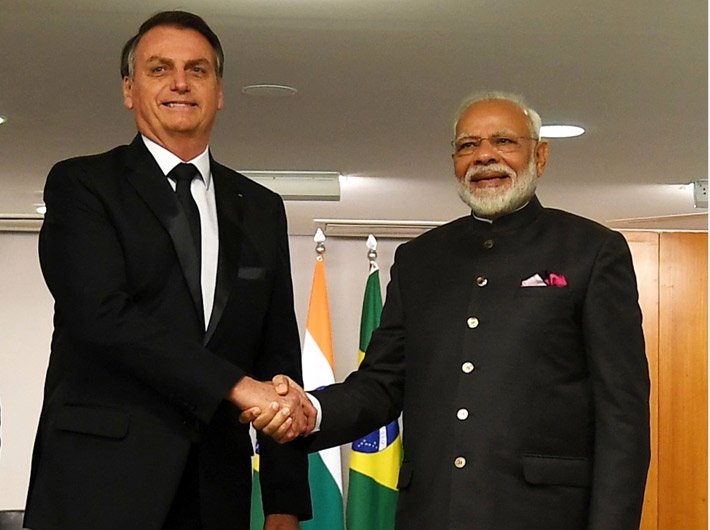
President arrives with sizeable delegation: Trade and commerce – and energy – will be in focus
As India gears up to celebrate its 71st Republic Day on January 26, it will host Brazilian president Jair Bolsonaro as the chief guest of the event that marks the day when the country formally adopted the Constitution as the guiding document. This will be Bolsonaro’s maiden visit, which he would like to turn into a great opportunity to reshape his country’s relationship with India, still seen as the fastest growing developing country in the world.
Arriving with a sizeable delegation, comprising ministers, officials and top business leaders, Bolsonaro will be the third Brazilian head of state to grace the occasion. President Luiz Inacio Lula da Silva was the Republic Day function’s chief guest in 2004 and president Fernando Henrique Cardoso in 1996 – indicating robust diplomatic ties between India and Brazil.
Trade and commerce will be a major focus of the two sides during the Brazilian president’s visit which is taking place at a time when India, worried about rising tension between the US and Iran, wants to shift its crude oil importing basket from the Middle-East region to Africa, Latin America, America and Russia for sake of its energy security. Brazil is considered the 10th largest producer with 150 million tonnes crude oil. It has the second-largest proven oil reserves in Latin America after Venezuela, which, like Iran, is facing the US economic sanctions. In 2018-19, India imported $1.59644 billion worth of crude oil from Brazil.
Hints from the New Delhi-based Brazilian embassy suggest that during Bolsonaro’s visit, oil and gas and mineral resources could be on top of the agenda of talks between the two sides. There is a possibility the two sides also sign an MoU on biofuel cooperation, a move which received a green signal during the union cabinet meet last year on December 24. Brazil is currently the world’s second largest producer and consumer of biofuel. “India has set a target of achieving 20 percent blending of ethanol in petrol and 5 percent blending of biodiesel in diesel by 2030 with the announcement of new policy on biofuels in 2018,” an official release had said then.
Besides, there is likelihood of India and Brazil signing agreements in the fields of science and technology, space, agriculture and IT. Also, the visit is expected to boost defence ties between the two. Yet, it is not clear whether it will inject strength to India, Brazil and South Africa forum or not as New Delhi wants the group to continue with the foreign minister-level meet for the time being as reviving the group with a leadership-level summit means ignoring “sensitivity” of Russia and China – the two strong BRICS members which are against running a platform parallel to the five countries’ group.
“Sensitivity of Russia and China is involved. These two countries don’t want India, Brazil and South Africa to operate on a similar front when BRICS is already working hard to match aspirations of all members of the group,” said Rajiv Bhatia who had an ambassadorial stint with South Africa and Kenya.
He also cited “fatigue” among the Indian, Brazilian and South African leadership as the reason why IBSA is not able to come out of BRICS shadow to become a forceful international forum.
But India under the leadership of prime minister Narendra Modi is keen to make the trilateral group a vehicle of development, a platform of influence and a ladder of connectivity and South-South cooperation. He wants the group to strategically remain alive to give push to agenda of reform of UNSC, WTO and IMF.
More than this, like India, Brazil too is concerned about China and its strategic design which the Belt and Road Initiative manifests. Helmed by staunch nationalist leaders, India and Brazil don’t want to lie low when China is increasingly ploughing in their neighbourhood by pumping in cheap money and goodies. In spite of all this, India is not keen to shred its balancing act with China, especially when it is going to host SCO summit in the second half of 2020, BRICS summit in 2021 and G-20 summit in 2022.
In IBSA, India sees its interest to keep alive the arc of democracy policy by closely aligning with Brazil and South Africa on issues of common interests. There is also a strategy to make China realise that it can’t push its agenda through BRICS hard. Against this background, there is a faint murmur in India’s diplomatic circle that if Bolsonaro remains steadfast in making IBSA an active platform with regular official, ministerial and summit-level talks among the three countries, New Delhi will not hesitate in extending its support to the his effort. In that way, it will not be surprising if India hosts an IBSA summit this year itself. However, clarity on the issue will be out once Modi and Bolsonaro meet to discuss their bilateral and international agenda.
Armed with ambition to expand the influence IBSA in deep Latin American and African countries, India is fine tuning innovative IBSA Visiting Fellow Programme to make countries outside the group members to access it. So far, this fellowship programme instituted by the ministry of external affairs last year, aims to promote academic exchange in the field of economics and social sciences for young scholars from India, Brazil and South Africa only. Now there is a proposal to expand the fellowship programme to include some more developing countries. It is expected that Brazil and South Africa may too follow suit and start their respective edition of IBSA Visiting Fellow Programme. Also there is a plan to raise IBSA Fund which is currently $35 million. Over the years, two-third of the IBSA Fund has been allocated to assist 19 poor countries across the world.
In all, the aim is to strengthen IBSA and its reach in the world so that BRICS members such as China and Russia could take more balanced approach to India, Brazil and South Africa while dealing with their interests.