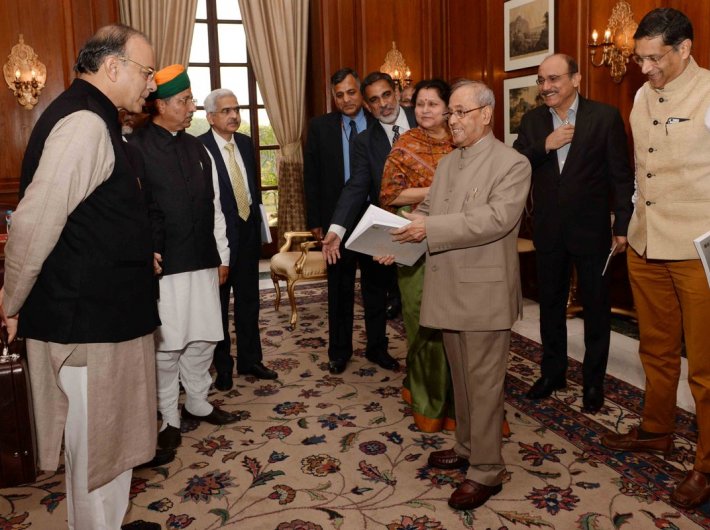
President Pranab Mukherjee outlined the major policy priorities of the government in his 2016 speech
President Pranab Mukherjee addressed parliament on February 23, 2016. In his address, he outlined the major policy priorities of the government across different sectors. PRS legislative research has undertaken an analysis of the address and provided the current status of the initiatives undertaken.
Efforts to tackle black money
The Taxation Laws (Second Amendment) Bill, 2016 was passed by Parliament and received the President’s assent in December, 2016.12 The Bill proposes to introduce the Pradhan Mantri Garib Kalyan Yojana, 2016. Under the scheme, taxpayers may declare undisclosed income possessed in the form of cash deposited in banks, post offices or RBI before a notified date.
On November 8, 2016, existing currency notes of Rs 500 and Rs 1,000 were demonetized to address storage of unaccounted wealth and circulation of counterfeit currency. No official estimation of black money is available.
Specified Bank Notes Cessation of Liabilities Ordinance, 2016 was issued in December, 2016. It provides that specified bank notes (old Rs 500 and Rs 1,000) will cease to be liabilities of the Reserve Bank of India from December 31, 2016 onwards.
Read: Demonetisation is a regressive and anti-poor measure: KC Chakrabarty
To put in place a simplified, progressive and non-adversarial tax regime
The Constitution (101st Amendment) Act, 2016 was enacted in September, 2016 to allow for the levy of a Goods and Services Tax (GST).
Model Central and State Goods and Services Tax Bills, 2016 were introduced in November 2016. The Model Central/ State GST Bills provide for the levy of: (i) the Central Goods and Services Tax (CGST), (ii) State Goods and Services Tax (SGST), (iii) levy of integrated Goods and Services Tax and (iv) compensation to states.
Read: The flawed premises of GST
Committed to improve quality of governance by reforming institutions, simplifying procedures and repealing obsolete laws.
Standing Committee on Personnel, Public Grievances, Law and Justice has submitted a report on delays in appointing higher court judges. The recommendations include increased transparency, timely filling of vacancies and finalisation of Memorandum of Procedure in relation to appointments of judges.
The Appropriation Acts (Repeal) Bill, 2016, repealed 758 Appropriation Acts passed between 1950 and 2012.
The Repealing and Amending Act, 2016 repealed 295 laws while amending two laws, which were passed between 1862 and 2014.
Gross Domestic Product (GDP) growth increased
GDP: The GDP is estimated to grow at 7.1 % in the year 2016-17. It grew at 7.1% in the first quarter (April-June) and 7.3% in the second quarter (July-September) of 2016-17. The GDP growth rate was 7.6% in the year 2015-16.
Read: Post DeMo, GDP growth in 2017-18 projected at 6.75 to 7.5 percent
Inflation, fiscal deficit and current account deficit decreased
Inflation: The average Consumer Price Index (CPI) in December 2016 was 3.4 %. CPI was 5.6% in December 2015.
Food inflation was 1.4% in December 2016 as compared to 6.4% in December 2015. Inflation target of 4% was notified by RBI for the period 2016-2021. It also set an upper limit of 6% and lower limit of 2% for the Consumer Price Index (CPI) inflation.
Fiscal Deficit: It is targeted at 3.5% of GDP in 2016-17 (compared to 3.9% in 2015- 16).
As of November 2016, the government had reached 85.8% of its fiscal deficit target, compared to 87% in November 2015.
Current Account Deficit: It decreased from $14.7 billion in 2015-16 (April-September) to $ 3.7 billion in the corresponding period in 2016-17.
Read: PRS legislative research analysis of the president’s address to parliament in 2016