
How to listen to the great storytellers that the trees are

T. R. Shankar Raman’s new book is a natural history of India in arboreal pen-portraits

GN Bureau | July 4, 2026

#Ecology   #Heritage   #Environment   #Science   #Climate Change  


The Trees of My Country: A Natural History of India in 50 Trees
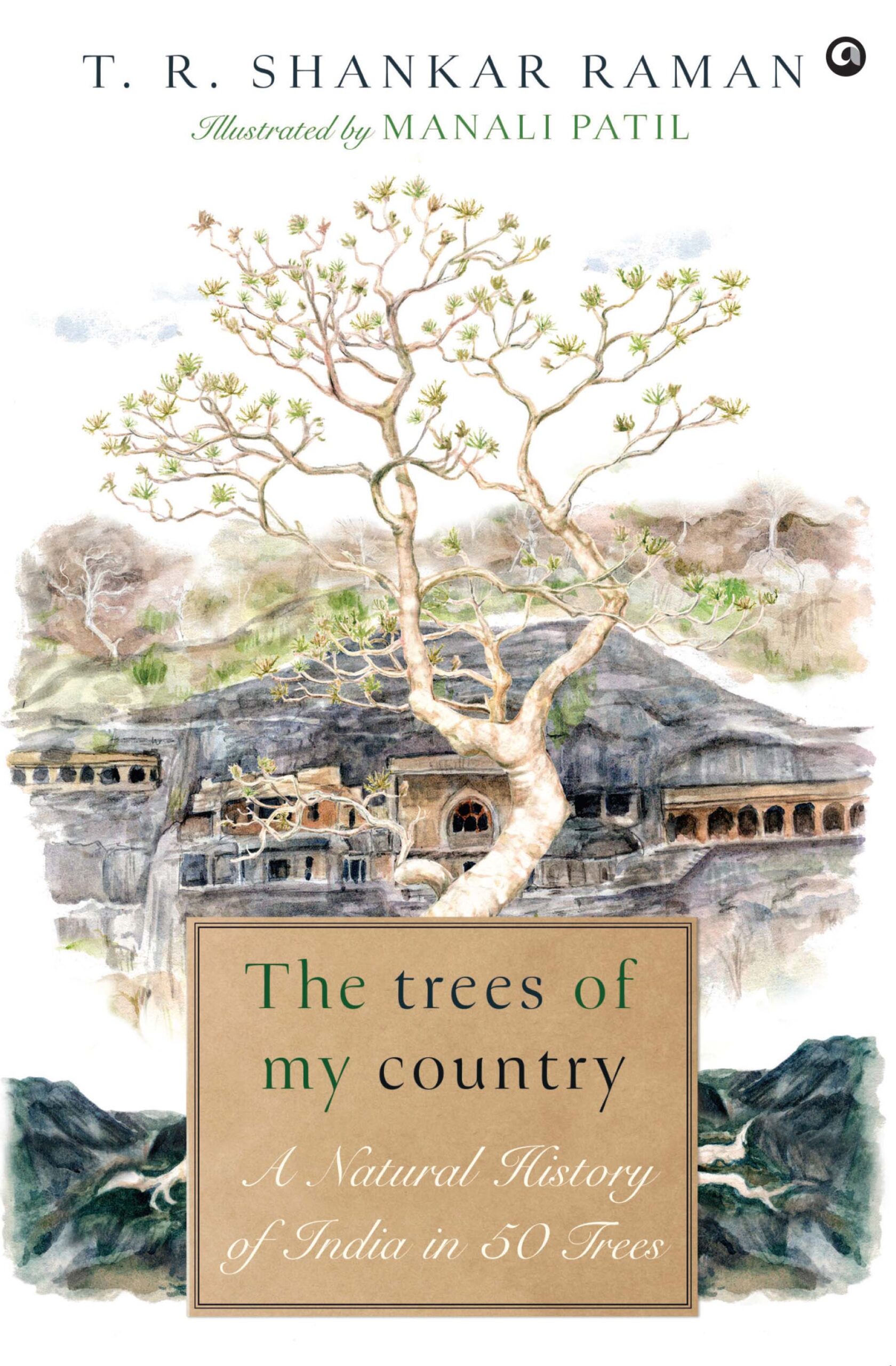
By T. R. Shankar Raman, with illustrations by Manali Patil
Aleph Book Company, 284 pages, Rs 1,499
 
There is a very old banyan tree in Munger, Bihar. People thought that it was planted in front of a historic 'Burra Bungalow', as a spot for dialogue between rulers and commoners. Given its architectural style, the bungalow seems to date back to the late Mughal-Early British period, which is 300-350 years old. But a new carbon-dating method found [https://www.governancenow.com/news/regular-story/this-tree-in-bihar-turns-out-to-be-the-oldest-accurately-dated-banyan] that the venerable tree is actually about double that age. The 700-year-old tree is possibly a surviving remnant of a natural forest that once existed in the region. Imagine the events it has, in a manner of speaking, witnessed! 
 
If you find this piece of news exciting, here’s a book exactly for you: ‘The Trees of My Country: A Natural History of India in 50 Trees’, by T. R. Shankar Raman with illustrations by Manali Patil.
 
Shankar Raman is a wildlife scientist – and an excellent writer. His book of essays, ‘The Wild Heart of India: Nature and Conservation in the City, the Country, and the Wild’, based on the findings of his field work and also his observations, has been a contemporary classic of nature writing in India. His latest work is a celebration of trees and of India’s landscapes and geographies through these trees.  
 
“Every tree is a storyteller, a historian, a chronicler of place. In their rootedness to particular places, in their long-lived and silent attention to the changes around them, and in their tendrils of connection to other life-forms, trees embody a perspective both unique and invaluable for us to understand the world,” he writes in the prologue. 
 
Trees, thus, help us better understand the people and the places around them. By the same logic, a closer look at 50 native trees of India, each remarkable and magnificent in its own way – like every other tree, can help us see our country in a new light. These trees have been witness to history, they have been grounded in geography, they have been interacting with their surroundings. 
 
As an ecologist, the author prefers to look at the trees as trees, and not in what they do for us, with their products or with the aesthetics of their presence. Getting acquainted with them is the idea.
 
Consider Ficus elastica, or Dieng-jri, from Meghalaya. They form the jingkieng jri or living root bridges. “Deep in the forest-clad gorges below one of the wettest places on earth are a number of these remarkable bridges. Khasi and Jaintia people have crafted these bridges using the peculiar roots of an astonishing tree, dieng-jri or India rubber, a wild fig tree known to science as Ficus elastica.” Or, Deodar: “The deodar is truly the cedar of the gods. They are among the oldest, the tallest, the most exalted, and impressively grand trees of India. Trees on relatively flat terrain or along river valleys can grow to great size, reaching a height of 75 metres, a tad taller than the Qutb Minar in Delhi.” In 1865, a forester found a tree whose age he estimated to be over 900 years – witness to a lot of historical upheavals in the subcontinent.
 
Many would have been entranced by Rhododendron arboreaum, better known as dupa, burans or billi. “Some Rhododendrons are so toxis that even consuming the honey that bees make from their flowers can make a person fall ill. But dupa is not such a species. The flowers of dupa (or burans) are used to make a syrup or sherbet popularly sold and consumed along the Himalaya.”
 
Every essay reminds us that the trees are great storytellers and living historians of place. By paying attention to trees, we can hear the stories they tell, the histories they document, and the places they describe. They shape their surroundings even as they themselves are shaped by their environment. 
 
The author brings together his study of botany and taxonomy, and unravels for us the intricacies of ecology and natural history of trees. We come to better appreciate their connections to the places they inhabit, to other species, and to people. The book also traces how changes in the world wrought by people influence trees and ultimately the people themselves. As the temperatures have soared in India, Europe and elsewhere this summer and climate change has become a more pressing concern, getting to know trees better might be our first line of defence.
 
Manali Patil, an artist and illustrator from Sindhudurg, Maharashtra, adds value to this beautifully produced book with her meticulously detailed illustrations.

Comments


Other News

This tree in Bihar turns out to be the oldest accurately dated banyan

A banyan tree in Munger, Bihar, estimated to be around 700 years old, has been identified as the oldest accurately dated banyan tree, Ficus benghalensis, using radiocarbon dating, a method that relies exclusively on scientific evidence rather than historical records or local lore. Banyan

Corporate Governance 3.0: What the boardroom of 2030 will look like

The phrase "corporate governance" often evokes images of board meetings, compliance checklists, and regulatory filings. For years, governance was viewed primarily as a mechanism to prevent fraud, protect minority shareholders, and ensure regulatory compliance. However, the events of the last deca

India, Japan open "a new chapter in special strategic and global partnership"

India and Japan are opening a new chapter in their special strategic and global partnership with the visit of prime minister Sanae Takaichi, India`s prime minister Narendra Modi said on Thursday,   "I had said in the G7 summit a few days ago that, in this environment of

AI studies sun images to track bright solar regions

Artificial Intelligence has been used to trace the shift in magnetically active patches on the Sun from 1916 to 2007 by scanning 100 years of hand-drawn Sun records from the Kodaikanal Solar Observatory (KoSO). This could give a much longer view of how solar activity changes over time.  

General Dhiraj Seth takes over as Chief of Army Staff

General Dhiraj Seth, PVSM, UYSM, AVSM, took over as the 31st Chief of the Army Staff (COAS) from General Upendra Dwivedi, PVSM, AVSM, who superannuated after more than four decades of distinguished service to the nation on Tuesday.   General Dhiraj Seth is an alumnus of the N

The women India doesn`t count enough

She runs a tailoring shop from a single room in her house. Every morning she stitches school uniforms, answers queries on WhatsApp, collects payments through UPI and orders fabric online. Officially, she still belongs to India`s informal economy. Yet her enterprise is no longer disconnected from the formal


Archives

Current Issue

Opinion

Facebook Twitter Google Plus Linkedin Subscribe Newsletter

Twitter







