
Why you must spare a thought for this poor farmer...

...but not for the reasons given in this ad

easwaran

SB Easwaran | December 3, 2016 | New Delhi

#gutkha   #cigarette   #FAIFA   #all Indian farmers association   #tobacco farmer   #beedi  
Why you must spare a thought for this poor farmer

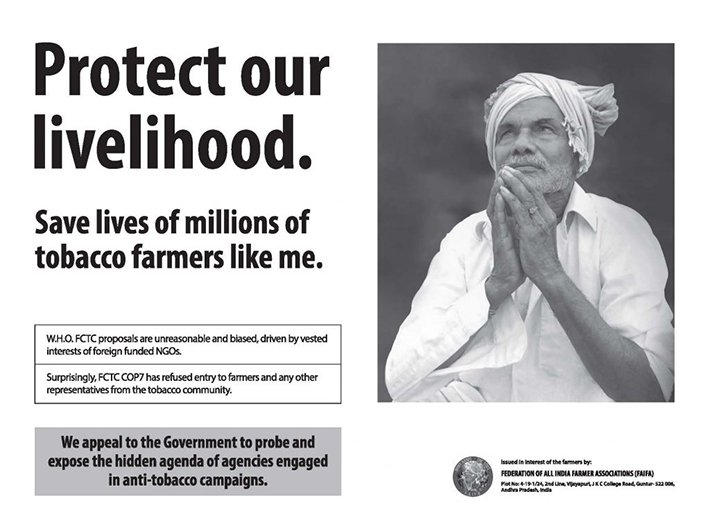
Emotional appeal is one of the sharpest swords of advertising. That it is double-edged becomes evident only when it fails. One such failure is an ad from the Federation of All-India Farmer Associations (FAIFA), displayed of late on the rexine hoods of some auto-rickshaws in Delhi. It shows a turbaned tobacco farmer, hands folded in supplication, and is captioned: 'Protect our livelihood. Save lives of millions of tobacco farmers like me.' It asks the government to probe the hidden agenda of anti-tobacco campaigners and raises the bogey of foreign-funded NGOs.

This is bound to provoke sneers from a public familiar only with prosperous tobacco farmers and beedi, gutkha and cigarette magnates. Few will buy the insinuation that anti-tobacco groups highlighting the very real health risks of tobacco are the poor farmer's tormentors, working covertly for foreign tobacco companies. Angled wrong, the ad works against the doleful man in the picture. And raises the suspicion that the federation (established only in 2015) might be the creation of a group of rich tobacco farmers trying to wangle tax concessions.
 
On its website, FAIFA alleges that steep levies meant to deter tobacco consumption are encouraging the smuggling of foreign cigarettes, which are sold cheap and without the ugh-inducing pictorial warnings. This is not untrue. Figures from the Directorate of Revenue Intelligence (DRI) indicate that 'butt-legging' has indeed skyrocketed. The picture might not be as bad as in Europe and along the US-Canada border, where big cigarette companies have been found to have links with smuggling mafias. But cheap contraband undermines government efforts to keep people healthier and robs it of revenue too.
 
Worldwide, science and sentiment have worked to deglamorise, if not effectively cut, tobacco use. But it's just a decades-old foray against a six-century-old addiction enmeshed in the history of mercantile, colonial and corporate power and profit. The small farmer who grows tobacco as a sturdy cash-crop in regions that will yield nothing else always was, and – as the ad, seen in sceptical light, reveals – still remains, a helpless coracle in these choppy seas, churned by immense merchant ships.
 
Policymakers and academicians vigorously debate the Millian question of how much the state may intervene to ensure healthy behaviour in citizens. The equally serious question of how to provide long-term livelihood alternatives to the farmer whose produce is losing acceptability for solid health reasons falls to activist groups. Sadly, some of these groups, though powerful enough to make themselves heard, are bogged in a crisis of credibility, thanks to their entanglement with vested interests. All the more tragic in a country where farmer suicides are a dark truth.


Comments


Other News

India is crossing a climate threshold

On June 28, Delhi recorded a maximum temperature of 41.3°C, four degrees above the seasonal normal. But the “feels like” temperature, which factors in humidity, showed more than 51°C. What the body experienced was very different from what the thermometer recorded.  India`

The Geography of India’s inflation

India today finds itself in an unusual position. At a time when geopolitical conflicts, trade fragmentation, and supply-chain disruptions are reshaping the global economy, the country`s macroeconomic fundamentals remain relatively upwards. Growth remains among the highest in the world, inflation has larg

How to listen to the great storytellers that the trees are

The Trees of My Country: A Natural History of India in 50 Trees By T. R. Shankar Raman, with illustrations by Manali Patil Aleph Book Company, 284 pages, Rs 1,499  

This tree in Bihar turns out to be the oldest accurately dated banyan

A banyan tree in Munger, Bihar, estimated to be around 700 years old, has been identified as the oldest accurately dated banyan tree, Ficus benghalensis, using radiocarbon dating, a method that relies exclusively on scientific evidence rather than historical records or local lore. Banyan

Corporate Governance 3.0: What the boardroom of 2030 will look like

The phrase "corporate governance" often evokes images of board meetings, compliance checklists, and regulatory filings. For years, governance was viewed primarily as a mechanism to prevent fraud, protect minority shareholders, and ensure regulatory compliance. However, the events of the last deca

India, Japan open "a new chapter in special strategic and global partnership"

India and Japan are opening a new chapter in their special strategic and global partnership with the visit of prime minister Sanae Takaichi, India`s prime minister Narendra Modi said on Thursday,   "I had said in the G7 summit a few days ago that, in this environment of


Archives

Current Issue

Opinion

Facebook Twitter Google Plus Linkedin Subscribe Newsletter

Twitter






