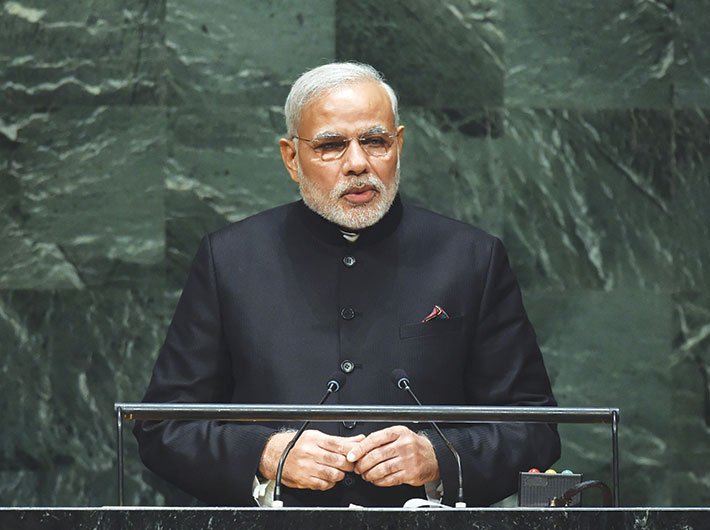
Here is a proposition: Narendra Modi is the top thinker, the top intellectual of our times. Is that an exaggerated claim? Not altogether. Here’s why.
After Brexit and after Trump, intellectuals, especially in the west, are busy guessing what exactly is going on in the world, what the masses are thinking. A sampling of their titles will give an idea: Age of Anger, Democracy for Realists, Myth of a Strong Leader, How Propaganda Works, What is Populism ... Except for the first, the rest do not have any overt reference to Modi. Modi, with his busy schedule, is not likely to have read any of these, all of them being recent publications. It is very surprising then that he is a step ahead of the preeminent intellectuals of our time who have written these books.
Take, for example, Jan-Werner Müller’s What is Populism (University of Pennsylvania Press, 2016). Everything the professor of politics at Princeton University, nothing less, says in this slim volume about populist leaders fits Modi is comprehensively. ‘What Populists Say’: Tick. ‘What Populists Do, or Populism in Power’: tick. ‘Seven Theses on Populism’: tick each one of them. It all fits so comprehensively with the Modi saga that either Modi is already one up on the professor of politics from Princeton or he had an early access to a preview copy. In 2002.
If this be the age of anger, as argued by Pankaj Mishra, Modi knows best what to do with it, and he does not need to read Jean-Jacques Rousseau for that. If these are days when people are looking for a new spin, Modi knows it and delivers the right one. Every trick in Trump’s book is an old game for him.
It is in having this understanding and this connect that Modi’s name is proposed as the top intellectual of our times. It is in harnessing the innovative technologies to channelise the urge for change that he is the thinker who has outthought all thinkers.
True, some of us have been diehard critics of Modi. That need not be called a lazy liberal’s attempt to seek intellectual legitimacy, because – and this is really remarkable – each of his actions, from his response to the 2002 communal riots to the perplexing demonetisation, has been criticised by somebody or the other from within his own fold.
However, what is equally remarkable is that Modi continues to have a rare rapport with the masses. Demonetisation was a foolhardy move which failed to achieve any of its three objectives stated beforehand as well as the one cooked up afterwards. It was a reverse surgical strike as it hurt precisely everybody other than those it was aimed at. And yet Modi has led his party to a kind of victory in Uttar Pradesh that no party has seen in this state for decades. This of course was not a referendum on demonetisation (otherwise, the results of five states would not have varied so much), but an indicator of Modi’s might in the heartland. If he can get away with the most self-destructive action and clinch the linchpin state, then the commentators need to rewrite the ongoing narrative and adversaries need to review their battle games.
How has Modi achieved this status today? In answer, his critics will name a whole range of tricks: He capitalised on capitalists. He deployed personal PR machinery. He used social media to counter traditional media which was once critical of him. He used social media to send out dog-whistle messages that cannot be conveyed through politically correct forums. He centralised power and promoted himself ruthlessly, usually at the cost of senior or fellow leaders’ careers. He made the bureaucracy deliver exactly what he wanted, bypassing the usual democratic channels of MLAs. He used the nuts and bolts of judicial mechanisms to his advantage. He set aside every principle espoused by Gandhi and Ambedkar and Vivekananda and others he keeps quoting. He weakened democratic institutions. He showed little regard for the spirit of the constitution – equality of all citizens. And so on.
But then who among his rivals hasn’t resorted to such tricks? The Congress, as main rival, is the one that pioneered the realpolitik approach behind these tricks.
Of course, the past crimes and misdemeanours of somebody else do not absolve today’s prime minister of his accountability to the citizen. These tricks are not conducive to the health of democracy either. His (and his supporters’) replies to the Congress charges are good for that party, not for the citizen.
Having made that prescriptive point, the descriptive view remains that these tricks are (as Arun Jaitley would’ve put it) well within four corners of the constitution, very much part of the Indian politician’s playbook, equally available and accessible to all, and one man outsmarted the others. In other words, in 2002 or in 2013-14, the field was wide open. After all, it is not the case that Rahul Gandhi or Nitish Kumar would have had any principled objection to the innovative spins and speeches loaded with coded messages.
Hate is of course an easier emotion to instigate, but there’s little evidence of the opposite emotion being tried out at all by anybody else. Also, Modi takes his ideology more seriously than most others take their own respective ideologies. For him, politics is a fulltime profession, with single-minded dedication that would put top corporate honchos to shame. Compare that to the vacation breaks abroad by Rahul Gandhi, or the Bengaluru retreats of Arvind Kejriwal. There is more to Moditva than Hindutva, of course. (For more on why his success story goes on and on, read the report in the following pages.)
The nation is constantly in dialogue with itself. Modi is plugged in into that dialogue like nobody else, and now he is also that dialogue. As long as the rest of them fail to offer an alternative vision of inclusiveness and the means to achieve it, the man will continue to pull the masses behind him.
[email protected]
(The column appears in the April 1-15, 2017 issue of Governance Now)