Cobrapost now stings PSU banks, names Andhra minister

SBI, LIC, PNB and other top public sector and private banks and financial institutions also involved, alleges Aniruddha Bahal of cobrapost.com

trithesh

Trithesh Nandan | May 6, 2013


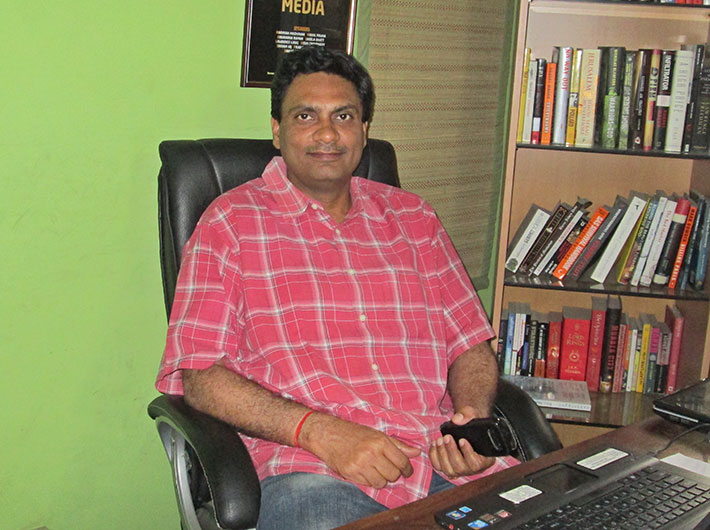
Aniruddha Bahal: Even more shocking is the cover-up, says cobrapost

After exposing alleged role of some of the biggest private sector banks in money laundering, Aniruddha Bahal of cobrapost.com has now stung 23 financial institutions, including big public sector banks like the State Bank of India and Punjab National Bank and financial institutions like the LIC, with similar charges.

In an expose — the sting operation has been christened Red Spider Part 2 — made public on Monday morning, Bahal accused Andhra Pradesh education minister S Sailajanath of guaranteeing the money laundering deal. He alleged that these financial institutions accept a huge amount of unaccounted-for cash, then split the money to make insurance deposits in multiple accounts.

In an effort to zoom in on the depth of alleged corruption, Bahal said that some banks operating from Parliament Street, sitting next door to both parliament and the Reserve Bank of India, are also involved. He claimed that the Parliament Street branches of HDFC, ICICI, Bank of Baroda, Allahabad Bank and central Bank of India are involved in money laundering.

Also read: our interview with Bahal after cobrapost’s first sting op, where he says, “I didn’t waste time (selling banking sting to channels)”

Besides SBI and PNB, the other banks named by cobrapost.com in money laundering are Indian bank, IDBI, Bank of Baroda, Canara bank, Oriental bank of Commerce, central Bank. These aside, private banks such as ICICI, HDFC, Dhanlaxmi Bank, Yes Bank, Axis Bank, Federal Bank and DCB Bank have also been accused of “investing” money laundering.

The website’s investigations were conducted for over six months in states like Delhi, Uttar Pradesh, Rajasthan, Haryana, Andhra Pradesh and Karnataka, among others.

The newest round of sting expose has revealed violation of provisions of Income Tax Act, FEMA, RBI regulations, KYC norms, the Banking Act, Bahal said at a media conference on Monday morning. “The revelations amount to crystal clear offenses under IPC and the PMLA (prevention of money laundering act),” he alleged.

Cobrapost also named insurance companies, including LIC, Tata AIG, Birla Sun Life, and Reliance Life Insurance, as launderers of black money.

According to cobrapost, “Money laundering practices are part and parcel of banking and insurance business across the board; even a walk-in customer can avail of such services that help him launder all his unaccounted cash; (and) money laundering services are being offered openly as a standard product across the board”.

But the “cover-up”, the website says, is “even more shocking”. It says: “Given (finance minister) P Chidambaram’s repeated warnings to money launderers and tax evaders that ‘we are watching you and will come after you’, till date, no investigative agency has launched any investigation into the heaps of evidence submitted by Cobrapost. Why is the FM himself overeager to declare innocence on part of the banks, as he did on March 14?

"Has the FM (or the RBI for that matter) not read the PMLA (?prevention of money laundering act)?”

In a statement issued on the occasion, the website says, “Operation Red Spider 2 establishes beyond doubt that money laundering is not confined to private banks, and is not an aberration, as is being made out in certain quarters in the wake of the first expose on March 14 in which HDFC Bank, ICICI Bank and Axis Bank were shown involved in money laundering.… It (money laundering) is rather endemic overarching the entire banking system and insurance sector, without exception, however shocking it might be. The scale is vast and unfathomable.”

Read the whole media statement, including what the website says some “selected bytes” culled out to show “how money laundering is a standard practice across the banking and insurance sector”. Click below:
 

Comments


Other News

Caring for cancer patients: the expanded network of facilities

Health is a State subject, and the primary responsibility for providing healthcare services, including cancer care, rests with the respective state governments. However, the Department of Health and Family Welfare provides technical and financial support to States and Union Territories across the country

Capabilities, aspirations of India’s youth limitless: Modi

The capabilities and aspirations of India’s youth are limitless, prime minister Narendra Modi said in his remarks to the media at the start of monsoon session of the parliament on Monday.  "In the past month, the country has achieved many milestones, filling citiz

India gets the first hydrogen train

Prime minister Narendra Modi on Friday laid the foundation stone and dedicated to the nation various development projects worth around ₹14,700 crore in Jind, Haryana.   The PM positioned the city as a shining reflection of the good governance model. Emphasizing that the entire Haryana

Climate change is stealing sleep

Climate change has at least doubled the temperature-related sleep loss across 1,338 major cities worldwide over the past five decades, highlighting an emerging but often overlooked public health consequence of rising global temperatures. A new study by Climate Central estimates that between 2020 and

Cabinet approves Mobile Phone Manufacturing Scheme

The union cabinet chaired by PM Narendra Modi has approved the Mobile Phone Manufacturing Scheme (MPMS) with a budgetary outlay of Rs 62,500 crore. It aims to further scale up the production, deepen domestic value addition, strengthen supply chain resilience, enhance global competitiveness. It

Building infrastructure is only half the job

Recent stories of stolen railway wires, disappearing communication towers and missing public infrastructure are often treated as bizarre law-and-order failures of India. Yet they raise a more fundamental question. Why does the State often discover the disappearance of a public asset only after it has alrea

Upcoming Conferences


Archives

Current Issue

Opinion

Facebook Twitter Google Plus Linkedin Subscribe Newsletter

Twitter