
India is learning to live with Covid-19

As lockdown nears scheduled end, dilemma of lives vs livelihoods raises its head again

GN Bureau | May 12, 2020

#Delhi   #Chief Ministers   #lockdown   #healthcare   #narendra modi   #prime minister   #epidemic   #coronavirus   #COVID-19   #Gujarat   #Maharashtra   #railways  
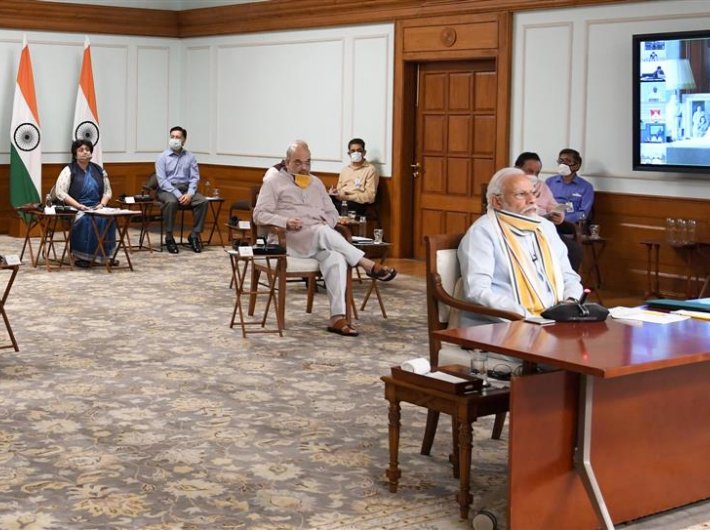
PM Modi with home minister Amit Shah and health minister Dr Harsh Vardhan during the video conferencing with the chief ministers on Monday.

As the world’s most extensive and arguably strictest lockdown completes 50 days, India remains in double mind: there are good arguments for and against extending the movement restrictions. The preference seems to be for a step-by-step, calibrated move towards opening up – beginning with the railways on Tuesday.

The world’s biggest railway network had closed down around March 24, when prime minister Narendra Modi announced a 21-day lockdown. While goods trains continued to play to move essential items, special passenger trains have been run in limited numbers to help migrant labourers from big cities reach native places. Still, Sunday’s announcement of resuming normal rail services with 15 pairs of trains from Tuesday surprised many. The booking was opened Monday afternoon, and there was heavy rush which jammed the IRCTC servers for a while.

Also on Monday, the PM held a video conference with the chief ministers for the fifth time since the Covid-19 outbreak began in March. Many states like the worst-hit Maharashtra called for extension of the lockdown, while many including the next worst-hit Gujarat and Delhi favoured partial reopening.

In the video conference, PM Modi said, “We now have reasonably clear indication as to the geographical spread of the pandemic in India, including the worst affected areas. Moreover, over the past few weeks, officials have understood operating procedures in a time such as this, right up to the district level.” He said that this understanding of the spread of COVID-19 will help the country in having a focussed fight against it.

“And therefore, we can now further focus our strategy in this battle against coronavirus, as should be the case. We have a twofold challenge – to reduce the transmission rate of the disease, and to increase public activity gradually, while adhering to all the guidelines, and we will have to work towards achieving both these objectives”, he said.

He said now the effort should be to stop the spread of the COVID-19 to rural areas. He added that the suggestions made by the States for a roadmap on Economy have been given due consideration.

While halting the spread of coronavirus is the top priority, it is equally necessary to provide economic opportunities when tens of thousands of unemployed migrant labourers are facing an existential crisis. The states too need revenues to continue basic operations, leading to the opening of liquor stores in many cities.

The debate over the lives and livelihoods is playing out even as on Monday the country recorded a high number of new infections. An official note said there was an increase of 4,213 Covid-19 confirmed cases in India, taking the total number to 67,152. Tamil Nadu in particular showed an unusual spike, while the top states – Maharashtra, Gujarat and Delhi – showed no respite. Meanwhile, a total of 20,917 people have been cured by Monday, taking the total recovery rate to 31.15%.

Extended twice, the lockdown is scheduled to end on May 17. However, the country has been divided in red, orange and green zones depending on the spread of the pandemic and many relaxations are already on in areas outside the red zones.


Comments


Other News

Citizens of the Bay: Why BIMSTEC matters now

The international order is drifting into a dangerous grey zone as the very powers that built today`s multilateral system begin to chip away at it. The United States has increasingly walked away from global rules and forums when they no longer suit its interests, while China has rushed to fill the vacuum on

PM salutes armed forces on one year of Operation Sindoor

Prime minister Narendra Modi on Thursday saluted the courage, precision and resolve of the armed forces on the completion of one year of Operation Sindoor.   The PM said that the armed forces had given a fitting response to those who dared to attack innocent Indians at Pahalgam.&

Supreme Court judge strength to go up by four to 37

The strength of the Supreme Court is set to go up from 33 judges to 37 judges, paving the way for a more efficient and speedier justice. The Union Cabinet on Tuesday approved the proposal for introducing The Supreme Court (Number of Judges) Amendment Bill, 2026 in Parliament to amend The Sup

BJP set to capture West Bengal

The political map of the country is set to be redrawn with the BJP set to win the West Bengal assembly elections, apart from Assam and the union territory of Puducherry. In Kerala, meanwhile, the Congress-led UDF is set to regain power. The filmstar Vijay-led TVK has emerged as the front-runner in Tamil Na

Beyond LPG: Is PNG ready for India’s next cooking fuel transition?

India, the second-largest importer and consumer of LPG after China, faces growing pressure due to supply constraints. Most of India`s LPG imports transit through the Strait of Hormuz, a focal point of global turmoil. Given that LPG forms the backbone of household kitchens and the restaurant industry, any s

Maharashtra adopts hybrid model for Census 2026 data collection

The government has initiated preparations for Census 2026 in Maharashtra, introducing a hybrid approach that combines optional self-enumeration with comprehensive door-to-door data collection to ensure complete coverage across the state.   According to senior officials, the Self-


Archives

Current Issue

Opinion

Facebook Twitter Google Plus Linkedin Subscribe Newsletter

Twitter







